 Add to Chrome
 Add to Firefox
 Add to Edge
Federated Learning at the Forefront of Fairness: A Multifaceted Perspective
Jan 31, 2026
Fairness in Federated Learning (FL) is emerging as a critical factor driven by heterogeneous clients' constraints and balanced model performance across various scenarios. In this survey, we delineate a comprehensive classification of the state-of-the-art fairness-aware approaches from a multifaceted perspective, i.e., model performance-oriented and capability-oriented. Moreover, we provide a framework to categorize and address various fairness concerns and associated technical aspects, examining their effectiveness in balancing equity and performance within FL frameworks. We further examine several significant evaluation metrics leveraged to measure fairness quantitatively. Finally, we explore exciting open research directions and propose prospective solutions that could drive future advancements in this important area, laying a solid foundation for researchers working toward fairness in FL.

Edge-Optimized Multimodal Learning for UAV Video Understanding via BLIP-2
Jan 13, 2026The demand for real-time visual understanding and interaction in complex scenarios is increasingly critical for unmanned aerial vehicles. However, a significant challenge arises from the contradiction between the high computational cost of large Vision language models and the limited computing resources available on UAV edge devices. To address this challenge, this paper proposes a lightweight multimodal task platform based on BLIP-2, integrated with YOLO-World and YOLOv8-Seg models. This integration extends the multi-task capabilities of BLIP-2 for UAV applications with minimal adaptation and without requiring task-specific fine-tuning on drone data. Firstly, the deep integration of BLIP-2 with YOLO models enables it to leverage the precise perceptual results of YOLO for fundamental tasks like object detection and instance segmentation, thereby facilitating deeper visual-attention understanding and reasoning. Secondly, a content-aware key frame sampling mechanism based on K-Means clustering is designed, which incorporates intelligent frame selection and temporal feature concatenation. This equips the lightweight BLIP-2 architecture with the capability to handle video-level interactive tasks effectively. Thirdly, a unified prompt optimization scheme for multi-task adaptation is implemented. This scheme strategically injects structured event logs from the YOLO models as contextual information into BLIP-2's input. Combined with output constraints designed to filter out technical details, this approach effectively guides the model to generate accurate and contextually relevant outputs for various tasks.
Large Language Models to Enhance Multi-task Drone Operations in Simulated Environments
Jan 13, 2026Benefiting from the rapid advancements in large language models (LLMs), human-drone interaction has reached unprecedented opportunities. In this paper, we propose a method that integrates a fine-tuned CodeT5 model with the Unreal Engine-based AirSim drone simulator to efficiently execute multi-task operations using natural language commands. This approach enables users to interact with simulated drones through prompts or command descriptions, allowing them to easily access and control the drone's status, significantly lowering the operational threshold. In the AirSim simulator, we can flexibly construct visually realistic dynamic environments to simulate drone applications in complex scenarios. By combining a large dataset of (natural language, program code) command-execution pairs generated by ChatGPT with developer-written drone code as training data, we fine-tune the CodeT5 to achieve automated translation from natural language to executable code for drone tasks. Experimental results demonstrate that the proposed method exhibits superior task execution efficiency and command understanding capabilities in simulated environments. In the future, we plan to extend the model functionality in a modular manner, enhancing its adaptability to complex scenarios and driving the application of drone technologies in real-world environments.
Hybrid Distillation with CoT Guidance for Edge-Drone Control Code Generation
Jan 13, 2026With large language models demonstrating significant potential in code generation tasks, their application to onboard control of resource-constrained Unmanned Aerial Vehicles has emerged as an important research direction. However, a notable contradiction exists between the high resource consumption of large models and the real-time, lightweight requirements of UAV platforms. This paper proposes an integrated approach that combines knowledge distillation, chain-of-thought guidance, and supervised fine-tuning for UAV multi-SDK control tasks, aiming to efficiently transfer complex reasoning and code generation capabilities to smaller models. Firstly, a high-quality dataset covering various mainstream UAV SDKs is constructed, featuring instruction-code-reasoning chains, and incorporates counterfactual negative samples for data augmentation, guiding the model to learn the end-to-end logic from instruction parsing to code generation. Secondly, leveraging DeepSeek-Coder-V2-Lite quantized via QLoRA as the teacher model, and based on a hybrid black-box and white-box distillation strategy, high-quality chain-of-thought soft labels are generated. These are combined with a weighted cross-entropy loss using hard labels to transfer complex reasoning capabilities to the smaller student model. Finally, through prompt tuning engineering optimized for the UAV control scenario, the model performance on core tasks such as SDK type recognition and function call matching is enhanced. Experimental results indicate that the distilled lightweight model maintains high code generation accuracy while achieving significant improvements in deployment and inference efficiency, effectively demonstrating the feasibility and superiority of our approach in achieving precise and lightweight intelligent control for UAVs
Configurable Spatial-Temporal Hierarchical Analysis for Flexible Video Anomaly Detection
May 12, 2023
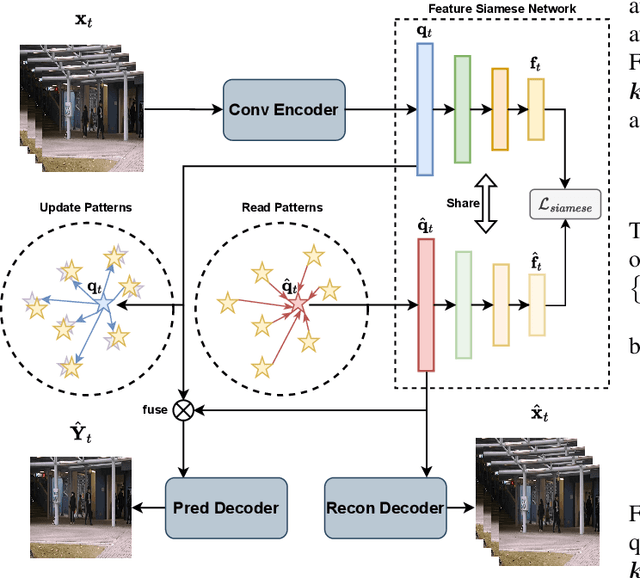

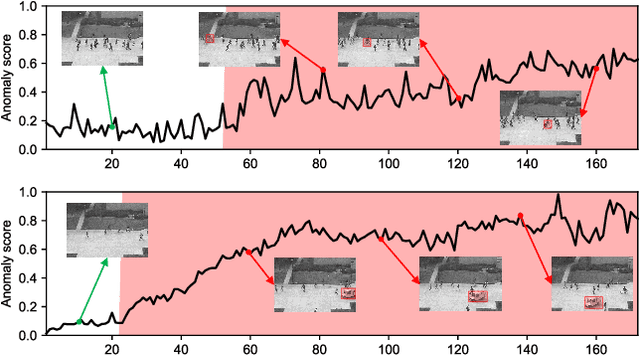
Video anomaly detection (VAD) is a vital task with great practical applications in industrial surveillance, security system, and traffic control. Unlike previous unsupervised VAD methods that adopt a fixed structure to learn normality without considering different detection demands, we design a spatial-temporal hierarchical architecture (STHA) as a configurable architecture to flexibly detect different degrees of anomaly. The comprehensive structure of the STHA is delineated into a tripartite hierarchy, encompassing the following tiers: the stream level, the stack level, and the block level. Specifically, we design several auto-encoder-based blocks that possess varying capacities for extracting normal patterns. Then, we stack blocks according to the complexity degrees with both intra-stack and inter-stack residual links to learn hierarchical normality gradually. Considering the multisource knowledge of videos, we also model the spatial normality of video frames and temporal normality of RGB difference by designing two parallel streams consisting of stacks. Thus, STHA can provide various representation learning abilities by expanding or contracting hierarchically to detect anomalies of different degrees. Since the anomaly set is complicated and unbounded, our STHA can adjust its detection ability to adapt to the human detection demands and the complexity degree of anomaly that happened in the history of a scene. We conduct experiments on three benchmarks and perform extensive analysis, and the results demonstrate that our method performs comparablely to the state-of-the-art methods. In addition, we design a toy dataset to prove that our model can better balance the learning ability to adapt to different detection demands.