 Add to Chrome
 Add to Firefox
 Add to Edge
A Two-Stage GPU Kernel Tuner Combining Semantic Refactoring and Search-Based Optimization
Jan 21, 2026
GPU code optimization is a key performance bottleneck for HPC workloads as well as large-model training and inference. Although compiler optimizations and hand-written kernels can partially alleviate this issue, achieving near-hardware-limit performance still relies heavily on manual code refactoring and parameter tuning. Recent progress in LLM-agent-based kernel generation and optimization has been reported, yet many approaches primarily focus on direct code rewriting, where parameter choices are often implicit and hard to control, or require human intervention, leading to unstable performance gains. This paper introduces a template-based rewriting layer on top of an agent-driven iterative loop: kernels are semantically refactored into explicitly parameterizable templates, and template parameters are then optimized via search-based autotuning, yielding more stable and higher-quality speedups. Experiments on a set of real-world kernels demonstrate speedups exceeding 3x in the best case. We extract representative CUDA kernels from SGLang as evaluation targets; the proposed agentic tuner iteratively performs templating, testing, analysis, and planning, and leverages profiling feedback to execute constrained parameter search under hardware resource limits. Compared to agent-only direct rewriting, the template-plus-search design significantly reduces the randomness of iterative optimization, making the process more interpretable and enabling a more systematic approach toward high-performance configurations. The proposed method can be further extended to OpenCL, HIP, and other backends to deliver automated performance optimization for real production workloads.

Collaborative Reconstruction and Repair for Multi-class Industrial Anomaly Detection
Dec 12, 2025Industrial anomaly detection is a challenging open-set task that aims to identify unknown anomalous patterns deviating from normal data distribution. To avoid the significant memory consumption and limited generalizability brought by building separate models per class, we focus on developing a unified framework for multi-class anomaly detection. However, under this challenging setting, conventional reconstruction-based networks often suffer from an identity mapping problem, where they directly replicate input features regardless of whether they are normal or anomalous, resulting in detection failures. To address this issue, this study proposes a novel framework termed Collaborative Reconstruction and Repair (CRR), which transforms the reconstruction to repairation. First, we optimize the decoder to reconstruct normal samples while repairing synthesized anomalies. Consequently, it generates distinct representations for anomalous regions and similar representations for normal areas compared to the encoder's output. Second, we implement feature-level random masking to ensure that the representations from decoder contain sufficient local information. Finally, to minimize detection errors arising from the discrepancies between feature representations from the encoder and decoder, we train a segmentation network supervised by synthetic anomaly masks, thereby enhancing localization performance. Extensive experiments on industrial datasets that CRR effectively mitigates the identity mapping issue and achieves state-of-the-art performance in multi-class industrial anomaly detection.
RPTS: Tree-Structured Reasoning Process Scoring for Faithful Multimodal Evaluation
Nov 10, 2025Large Vision-Language Models (LVLMs) excel in multimodal reasoning and have shown impressive performance on various multimodal benchmarks. However, most of these benchmarks evaluate models primarily through multiple-choice or short-answer formats, which do not take the reasoning process into account. Although some benchmarks assess the reasoning process, their methods are often overly simplistic and only examine reasoning when answers are incorrect. This approach overlooks scenarios where flawed reasoning leads to correct answers. In addition, these benchmarks do not consider the impact of intermodal relationships on reasoning. To address this issue, we propose the Reasoning Process Tree Score (RPTS), a tree structure-based metric to assess reasoning processes. Specifically, we organize the reasoning steps into a reasoning tree and leverage its hierarchical information to assign weighted faithfulness scores to each reasoning step. By dynamically adjusting these weights, RPTS not only evaluates the overall correctness of the reasoning, but also pinpoints where the model fails in the reasoning. To validate RPTS in real-world multimodal scenarios, we construct a new benchmark, RPTS-Eval, comprising 374 images and 390 reasoning instances. Each instance includes reliable visual-textual clues that serve as leaf nodes of the reasoning tree. Furthermore, we define three types of intermodal relationships to investigate how intermodal interactions influence the reasoning process. We evaluated representative LVLMs (e.g., GPT4o, Llava-Next), uncovering their limitations in multimodal reasoning and highlighting the differences between open-source and closed-source commercial LVLMs. We believe that this benchmark will contribute to the advancement of research in the field of multimodal reasoning.
Exploring Hybrid Question Answering via Program-based Prompting
Feb 16, 2024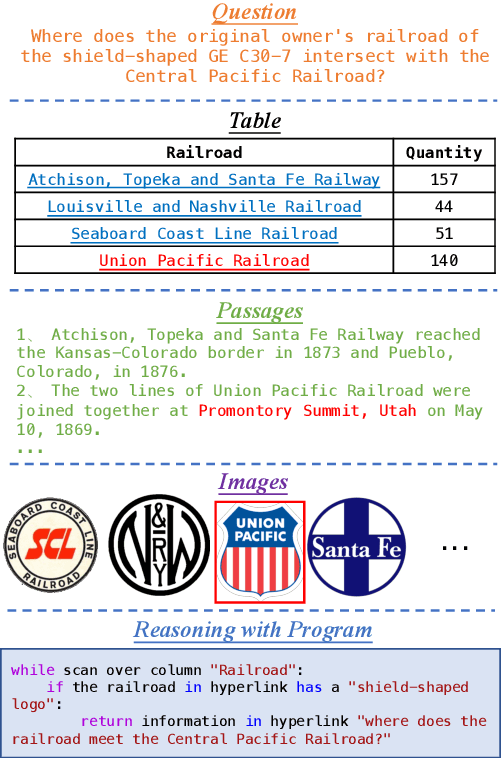
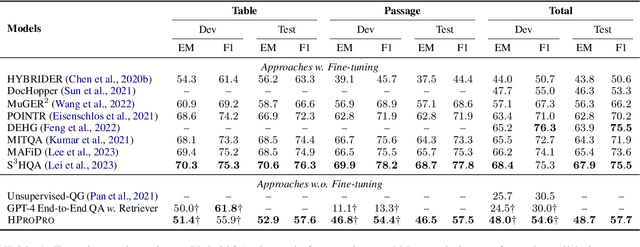
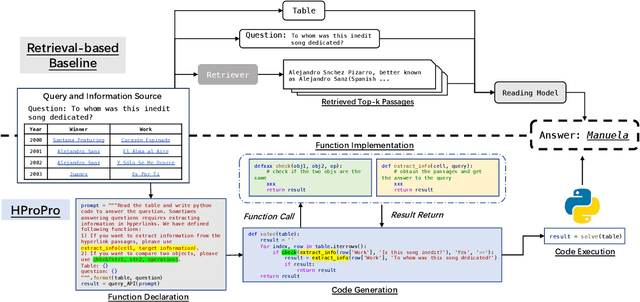
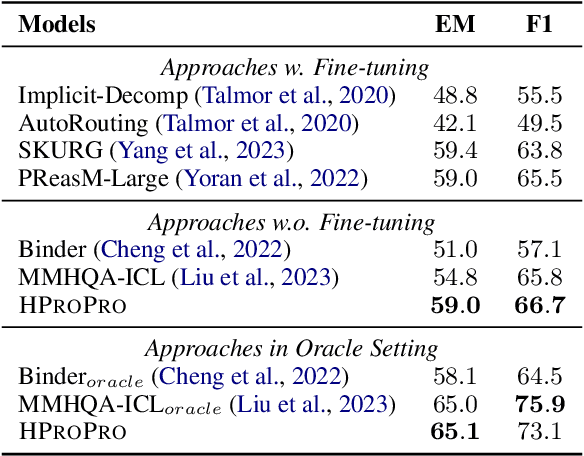
Question answering over heterogeneous data requires reasoning over diverse sources of data, which is challenging due to the large scale of information and organic coupling of heterogeneous data. Various approaches have been proposed to address these challenges. One approach involves training specialized retrievers to select relevant information, thereby reducing the input length. Another approach is to transform diverse modalities of data into a single modality, simplifying the task difficulty and enabling more straightforward processing. In this paper, we propose HProPro, a novel program-based prompting framework for the hybrid question answering task. HProPro follows the code generation and execution paradigm. In addition, HProPro integrates various functions to tackle the hybrid reasoning scenario. Specifically, HProPro contains function declaration and function implementation to perform hybrid information-seeking over data from various sources and modalities, which enables reasoning over such data without training specialized retrievers or performing modal transformations. Experimental results on two typical hybrid question answering benchmarks HybridQA and MultiModalQA demonstrate the effectiveness of HProPro: it surpasses all baseline systems and achieves the best performances in the few-shot settings on both datasets.