 Add to Chrome
 Add to Firefox
 Add to Edge
LocalScore: Local Density-Aware Similarity Scoring for Biometrics
Feb 01, 2026
Open-set biometrics faces challenges with probe subjects who may not be enrolled in the gallery, as traditional biometric systems struggle to detect these non-mated probes. Despite the growing prevalence of multi-sample galleries in real-world deployments, most existing methods collapse intra-subject variability into a single global representation, leading to suboptimal decision boundaries and poor open-set robustness. To address this issue, we propose LocalScore, a simple yet effective scoring algorithm that explicitly incorporates the local density of the gallery feature distribution using the k-th nearest neighbors. LocalScore is architecture-agnostic, loss-independent, and incurs negligible computational overhead, making it a plug-and-play solution for existing biometric systems. Extensive experiments across multiple modalities demonstrate that LocalScore consistently achieves substantial gains in open-set retrieval (FNIR@FPIR reduced from 53% to 40%) and verification (TAR@FAR improved from 51% to 74%). We further provide theoretical analysis and empirical validation explaining when and why the method achieves the most significant gains based on dataset characteristics.

Person Recognition at Altitude and Range: Fusion of Face, Body Shape and Gait
May 07, 2025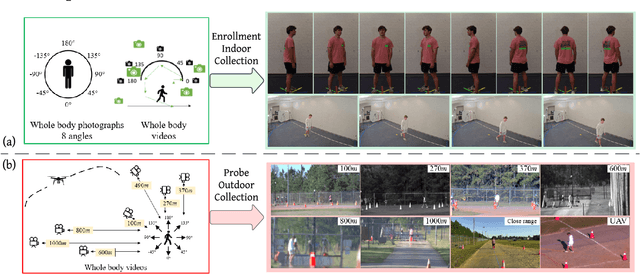
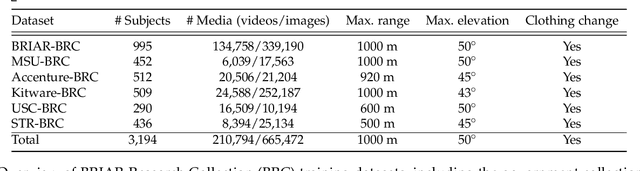
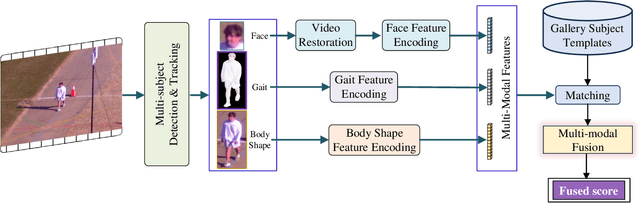
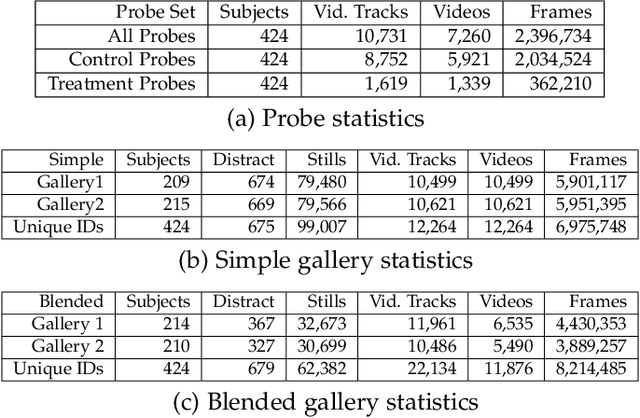
We address the problem of whole-body person recognition in unconstrained environments. This problem arises in surveillance scenarios such as those in the IARPA Biometric Recognition and Identification at Altitude and Range (BRIAR) program, where biometric data is captured at long standoff distances, elevated viewing angles, and under adverse atmospheric conditions (e.g., turbulence and high wind velocity). To this end, we propose FarSight, a unified end-to-end system for person recognition that integrates complementary biometric cues across face, gait, and body shape modalities. FarSight incorporates novel algorithms across four core modules: multi-subject detection and tracking, recognition-aware video restoration, modality-specific biometric feature encoding, and quality-guided multi-modal fusion. These components are designed to work cohesively under degraded image conditions, large pose and scale variations, and cross-domain gaps. Extensive experiments on the BRIAR dataset, one of the most comprehensive benchmarks for long-range, multi-modal biometric recognition, demonstrate the effectiveness of FarSight. Compared to our preliminary system, this system achieves a 34.1% absolute gain in 1:1 verification accuracy (TAR@0.1% FAR), a 17.8% increase in closed-set identification (Rank-20), and a 34.3% reduction in open-set identification errors (FNIR@1% FPIR). Furthermore, FarSight was evaluated in the 2025 NIST RTE Face in Video Evaluation (FIVE), which conducts standardized face recognition testing on the BRIAR dataset. These results establish FarSight as a state-of-the-art solution for operational biometric recognition in challenging real-world conditions.
FarSight: A Physics-Driven Whole-Body Biometric System at Large Distance and Altitude
Jun 29, 2023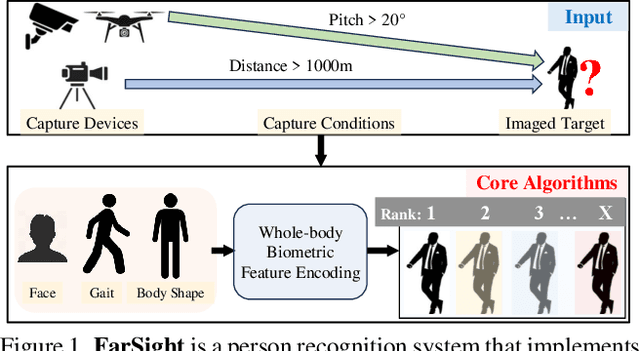
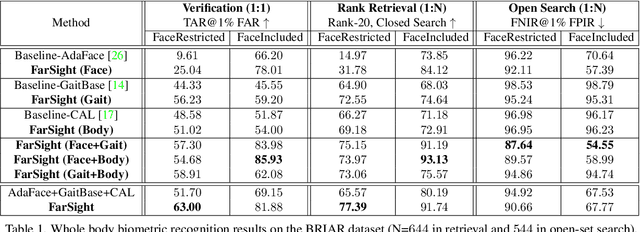
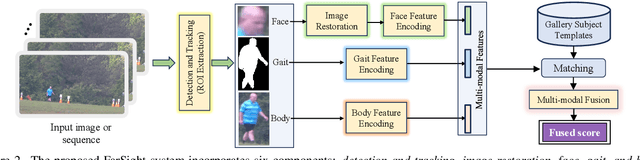
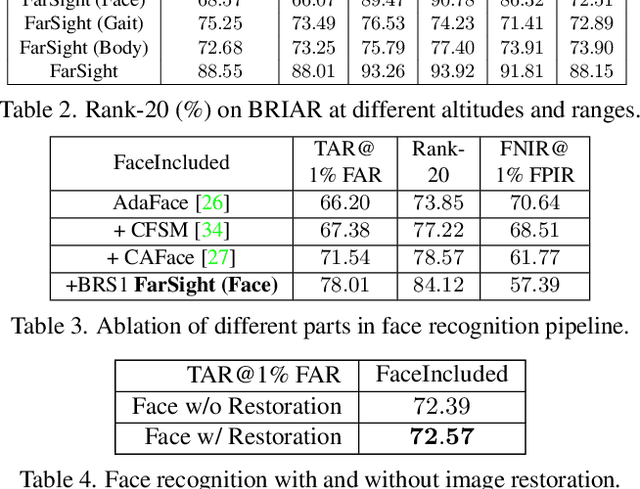
Whole-body biometric recognition is an important area of research due to its vast applications in law enforcement, border security, and surveillance. This paper presents the end-to-end design, development and evaluation of FarSight, an innovative software system designed for whole-body (fusion of face, gait and body shape) biometric recognition. FarSight accepts videos from elevated platforms and drones as input and outputs a candidate list of identities from a gallery. The system is designed to address several challenges, including (i) low-quality imagery, (ii) large yaw and pitch angles, (iii) robust feature extraction to accommodate large intra-person variabilities and large inter-person similarities, and (iv) the large domain gap between training and test sets. FarSight combines the physics of imaging and deep learning models to enhance image restoration and biometric feature encoding. We test FarSight's effectiveness using the newly acquired IARPA Biometric Recognition and Identification at Altitude and Range (BRIAR) dataset. Notably, FarSight demonstrated a substantial performance increase on the BRIAR dataset, with gains of +11.82% Rank-20 identification and +11.3% TAR@1% FAR.