 Add to Chrome
 Add to Firefox
 Add to Edge
FaceRefiner: High-Fidelity Facial Texture Refinement with Differentiable Rendering-based Style Transfer
Jan 08, 2026
Recent facial texture generation methods prefer to use deep networks to synthesize image content and then fill in the UV map, thus generating a compelling full texture from a single image. Nevertheless, the synthesized texture UV map usually comes from a space constructed by the training data or the 2D face generator, which limits the methods' generalization ability for in-the-wild input images. Consequently, their facial details, structures and identity may not be consistent with the input. In this paper, we address this issue by proposing a style transfer-based facial texture refinement method named FaceRefiner. FaceRefiner treats the 3D sampled texture as style and the output of a texture generation method as content. The photo-realistic style is then expected to be transferred from the style image to the content image. Different from current style transfer methods that only transfer high and middle level information to the result, our style transfer method integrates differentiable rendering to also transfer low level (or pixel level) information in the visible face regions. The main benefit of such multi-level information transfer is that, the details, structures and semantics in the input can thus be well preserved. The extensive experiments on Multi-PIE, CelebA and FFHQ datasets demonstrate that our refinement method can improve the texture quality and the face identity preserving ability, compared with state-of-the-arts.

VLA-RAIL: A Real-Time Asynchronous Inference Linker for VLA Models and Robots
Dec 31, 2025Vision-Language-Action (VLA) models have achieved remarkable breakthroughs in robotics, with the action chunk playing a dominant role in these advances. Given the real-time and continuous nature of robotic motion control, the strategies for fusing a queue of successive action chunks have a profound impact on the overall performance of VLA models. Existing methods suffer from jitter, stalling, or even pauses in robotic action execution, which not only limits the achievable execution speed but also reduces the overall success rate of task completion. This paper introduces VLA-RAIL (A Real-Time Asynchronous Inference Linker), a novel framework designed to address these issues by conducting model inference and robot motion control asynchronously and guaranteeing smooth, continuous, and high-speed action execution. The core contributions of the paper are two fold: a Trajectory Smoother that effectively filters out the noise and jitter in the trajectory of one action chunk using polynomial fitting and a Chunk Fuser that seamlessly align the current executing trajectory and the newly arrived chunk, ensuring position, velocity, and acceleration continuity between two successive action chunks. We validate the effectiveness of VLA-RAIL on a benchmark of dynamic simulation tasks and several real-world manipulation tasks. Experimental results demonstrate that VLA-RAIL significantly reduces motion jitter, enhances execution speed, and improves task success rates, which will become a key infrastructure for the large-scale deployment of VLA models.
Few-shot Semantic Encoding and Decoding for Video Surveillance
May 12, 2025With the continuous increase in the number and resolution of video surveillance cameras, the burden of transmitting and storing surveillance video is growing. Traditional communication methods based on Shannon's theory are facing optimization bottlenecks. Semantic communication, as an emerging communication method, is expected to break through this bottleneck and reduce the storage and transmission consumption of video. Existing semantic decoding methods often require many samples to train the neural network for each scene, which is time-consuming and labor-intensive. In this study, a semantic encoding and decoding method for surveillance video is proposed. First, the sketch was extracted as semantic information, and a sketch compression method was proposed to reduce the bit rate of semantic information. Then, an image translation network was proposed to translate the sketch into a video frame with a reference frame. Finally, a few-shot sketch decoding network was proposed to reconstruct video from sketch. Experimental results showed that the proposed method achieved significantly better video reconstruction performance than baseline methods. The sketch compression method could effectively reduce the storage and transmission consumption of semantic information with little compromise on video quality. The proposed method provides a novel semantic encoding and decoding method that only needs a few training samples for each surveillance scene, thus improving the practicality of the semantic communication system.
DNPM: A Neural Parametric Model for the Synthesis of Facial Geometric Details
May 30, 2024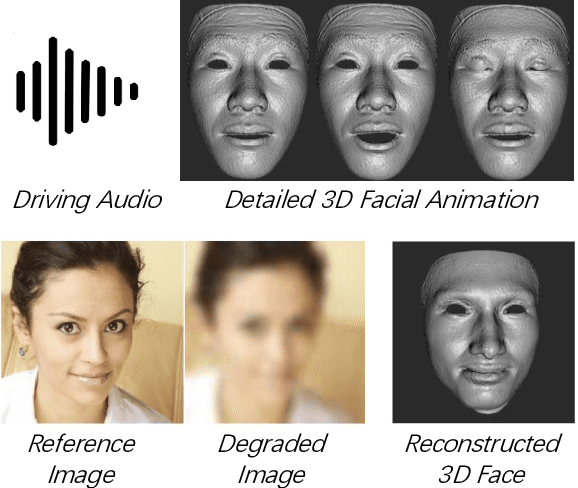
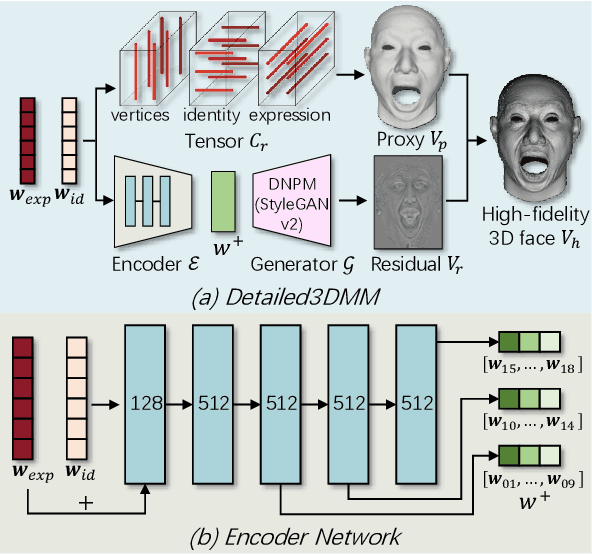
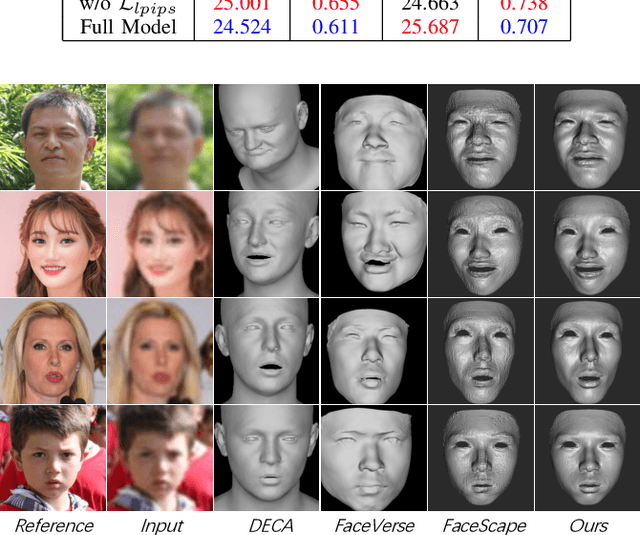
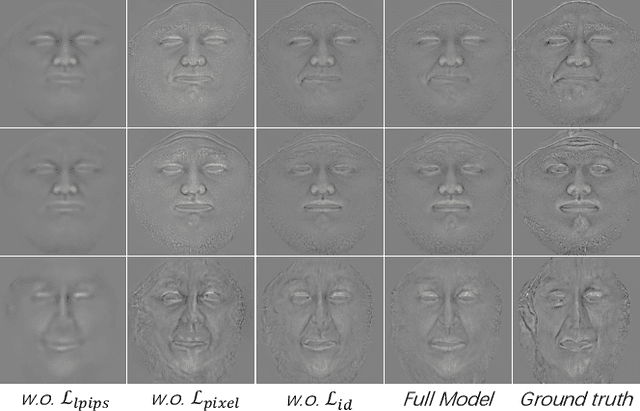
Parametric 3D models have enabled a wide variety of computer vision and graphics tasks, such as modeling human faces, bodies and hands. In 3D face modeling, 3DMM is the most widely used parametric model, but can't generate fine geometric details solely from identity and expression inputs. To tackle this limitation, we propose a neural parametric model named DNPM for the facial geometric details, which utilizes deep neural network to extract latent codes from facial displacement maps encoding details and wrinkles. Built upon DNPM, a novel 3DMM named Detailed3DMM is proposed, which augments traditional 3DMMs by including the synthesis of facial details only from the identity and expression inputs. Moreover, we show that DNPM and Detailed3DMM can facilitate two downstream applications: speech-driven detailed 3D facial animation and 3D face reconstruction from a degraded image. Extensive experiments have shown the usefulness of DNPM and Detailed3DMM, and the progressiveness of two proposed applications.
Learn2Talk: 3D Talking Face Learns from 2D Talking Face
Apr 19, 2024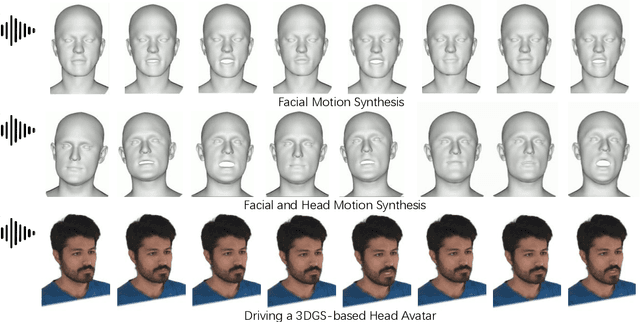
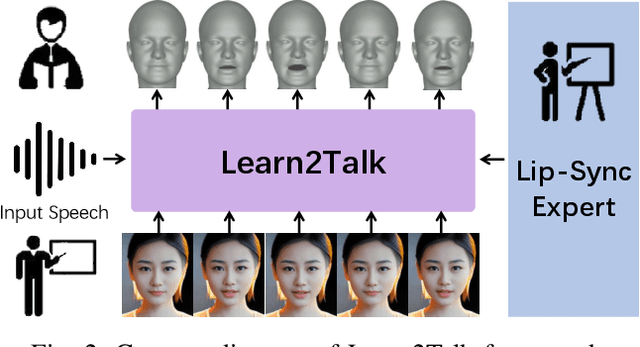
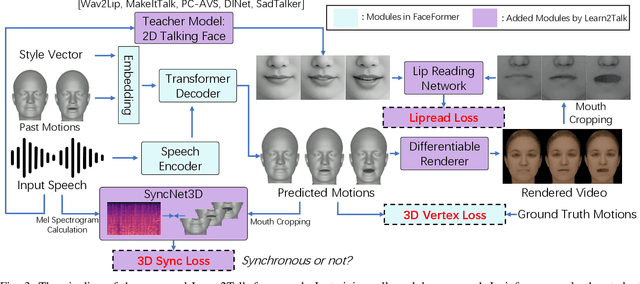
Speech-driven facial animation methods usually contain two main classes, 3D and 2D talking face, both of which attract considerable research attention in recent years. However, to the best of our knowledge, the research on 3D talking face does not go deeper as 2D talking face, in the aspect of lip-synchronization (lip-sync) and speech perception. To mind the gap between the two sub-fields, we propose a learning framework named Learn2Talk, which can construct a better 3D talking face network by exploiting two expertise points from the field of 2D talking face. Firstly, inspired by the audio-video sync network, a 3D sync-lip expert model is devised for the pursuit of lip-sync between audio and 3D facial motion. Secondly, a teacher model selected from 2D talking face methods is used to guide the training of the audio-to-3D motions regression network to yield more 3D vertex accuracy. Extensive experiments show the advantages of the proposed framework in terms of lip-sync, vertex accuracy and speech perception, compared with state-of-the-arts. Finally, we show two applications of the proposed framework: audio-visual speech recognition and speech-driven 3D Gaussian Splatting based avatar animation.