 Add to Chrome
 Add to Firefox
 Add to Edge
Summe Video Summarization
Papers and Code
TRIM: A Self-Supervised Video Summarization Framework Maximizing Temporal Relative Information and Representativeness
Jun 25, 2025
The increasing ubiquity of video content and the corresponding demand for efficient access to meaningful information have elevated video summarization and video highlights as a vital research area. However, many state-of-the-art methods depend heavily either on supervised annotations or on attention-based models, which are computationally expensive and brittle in the face of distribution shifts that hinder cross-domain applicability across datasets. We introduce a pioneering self-supervised video summarization model that captures both spatial and temporal dependencies without the overhead of attention, RNNs, or transformers. Our framework integrates a novel set of Markov process-driven loss metrics and a two-stage self supervised learning paradigm that ensures both performance and efficiency. Our approach achieves state-of-the-art performance on the SUMME and TVSUM datasets, outperforming all existing unsupervised methods. It also rivals the best supervised models, demonstrating the potential for efficient, annotation-free architectures. This paves the way for more generalizable video summarization techniques and challenges the prevailing reliance on complex architectures.

PRISM: Perceptual Recognition for Identifying Standout Moments in Human-Centric Keyframe Extraction
Jun 23, 2025Online videos play a central role in shaping political discourse and amplifying cyber social threats such as misinformation, propaganda, and radicalization. Detecting the most impactful or "standout" moments in video content is crucial for content moderation, summarization, and forensic analysis. In this paper, we introduce PRISM (Perceptual Recognition for Identifying Standout Moments), a lightweight and perceptually-aligned framework for keyframe extraction. PRISM operates in the CIELAB color space and uses perceptual color difference metrics to identify frames that align with human visual sensitivity. Unlike deep learning-based approaches, PRISM is interpretable, training-free, and computationally efficient, making it well suited for real-time and resource-constrained environments. We evaluate PRISM on four benchmark datasets: BBC, TVSum, SumMe, and ClipShots, and demonstrate that it achieves strong accuracy and fidelity while maintaining high compression ratios. These results highlight PRISM's effectiveness in both structured and unstructured video content, and its potential as a scalable tool for analyzing and moderating harmful or politically sensitive media in online platforms.
Prompts to Summaries: Zero-Shot Language-Guided Video Summarization
Jun 12, 2025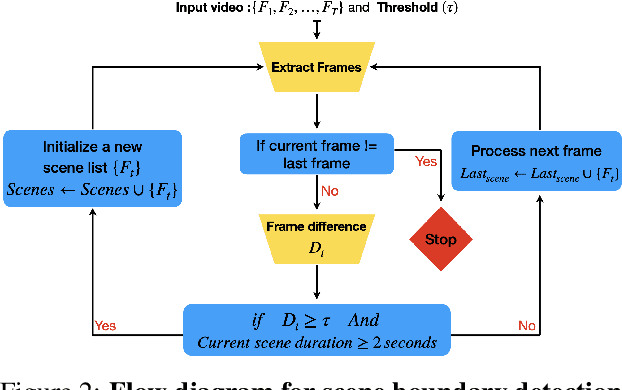
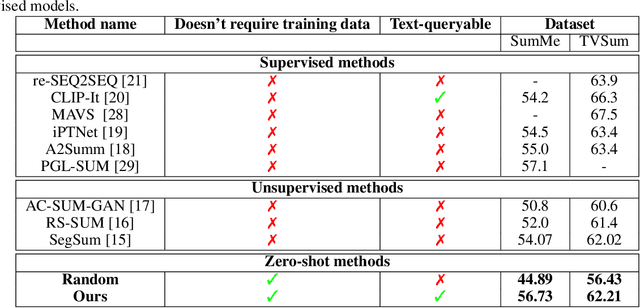
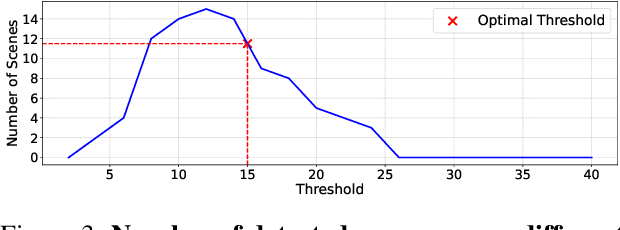
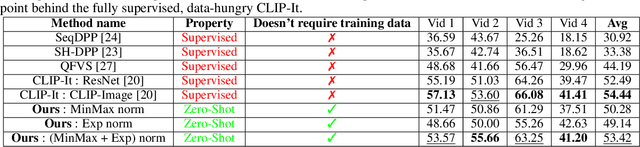
The explosive growth of video data intensified the need for flexible user-controllable summarization tools that can operate without domain-specific training data. Existing methods either rely on datasets, limiting generalization, or cannot incorporate user intent expressed in natural language. We introduce Prompts-to-Summaries: the first zero-shot, text-queryable video summarizer that converts off-the-shelf video-language models (VidLMs) captions into user-guided skims via large language models (LLMs) judging, without the use of training data at all, beating all unsupervised and matching supervised methods. Our pipeline (i) segments raw video footage into coherent scenes, (ii) generates rich scene-level descriptions through a memory-efficient, batch-style VidLM prompting scheme that scales to hours-long videos on a single GPU, (iii) leverages an LLM as a judge to assign scene-level importance scores under a carefully crafted prompt, and finally, (iv) propagates those scores to short segments level via two new metrics: consistency (temporal coherency) and uniqueness (novelty), yielding fine-grained frame importance. On SumMe and TVSum, our data-free approach surpasses all prior data-hungry unsupervised methods. It also performs competitively on the Query-Focused Video Summarization (QFVS) benchmark, despite using no training data and the competing methods requiring supervised frame-level importance. To spur further research, we release VidSum-Reason, a new query-driven dataset featuring long-tailed concepts and multi-step reasoning; our framework attains robust F1 scores and serves as the first challenging baseline. Overall, our results demonstrate that pretrained multimodal models, when orchestrated with principled prompting and score propagation, already provide a powerful foundation for universal, text-queryable video summarization.
MF2Summ: Multimodal Fusion for Video Summarization with Temporal Alignment
Jun 12, 2025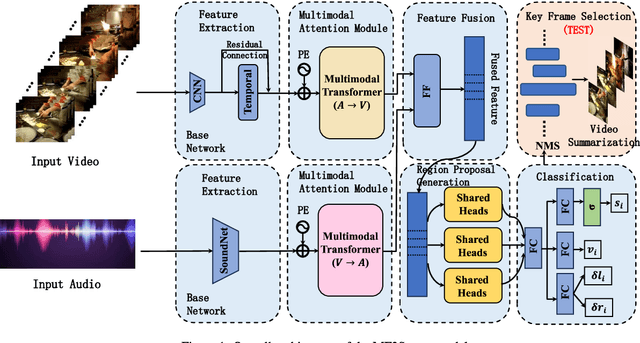
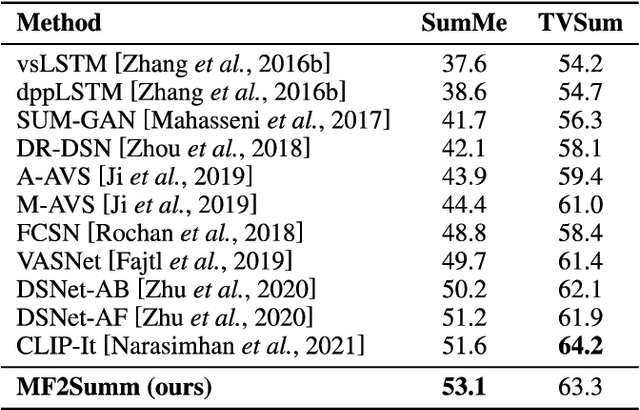
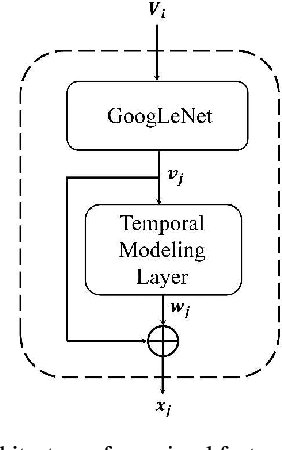
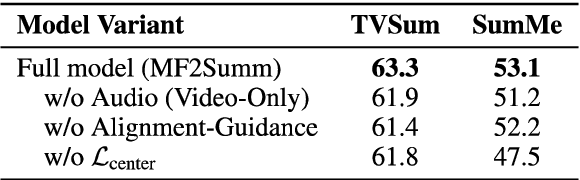
The rapid proliferation of online video content necessitates effective video summarization techniques. Traditional methods, often relying on a single modality (typically visual), struggle to capture the full semantic richness of videos. This paper introduces MF2Summ, a novel video summarization model based on multimodal content understanding, integrating both visual and auditory information. MF2Summ employs a five-stage process: feature extraction, cross-modal attention interaction, feature fusion, segment prediction, and key shot selection. Visual features are extracted using a pre-trained GoogLeNet model, while auditory features are derived using SoundNet. The core of our fusion mechanism involves a cross-modal Transformer and an alignment-guided self-attention Transformer, designed to effectively model inter-modal dependencies and temporal correspondences. Segment importance, location, and center-ness are predicted, followed by key shot selection using Non-Maximum Suppression (NMS) and the Kernel Temporal Segmentation (KTS) algorithm. Experimental results on the SumMe and TVSum datasets demonstrate that MF2Summ achieves competitive performance, notably improving F1-scores by 1.9\% and 0.6\% respectively over the DSNet model, and performing favorably against other state-of-the-art methods.
FullTransNet: Full Transformer with Local-Global Attention for Video Summarization
Jan 01, 2025Video summarization mainly aims to produce a compact, short, informative, and representative synopsis of raw videos, which is of great importance for browsing, analyzing, and understanding video content. Dominant video summarization approaches are generally based on recurrent or convolutional neural networks, even recent encoder-only transformers. We propose using full transformer as an alternative architecture to perform video summarization. The full transformer with an encoder-decoder structure, specifically designed for handling sequence transduction problems, is naturally suitable for video summarization tasks. This work considers supervised video summarization and casts it as a sequence-to-sequence learning problem. Our key idea is to directly apply the full transformer to the video summarization task, which is intuitively sound and effective. Also, considering the efficiency problem, we replace full attention with the combination of local and global sparse attention, which enables modeling long-range dependencies while reducing computational costs. Based on this, we propose a transformer-like architecture, named FullTransNet, which has a full encoder-decoder structure with local-global sparse attention for video summarization. Specifically, both the encoder and decoder in FullTransNet are stacked the same way as ones in the vanilla transformer, and the local-global sparse attention is used only at the encoder side. Extensive experiments on two public multimedia benchmark datasets SumMe and TVSum demonstrate that our proposed model can outperform other video summarization approaches, achieving F-Measures of 54.4% on SumMe and 63.9% on TVSum with relatively lower compute and memory requirements, verifying its effectiveness and efficiency. The code and models are publicly available on GitHub.
Video Summarization using Denoising Diffusion Probabilistic Model
Dec 12, 2024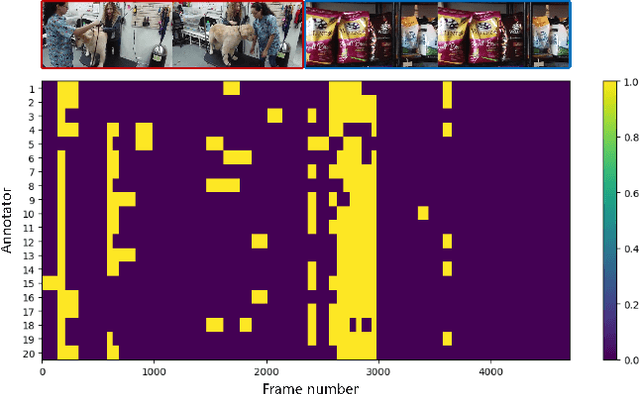
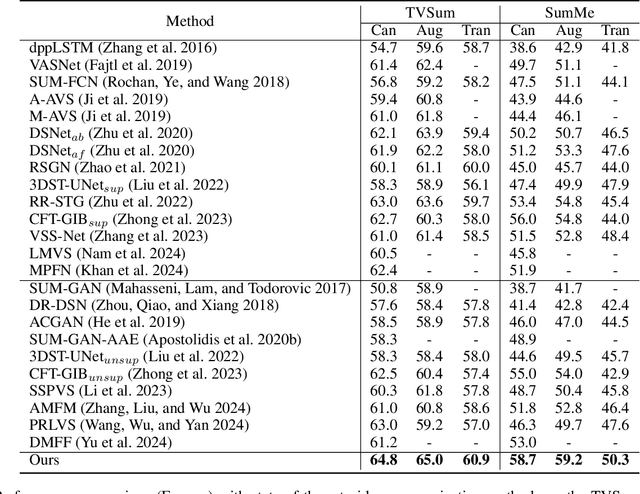
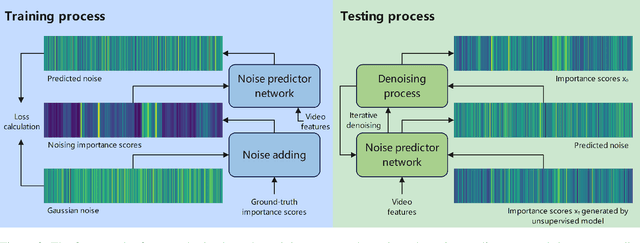
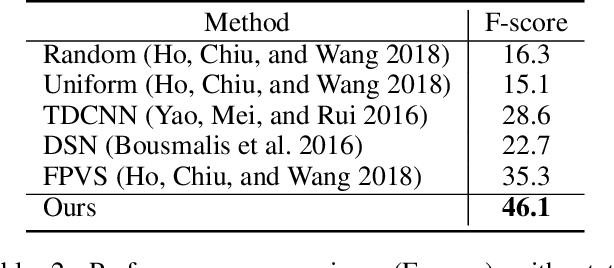
Video summarization aims to eliminate visual redundancy while retaining key parts of video to construct concise and comprehensive synopses. Most existing methods use discriminative models to predict the importance scores of video frames. However, these methods are susceptible to annotation inconsistency caused by the inherent subjectivity of different annotators when annotating the same video. In this paper, we introduce a generative framework for video summarization that learns how to generate summaries from a probability distribution perspective, effectively reducing the interference of subjective annotation noise. Specifically, we propose a novel diffusion summarization method based on the Denoising Diffusion Probabilistic Model (DDPM), which learns the probability distribution of training data through noise prediction, and generates summaries by iterative denoising. Our method is more resistant to subjective annotation noise, and is less prone to overfitting the training data than discriminative methods, with strong generalization ability. Moreover, to facilitate training DDPM with limited data, we employ an unsupervised video summarization model to implement the earlier denoising process. Extensive experiments on various datasets (TVSum, SumMe, and FPVSum) demonstrate the effectiveness of our method.
Does SpatioTemporal information benefit Two video summarization benchmarks?
Oct 04, 2024An important aspect of summarizing videos is understanding the temporal context behind each part of the video to grasp what is and is not important. Video summarization models have in recent years modeled spatio-temporal relationships to represent this information. These models achieved state-of-the-art correlation scores on important benchmark datasets. However, what has not been reviewed is whether spatio-temporal relationships are even required to achieve state-of-the-art results. Previous work in activity recognition has found biases, by prioritizing static cues such as scenes or objects, over motion information. In this paper we inquire if similar spurious relationships might influence the task of video summarization. To do so, we analyse the role that temporal information plays on existing benchmark datasets. We first estimate a baseline with temporally invariant models to see how well such models rank on benchmark datasets (TVSum and SumMe). We then disrupt the temporal order of the videos to investigate the impact it has on existing state-of-the-art models. One of our findings is that the temporally invariant models achieve competitive correlation scores that are close to the human baselines on the TVSum dataset. We also demonstrate that existing models are not affected by temporal perturbations. Furthermore, with certain disruption strategies that shuffle fixed time segments, we can actually improve their correlation scores. With these results, we find that spatio-temporal relationship play a minor role and we raise the question whether these benchmarks adequately model the task of video summarization. Code available at: https://github.com/AashGan/TemporalPerturbSum
Unsupervised Video Summarization via Reinforcement Learning and a Trained Evaluator
Jul 05, 2024This paper presents a novel approach for unsupervised video summarization using reinforcement learning. It aims to address the existing limitations of current unsupervised methods, including unstable training of adversarial generator-discriminator architectures and reliance on hand-crafted reward functions for quality evaluation. The proposed method is based on the concept that a concise and informative summary should result in a reconstructed video that closely resembles the original. The summarizer model assigns an importance score to each frame and generates a video summary. In the proposed scheme, reinforcement learning, coupled with a unique reward generation pipeline, is employed to train the summarizer model. The reward generation pipeline trains the summarizer to create summaries that lead to improved reconstructions. It comprises a generator model capable of reconstructing masked frames from a partially masked video, along with a reward mechanism that compares the reconstructed video from the summary against the original. The video generator is trained in a self-supervised manner to reconstruct randomly masked frames, enhancing its ability to generate accurate summaries. This training pipeline results in a summarizer model that better mimics human-generated video summaries compared to methods relying on hand-crafted rewards. The training process consists of two stable and isolated training steps, unlike adversarial architectures. Experimental results demonstrate promising performance, with F-scores of 62.3 and 54.5 on TVSum and SumMe datasets, respectively. Additionally, the inference stage is 300 times faster than our previously reported state-of-the-art method.
VideoSAGE: Video Summarization with Graph Representation Learning
Apr 14, 2024We propose a graph-based representation learning framework for video summarization. First, we convert an input video to a graph where nodes correspond to each of the video frames. Then, we impose sparsity on the graph by connecting only those pairs of nodes that are within a specified temporal distance. We then formulate the video summarization task as a binary node classification problem, precisely classifying video frames whether they should belong to the output summary video. A graph constructed this way aims to capture long-range interactions among video frames, and the sparsity ensures the model trains without hitting the memory and compute bottleneck. Experiments on two datasets(SumMe and TVSum) demonstrate the effectiveness of the proposed nimble model compared to existing state-of-the-art summarization approaches while being one order of magnitude more efficient in compute time and memory
Cluster-based Video Summarization with Temporal Context Awareness
Apr 06, 2024In this paper, we present TAC-SUM, a novel and efficient training-free approach for video summarization that addresses the limitations of existing cluster-based models by incorporating temporal context. Our method partitions the input video into temporally consecutive segments with clustering information, enabling the injection of temporal awareness into the clustering process, setting it apart from prior cluster-based summarization methods. The resulting temporal-aware clusters are then utilized to compute the final summary, using simple rules for keyframe selection and frame importance scoring. Experimental results on the SumMe dataset demonstrate the effectiveness of our proposed approach, outperforming existing unsupervised methods and achieving comparable performance to state-of-the-art supervised summarization techniques. Our source code is available for reference at \url{https://github.com/hcmus-thesis-gulu/TAC-SUM}.