 Add to Chrome
 Add to Firefox
 Add to Edge
Cell-Free MIMO with Rotatable Antennas: When Macro-Diversity Meets Antenna Directivity
Jan 23, 2026
Cell-free networks leverage distributed access points (APs) to achieve macro-diversity, yet their performance is often constrained by large disparities in channel quality arising from user geometry and blockages. To address this, rotatable antennas (RAs) add a lightweight hardware degree of freedom by steering the antenna boresight toward dominant propagation directions to strengthen unfavorable links, thereby enabling the network to better exploit macro-diversity for higher and more uniform performance. This paper investigates an RA-enabled cell-free downlink network and formulates a max-min rate problem that jointly optimizes transmit beamforming and antenna orientations. To tackle this challenging problem, we develop an alternating-optimization-based algorithm that iteratively updates the beamformers via a second-order cone program (SOCP) and optimizes the antenna orientations using successive convex approximation. To reduce complexity, we further propose an efficient two-stage scheme that first designs orientations by maximizing a proportional-fair log-utility using manifold-aware Frank-Wolfe updates, and then computes the beamformers using an SOCP-based design. Simulation results demonstrate that the proposed orientation-aware designs achieve a substantially higher worst-user rate than conventional beamforming-only benchmarks. Furthermore, larger antenna directivity enhances fairness with proper orientation but can degrade the worst-user performance otherwise.

Two-Scale Spatial Deployment for Cost-Effective Wireless Networks via Cooperative IRSs and Movable Antennas
Jan 14, 2026This paper proposes a two-scale spatial deployment strategy to ensure reliable coverage for multiple target areas, integrating macroscopic intelligent reflecting surfaces (IRSs) and fine-grained movable antennas (MAs). Specifically, IRSs are selectively deployed from candidate sites to shape the propagation geometry, while MAs are locally repositioned among discretized locations to exploit small-scale channel variations. The objective is to minimize the total deployment cost of MAs and IRSs by jointly optimizing the IRS site selection, MA positions, transmit precoding, and IRS phase shifts, subject to the signal-to-noise ratio (SNR) requirements for all target areas. This leads to a challenging mixed-integer non-convex optimization problem that is intractable to solve directly. To address this, we first formulate an auxiliary problem to verify the feasibility. A penalty-based double-loop algorithm integrating alternating optimization and successive convex approximation (SCA) is developed to solve this feasibility issue, which is subsequently adapted to obtain a suboptimal solution for the original cost minimization problem. Finally, based on the obtained solution, we formulate an element refinement problem to further reduce the deployment cost, which is solved by a penalty-based SCA algorithm. Simulation results demonstrate that the proposed designs consistently outperform benchmarks relying on independent area planning or full IRS deployment in terms of cost-efficiency. Moreover, for cost minimization, MA architectures are preferable in large placement apertures, whereas fully populated FPA architectures excel in compact ones; for worst-case SNR maximization, MA architectures exhibit a lower cost threshold for feasibility, while FPA architectures can attain peak SNR at a lower total cost.
Low-Altitude ISAC with Rotatable Active and Passive Arrays
Dec 24, 2025This paper investigates a low-altitude integrated sensing and communication (ISAC) system that leverages cooperative rotatable active and passive arrays. We consider a downlink scenario where a base station (BS) with an active rotatable array serves multiple communication users and senses low-altitude targets, assisted by a rotatable reconfigurable intelligent surface (RIS). A rotation-aware geometry-based multipath model is developed to capture the impact of three-dimensional (3D) array orientations on both steering vectors and direction-dependent element gains. On this basis, we formulate a new optimization problem that maximizes the downlink sum rate subject to a transmit power budget, RIS unit-modulus constraints, mechanical rotation limits, and a sensing beampattern mean-squared-error (MSE) constraint. To address the resulting highly non-convex problem, we propose a penalty-based alternating-optimization (AO) framework that alternately updates the BS precoder, RIS phase shifts, and BS/RIS array rotation angles. The three blocks are efficiently handled via a convex optimization method based on quadratic-transform (QT) and majorization-minorization (MM), Riemannian conjugate gradient (RCG) on the unit-modulus manifold, and projected gradient descent (PGD) with Barzilai-Borwein step sizes, respectively. Numerical results in low-altitude geometries demonstrate that the proposed jointly rotatable BS-RIS architecture achieves significant sum-rate gains over fixed or partially rotatable baselines while guaranteeing sensing requirements, especially with directional antennas and in interference-limited regimes.
Beamforming for Transmissive RIS Transmitter Enabled Simultaneous Wireless Information and Power Transfer Systems
Nov 15, 2025This paper investigates a novel transmissive reconfigurable intelligent surface (TRIS) transceiver-empowered simultaneous wireless information and power transfer (SWIPT) system with multiple information decoding (ID) and energy harvesting (EH) users. Under the considered system model, we formulate an optimization problem that maximizes the sum-rate of all ID users via the design of the TRIS transceiver's active beamforming. The design is constrained by per-antenna power limits at the TRIS transceiver and by the minimum harvested energy demand of all EH users. Due to the non-convexity of the objective function and the energy harvesting constraint, the sum-rate problem is difficult to tackle. To solve this challenging optimization problem, by leveraging the weighted minimum mean squared error (WMMSE) framework and the majorization-minimization (MM) method, we propose a second-order cone programming (SOCP)-based algorithm. Per-element power constraints introduce a large number of constraints, making the problem considerably more difficult. By applying the alternating direction method of multipliers (ADMM) method, we successfully develop an analytical, computationally efficient, and highly parallelizable algorithm to address this challenge. Numerical results are provided to validate the convergence and effectiveness of the proposed algorithms. Furthermore, the low-complexity algorithm significantly reduces computational complexity without performance degradation.
Intelligent Reflecting Surfaces for Integrated Sensing and Communications: A Survey
Nov 14, 2025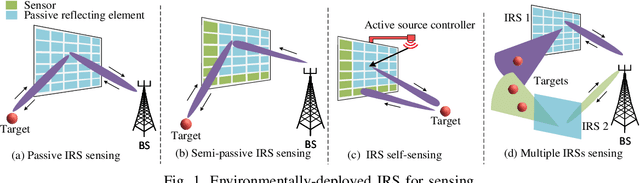
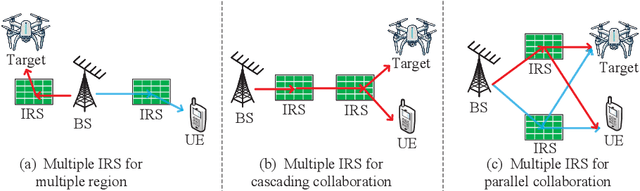
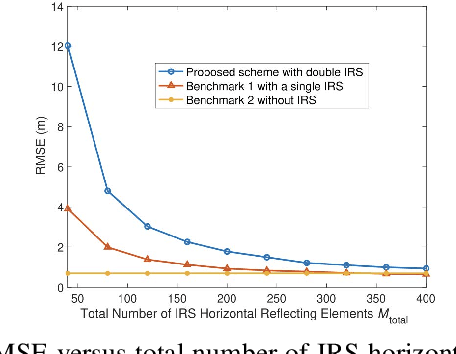
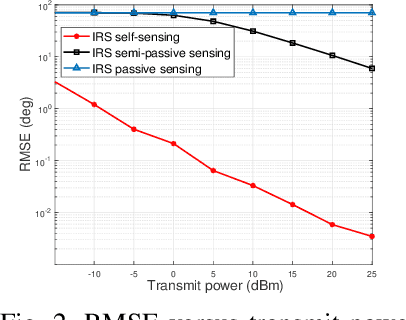
The rapid development of sixth-generation (6G) wireless networks requires seamless integration of communication and sensing to support ubiquitous intelligence and real-time, high-reliability applications. Integrated sensing and communication (ISAC) has emerged as a key solution for achieving this convergence, offering joint utilization of spectral, hardware, and computing resources. However, realizing high-performance ISAC remains challenging due to environmental line-of-sight (LoS) blockage, limited spatial resolution, and the inherent coverage asymmetry and resource coupling between sensing and communication. Intelligent reflecting surfaces (IRSs), featuring low-cost, energy-efficient, and programmable electromagnetic reconfiguration, provide a promising solution to overcome these limitations. This article presents a comprehensive overview of IRS-aided wireless sensing and ISAC technologies, including IRS architectures, target detection and estimation techniques, beamforming designs, and performance metrics. It further explores IRS-enabled new opportunities for more efficient performance balancing, coexistence, and networking in ISAC systems, focuses on current design bottlenecks, and outlines future research directions. This article aims to offer a unified design framework that guides the development of practical and scalable IRS-aided ISAC systems for the next-generation wireless network.
Reconfigurable Airspace: Synergizing Movable Antenna and Intelligent Surface for Low-Altitude ISAC Networks
Nov 13, 2025Low-altitude unmanned aerial vehicle (UAV) networks are integral to future 6G integrated sensing and communication (ISAC) systems. However, their deployment is hindered by challenges stemming from high mobility of UAVs, complex propagation environments, and the inherent trade-offs between coexisting sensing and communication functions. This article proposes a novel framework that leverages movable antennas (MAs) and intelligent reflecting surfaces (IRSs) as dual enablers to overcome these limitations. MAs, through active transceiver reconfiguration, and IRSs, via passive channel reconstruction, can work in synergy to significantly enhance system performance. Our analysis first elaborates on the fundamental gains offered by MAs and IRSs, and provides simulation results that validate the immense potential of the MA-IRS-enabled ISAC architecture. Two core UAV deployment scenarios are then investigated: (i) UAVs as ISAC users, where we focus on achieving high-precision tracking and aerial safety, and (ii) UAVs as aerial network nodes, where we address robust design and complex coupled resource optimization. Finally, key technical challenges and research opportunities are identified and analyzed for each scenario, charting a clear course for the future design of advanced low-altitude ISAC networks.
Wireless Sensing with Movable Intelligent Surface
Sep 19, 2025Future wireless networks are envisioned to deliver not only gigabit communications but also ubiquitous sensing. Reconfigurable intelligent surfaces (RISs) have emerged to reshape radio propagation, recently showing considerable promise for wireless sensing. Still, their per-element electronic tuning incurs prohibitive hardware cost and power consumption. Motivated by the concept of fluid antenna system (FAS), this paper introduces a low-cost movable intelligent surface (MIS) for wireless sensing, which replaces element-wise electronic phase tuning with panel-wise mechanical reconfiguration. The MIS stacks a large fixed and a smaller movable pre-phased metasurface layers, whose differential position shifts synthesize distinct composite phase patterns, enabling multiple beam patterns for multi-target detection. We characterize a MIS-enabled multi-hop echo signal model with multi-target interference and then formulate a worst-case sensing signal-to-interference-plus-noise ratio (SINR) maximization problem that jointly designs MIS phase shifts and schedules MS2's position. A Riemannian Augmented Lagrangian Method (RALM)-based algorithm is developed to solve the formulated mixed-integer non-convex problem. We also derive a heuristic MIS beam steering design with closed-form phase distribution and position scheduling. Simulations validate MIS's beam pattern reconfiguration capability, show that the RALM-based scheme significantly outperforms the closed-form scheme in improving sensing SINR, and uncover a gain-diversity trade-off in beam patterns that informs the optimal choice of MIS configuration.
Suppressing Beam Squint Effect For Near-Field Wideband Communication Through Movable Antennas
Jul 28, 2024In this correspondence, we study deploying movable antenna (MA) array in a wideband multiple-input-single-output (MISO) communication system, where near-field (NF) channel model is considered. To alleviate beam squint effect, we propose to maximize the minimum analog beamforming gain across the entire wideband spectrum by appropriately adjusting MAs' positions, which is a highly challenging task. By introducing a slack variable and adopting the cutting-the-edge smoothed-gradient-descent-ascent (SGDA) method, we develop algorithms to resolve the aforementioned challenge. Numerical results verify the effectiveness of our proposed algorithms and demonstrate the benefit of utilizing MA array to mitigate beam squint effect in NF wideband system.