 Add to Chrome
 Add to Firefox
 Add to Edge
PILD: Physics-Informed Learning via Diffusion
Jan 29, 2026
Diffusion models have emerged as powerful generative tools for modeling complex data distributions, yet their purely data-driven nature limits applicability in practical engineering and scientific problems where physical laws need to be followed. This paper proposes Physics-Informed Learning via Diffusion (PILD), a framework that unifies diffusion modeling and first-principles physical constraints by introducing a virtual residual observation sampled from a Laplace distribution to supervise generation during training. To further integrate physical laws, a conditional embedding module is incorporated to inject physical information into the denoising network at multiple layers, ensuring consistent guidance throughout the diffusion process. The proposed PILD framework is concise, modular, and broadly applicable to problems governed by ordinary differential equations, partial differential equations, as well as algebraic equations or inequality constraints. Extensive experiments across engineering and scientific tasks including estimating vehicle trajectories, tire forces, Darcy flow and plasma dynamics, demonstrate that our PILD substantially improves accuracy, stability, and generalization over existing physics-informed and diffusion-based baselines.

Bridging the Gap: Self-Optimized Fine-Tuning for LLM-based Recommender Systems
May 27, 2025Recent years have witnessed extensive exploration of Large Language Models (LLMs) on the field of Recommender Systems (RS). There are currently two commonly used strategies to enable LLMs to have recommendation capabilities: 1) The "Guidance-Only" strategy uses in-context learning to exploit and amplify the inherent semantic understanding and item recommendation capabilities of LLMs; 2) The "Tuning-Only" strategy uses supervised fine-tuning (SFT) to fine-tune LLMs with the aim of fitting them to real recommendation data. However, neither of these strategies can effectively bridge the gap between the knowledge space of LLMs and recommendation, and their performance do not meet our expectations. To better enable LLMs to learn recommendation knowledge, we combine the advantages of the above two strategies and proposed a novel "Guidance+Tuning" method called Self-Optimized Fine-Tuning (SOFT), which adopts the idea of curriculum learning. It first employs self-distillation to construct an auxiliary easy-to-learn but meaningful dataset from a fine-tuned LLM. Then it further utilizes a self-adaptive curriculum scheduler to enable LLMs to gradually learn from simpler data (self-distilled data) to more challenging data (real RS data). Extensive experiments demonstrate that SOFT significantly enhances the recommendation accuracy (37.59\% on average) of LLM-based methods. The code is available via https://anonymous.4open.science/r/Self-Optimized-Fine-Tuning-264E
Damper-B-PINN: Damper Characteristics-Based Bayesian Physics-Informed Neural Network for Vehicle State Estimation
Feb 28, 2025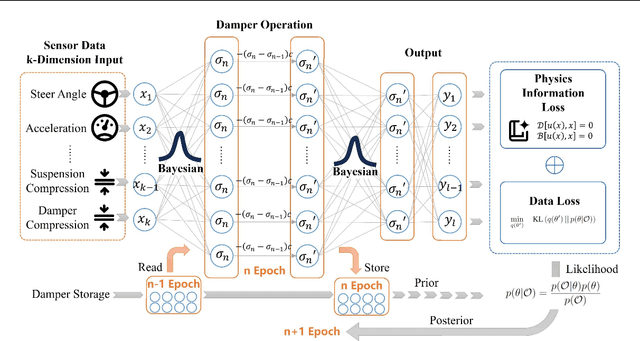
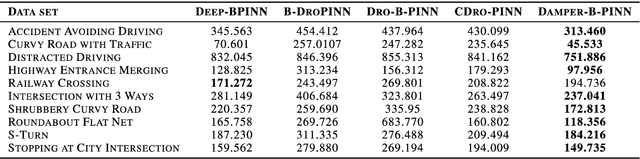
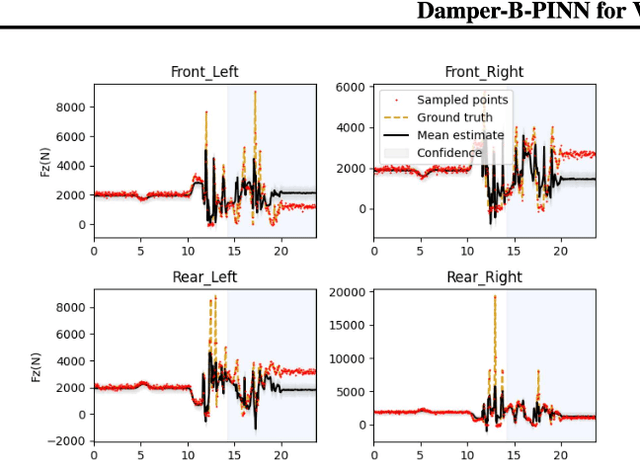
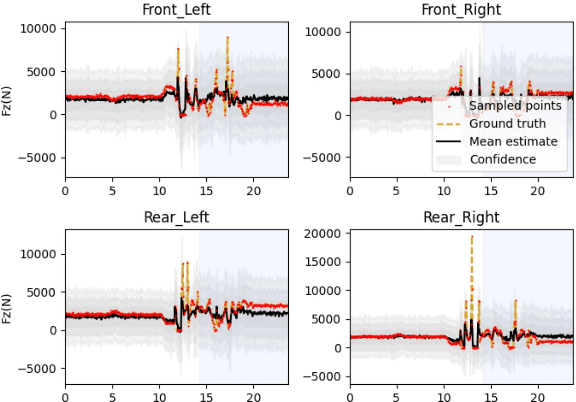
State estimation for Multi-Input Multi-Output (MIMO) systems with noise, such as vehicle chassis systems, presents a significant challenge due to the imperfect and complex relationship between inputs and outputs. To solve this problem, we design a Damper characteristics-based Bayesian Physics-Informed Neural Network (Damper-B-PINN). First, we introduce a neuron forward process inspired by the mechanical properties of dampers, which limits abrupt jumps in neuron values between epochs while maintaining search capability. Additionally, we apply an optimized Bayesian dropout layer to the MIMO system to enhance robustness against noise and prevent non-convergence issues. Physical information is incorporated into the loss function to serve as a physical prior for the neural network. The effectiveness of our Damper-B-PINN architecture is then validated across ten datasets and fourteen vehicle types, demonstrating superior accuracy, computational efficiency, and convergence in vehicle state estimation (i.e., dynamic wheel load) compared to other state-of-the-art benchmarks.