 Add to Chrome
 Add to Firefox
 Add to Edge
Inference-Time Scaling for Visual AutoRegressive modeling by Searching Representative Samples
Jan 12, 2026
While inference-time scaling has significantly enhanced generative quality in large language and diffusion models, its application to vector-quantized (VQ) visual autoregressive modeling (VAR) remains unexplored. We introduce VAR-Scaling, the first general framework for inference-time scaling in VAR, addressing the critical challenge of discrete latent spaces that prohibit continuous path search. We find that VAR scales exhibit two distinct pattern types: general patterns and specific patterns, where later-stage specific patterns conditionally optimize early-stage general patterns. To overcome the discrete latent space barrier in VQ models, we map sampling spaces to quasi-continuous feature spaces via kernel density estimation (KDE), where high-density samples approximate stable, high-quality solutions. This transformation enables effective navigation of sampling distributions. We propose a density-adaptive hybrid sampling strategy: Top-k sampling focuses on high-density regions to preserve quality near distribution modes, while Random-k sampling explores low-density areas to maintain diversity and prevent premature convergence. Consequently, VAR-Scaling optimizes sample fidelity at critical scales to enhance output quality. Experiments in class-conditional and text-to-image evaluations demonstrate significant improvements in inference process. The code is available at https://github.com/WD7ang/VAR-Scaling.

Compositional Attribute Imbalance in Vision Datasets
Jun 17, 2025Visual attribute imbalance is a common yet underexplored issue in image classification, significantly impacting model performance and generalization. In this work, we first define the first-level and second-level attributes of images and then introduce a CLIP-based framework to construct a visual attribute dictionary, enabling automatic evaluation of image attributes. By systematically analyzing both single-attribute imbalance and compositional attribute imbalance, we reveal how the rarity of attributes affects model performance. To tackle these challenges, we propose adjusting the sampling probability of samples based on the rarity of their compositional attributes. This strategy is further integrated with various data augmentation techniques (such as CutMix, Fmix, and SaliencyMix) to enhance the model's ability to represent rare attributes. Extensive experiments on benchmark datasets demonstrate that our method effectively mitigates attribute imbalance, thereby improving the robustness and fairness of deep neural networks. Our research highlights the importance of modeling visual attribute distributions and provides a scalable solution for long-tail image classification tasks.
PEBench: A Fictitious Dataset to Benchmark Machine Unlearning for Multimodal Large Language Models
Mar 16, 2025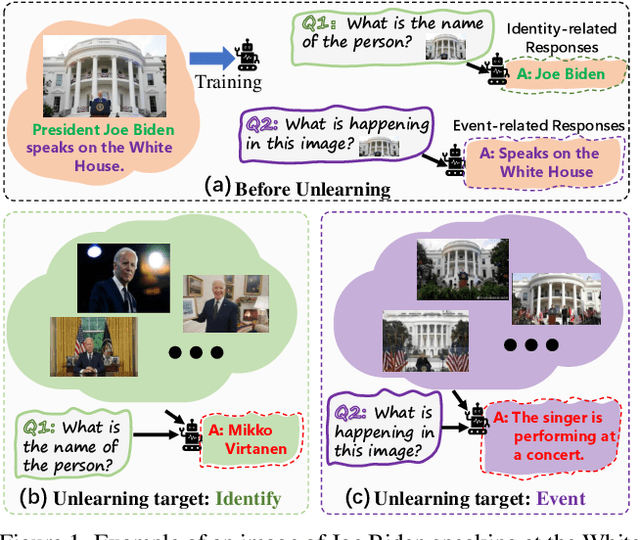
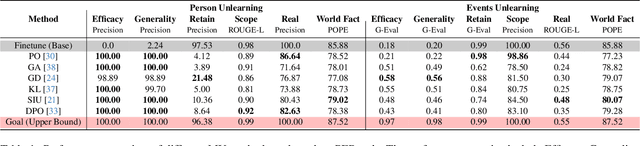
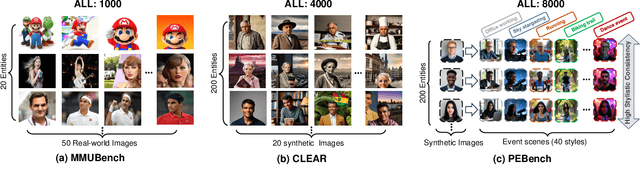

In recent years, Multimodal Large Language Models (MLLMs) have demonstrated remarkable advancements in tasks such as visual question answering, visual understanding, and reasoning. However, this impressive progress relies on vast amounts of data collected from the internet, raising significant concerns about privacy and security. To address these issues, machine unlearning (MU) has emerged as a promising solution, enabling the removal of specific knowledge from an already trained model without requiring retraining from scratch. Although MU for MLLMs has gained attention, current evaluations of its efficacy remain incomplete, and the underlying problem is often poorly defined, which hinders the development of strategies for creating more secure and trustworthy systems. To bridge this gap, we introduce a benchmark, named PEBench, which includes a dataset of personal entities and corresponding general event scenes, designed to comprehensively assess the performance of MU for MLLMs. Through PEBench, we aim to provide a standardized and robust framework to advance research in secure and privacy-preserving multimodal models. We benchmarked 6 MU methods, revealing their strengths and limitations, and shedding light on key challenges and opportunities for MU in MLLMs.