 Add to Chrome
 Add to Firefox
 Add to Edge
Forget Less by Learning Together through Concept Consolidation
Jan 05, 2026
Custom Diffusion Models (CDMs) have gained significant attention due to their remarkable ability to personalize generative processes. However, existing CDMs suffer from catastrophic forgetting when continuously learning new concepts. Most prior works attempt to mitigate this issue under the sequential learning setting with a fixed order of concept inflow and neglect inter-concept interactions. In this paper, we propose a novel framework - Forget Less by Learning Together (FL2T) - that enables concurrent and order-agnostic concept learning while addressing catastrophic forgetting. Specifically, we introduce a set-invariant inter-concept learning module where proxies guide feature selection across concepts, facilitating improved knowledge retention and transfer. By leveraging inter-concept guidance, our approach preserves old concepts while efficiently incorporating new ones. Extensive experiments, across three datasets, demonstrates that our method significantly improves concept retention and mitigates catastrophic forgetting, highlighting the effectiveness of inter-concept catalytic behavior in incremental concept learning of ten tasks with at least 2% gain on average CLIP Image Alignment scores.

Forget Less by Learning from Parents Through Hierarchical Relationships
Jan 05, 2026Custom Diffusion Models (CDMs) offer impressive capabilities for personalization in generative modeling, yet they remain vulnerable to catastrophic forgetting when learning new concepts sequentially. Existing approaches primarily focus on minimizing interference between concepts, often neglecting the potential for positive inter-concept interactions. In this work, we present Forget Less by Learning from Parents (FLLP), a novel framework that introduces a parent-child inter-concept learning mechanism in hyperbolic space to mitigate forgetting. By embedding concept representations within a Lorentzian manifold, naturally suited to modeling tree-like hierarchies, we define parent-child relationships in which previously learned concepts serve as guidance for adapting to new ones. Our method not only preserves prior knowledge but also supports continual integration of new concepts. We validate FLLP on three public datasets and one synthetic benchmark, showing consistent improvements in both robustness and generalization.
Model-Agnostic Gender Bias Control for Text-to-Image Generation via Sparse Autoencoder
Jul 28, 2025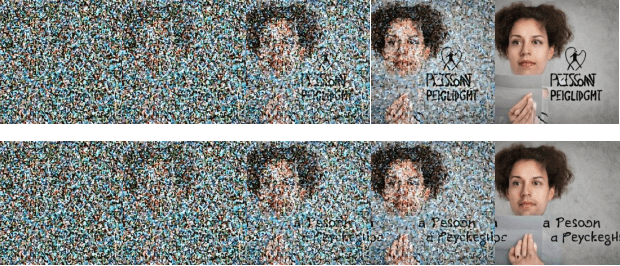
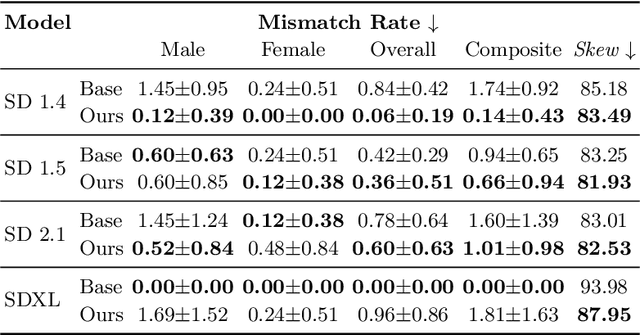
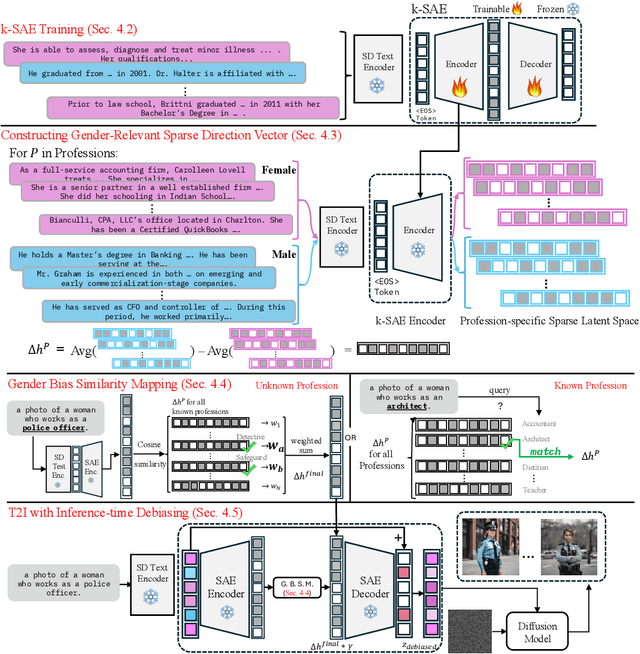
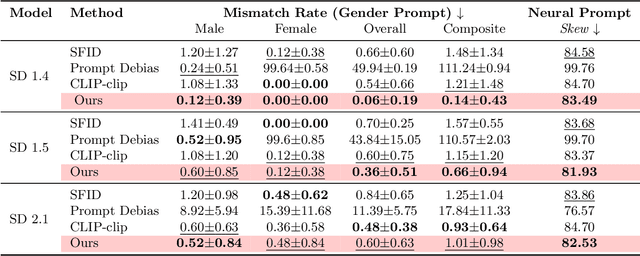
Text-to-image (T2I) diffusion models often exhibit gender bias, particularly by generating stereotypical associations between professions and gendered subjects. This paper presents SAE Debias, a lightweight and model-agnostic framework for mitigating such bias in T2I generation. Unlike prior approaches that rely on CLIP-based filtering or prompt engineering, which often require model-specific adjustments and offer limited control, SAE Debias operates directly within the feature space without retraining or architectural modifications. By leveraging a k-sparse autoencoder pre-trained on a gender bias dataset, the method identifies gender-relevant directions within the sparse latent space, capturing professional stereotypes. Specifically, a biased direction per profession is constructed from sparse latents and suppressed during inference to steer generations toward more gender-balanced outputs. Trained only once, the sparse autoencoder provides a reusable debiasing direction, offering effective control and interpretable insight into biased subspaces. Extensive evaluations across multiple T2I models, including Stable Diffusion 1.4, 1.5, 2.1, and SDXL, demonstrate that SAE Debias substantially reduces gender bias while preserving generation quality. To the best of our knowledge, this is the first work to apply sparse autoencoders for identifying and intervening in gender bias within T2I models. These findings contribute toward building socially responsible generative AI, providing an interpretable and model-agnostic tool to support fairness in text-to-image generation.
Your Text Encoder Can Be An Object-Level Watermarking Controller
Mar 15, 2025Invisible watermarking of AI-generated images can help with copyright protection, enabling detection and identification of AI-generated media. In this work, we present a novel approach to watermark images of T2I Latent Diffusion Models (LDMs). By only fine-tuning text token embeddings $W_*$, we enable watermarking in selected objects or parts of the image, offering greater flexibility compared to traditional full-image watermarking. Our method leverages the text encoder's compatibility across various LDMs, allowing plug-and-play integration for different LDMs. Moreover, introducing the watermark early in the encoding stage improves robustness to adversarial perturbations in later stages of the pipeline. Our approach achieves $99\%$ bit accuracy ($48$ bits) with a $10^5 \times$ reduction in model parameters, enabling efficient watermarking.
AMuSE: Adaptive Multimodal Analysis for Speaker Emotion Recognition in Group Conversations
Jan 26, 2024Analyzing individual emotions during group conversation is crucial in developing intelligent agents capable of natural human-machine interaction. While reliable emotion recognition techniques depend on different modalities (text, audio, video), the inherent heterogeneity between these modalities and the dynamic cross-modal interactions influenced by an individual's unique behavioral patterns make the task of emotion recognition very challenging. This difficulty is compounded in group settings, where the emotion and its temporal evolution are not only influenced by the individual but also by external contexts like audience reaction and context of the ongoing conversation. To meet this challenge, we propose a Multimodal Attention Network that captures cross-modal interactions at various levels of spatial abstraction by jointly learning its interactive bunch of mode-specific Peripheral and Central networks. The proposed MAN injects cross-modal attention via its Peripheral key-value pairs within each layer of a mode-specific Central query network. The resulting cross-attended mode-specific descriptors are then combined using an Adaptive Fusion technique that enables the model to integrate the discriminative and complementary mode-specific data patterns within an instance-specific multimodal descriptor. Given a dialogue represented by a sequence of utterances, the proposed AMuSE model condenses both spatial and temporal features into two dense descriptors: speaker-level and utterance-level. This helps not only in delivering better classification performance (3-5% improvement in Weighted-F1 and 5-7% improvement in Accuracy) in large-scale public datasets but also helps the users in understanding the reasoning behind each emotion prediction made by the model via its Multimodal Explainability Visualization module.