 Add to Chrome
 Add to Firefox
 Add to Edge
AgentDoG: A Diagnostic Guardrail Framework for AI Agent Safety and Security
Jan 26, 2026
The rise of AI agents introduces complex safety and security challenges arising from autonomous tool use and environmental interactions. Current guardrail models lack agentic risk awareness and transparency in risk diagnosis. To introduce an agentic guardrail that covers complex and numerous risky behaviors, we first propose a unified three-dimensional taxonomy that orthogonally categorizes agentic risks by their source (where), failure mode (how), and consequence (what). Guided by this structured and hierarchical taxonomy, we introduce a new fine-grained agentic safety benchmark (ATBench) and a Diagnostic Guardrail framework for agent safety and security (AgentDoG). AgentDoG provides fine-grained and contextual monitoring across agent trajectories. More Crucially, AgentDoG can diagnose the root causes of unsafe actions and seemingly safe but unreasonable actions, offering provenance and transparency beyond binary labels to facilitate effective agent alignment. AgentDoG variants are available in three sizes (4B, 7B, and 8B parameters) across Qwen and Llama model families. Extensive experimental results demonstrate that AgentDoG achieves state-of-the-art performance in agentic safety moderation in diverse and complex interactive scenarios. All models and datasets are openly released.

The Why Behind the Action: Unveiling Internal Drivers via Agentic Attribution
Jan 21, 2026Large Language Model (LLM)-based agents are widely used in real-world applications such as customer service, web navigation, and software engineering. As these systems become more autonomous and are deployed at scale, understanding why an agent takes a particular action becomes increasingly important for accountability and governance. However, existing research predominantly focuses on \textit{failure attribution} to localize explicit errors in unsuccessful trajectories, which is insufficient for explaining the reasoning behind agent behaviors. To bridge this gap, we propose a novel framework for \textbf{general agentic attribution}, designed to identify the internal factors driving agent actions regardless of the task outcome. Our framework operates hierarchically to manage the complexity of agent interactions. Specifically, at the \textit{component level}, we employ temporal likelihood dynamics to identify critical interaction steps; then at the \textit{sentence level}, we refine this localization using perturbation-based analysis to isolate the specific textual evidence. We validate our framework across a diverse suite of agentic scenarios, including standard tool use and subtle reliability risks like memory-induced bias. Experimental results demonstrate that the proposed framework reliably pinpoints pivotal historical events and sentences behind the agent behavior, offering a critical step toward safer and more accountable agentic systems.
RewardDS: Privacy-Preserving Fine-Tuning for Large Language Models via Reward Driven Data Synthesis
Feb 23, 2025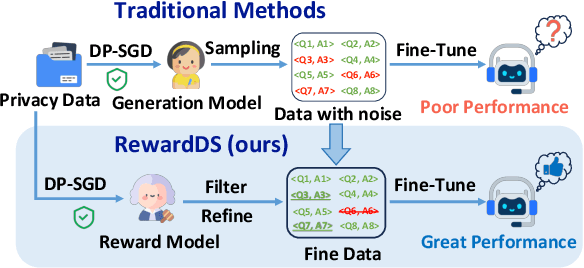
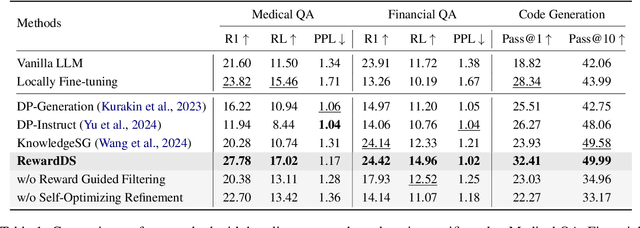
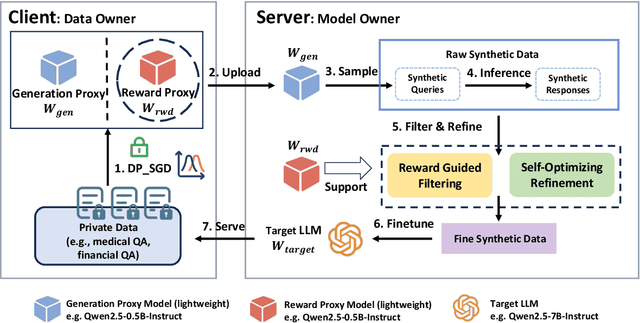
The success of large language models (LLMs) has attracted many individuals to fine-tune them for domain-specific tasks by uploading their data. However, in sensitive areas like healthcare and finance, privacy concerns often arise. One promising solution is to sample synthetic data with Differential Privacy (DP) guarantees to replace private data. However, these synthetic data contain significant flawed data, which are considered as noise. Existing solutions typically rely on naive filtering by comparing ROUGE-L scores or embedding similarities, which are ineffective in addressing the noise. To address this issue, we propose RewardDS, a novel privacy-preserving framework that fine-tunes a reward proxy model and uses reward signals to guide the synthetic data generation. Our RewardDS introduces two key modules, Reward Guided Filtering and Self-Optimizing Refinement, to both filter and refine the synthetic data, effectively mitigating the noise. Extensive experiments across medical, financial, and code generation domains demonstrate the effectiveness of our method.