 Add to Chrome
 Add to Firefox
 Add to Edge
STEP3-VL-10B Technical Report
Jan 15, 2026
We present STEP3-VL-10B, a lightweight open-source foundation model designed to redefine the trade-off between compact efficiency and frontier-level multimodal intelligence. STEP3-VL-10B is realized through two strategic shifts: first, a unified, fully unfrozen pre-training strategy on 1.2T multimodal tokens that integrates a language-aligned Perception Encoder with a Qwen3-8B decoder to establish intrinsic vision-language synergy; and second, a scaled post-training pipeline featuring over 1k iterations of reinforcement learning. Crucially, we implement Parallel Coordinated Reasoning (PaCoRe) to scale test-time compute, allocating resources to scalable perceptual reasoning that explores and synthesizes diverse visual hypotheses. Consequently, despite its compact 10B footprint, STEP3-VL-10B rivals or surpasses models 10$\times$-20$\times$ larger (e.g., GLM-4.6V-106B, Qwen3-VL-235B) and top-tier proprietary flagships like Gemini 2.5 Pro and Seed-1.5-VL. Delivering best-in-class performance, it records 92.2% on MMBench and 80.11% on MMMU, while excelling in complex reasoning with 94.43% on AIME2025 and 75.95% on MathVision. We release the full model suite to provide the community with a powerful, efficient, and reproducible baseline.

Perception-R1: Pioneering Perception Policy with Reinforcement Learning
Apr 10, 2025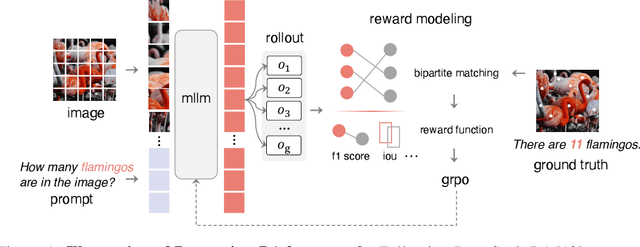
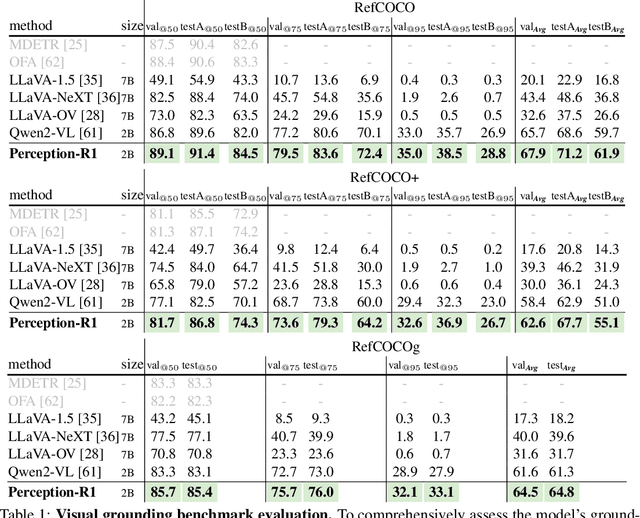
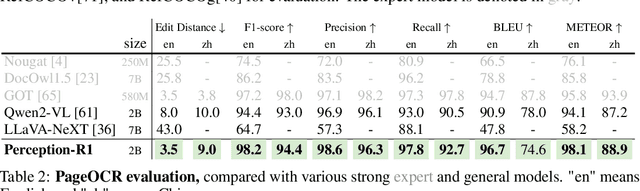
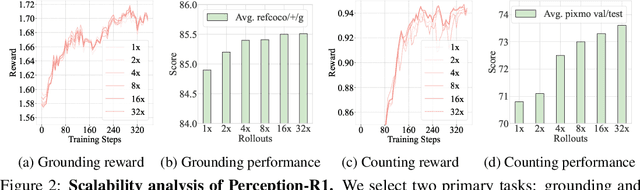
Inspired by the success of DeepSeek-R1, we explore the potential of rule-based reinforcement learning (RL) in MLLM post-training for perception policy learning. While promising, our initial experiments reveal that incorporating a thinking process through RL does not consistently lead to performance gains across all visual perception tasks. This leads us to delve into the essential role of RL in the context of visual perception. In this work, we return to the fundamentals and explore the effects of RL on different perception tasks. We observe that the perceptual complexity is a major factor in determining the effectiveness of RL. We also observe that reward design plays a crucial role in further approching the upper limit of model perception. To leverage these findings, we propose Perception-R1, a scalable RL framework using GRPO during MLLM post-training. With a standard Qwen2.5-VL-3B-Instruct, Perception-R1 achieves +4.2% on RefCOCO+, +17.9% on PixMo-Count, +4.2% on PageOCR, and notably, 31.9% AP on COCO2017 val for the first time, establishing a strong baseline for perception policy learning.