 Add to Chrome
 Add to Firefox
 Add to Edge
AgentOCR: Reimagining Agent History via Optical Self-Compression
Jan 08, 2026
Recent advances in large language models (LLMs) enable agentic systems trained with reinforcement learning (RL) over multi-turn interaction trajectories, but practical deployment is bottlenecked by rapidly growing textual histories that inflate token budgets and memory usage. We introduce AgentOCR, a framework that exploits the superior information density of visual tokens by representing the accumulated observation-action history as a compact rendered image. To make multi-turn rollouts scalable, AgentOCR proposes segment optical caching. By decomposing history into hashable segments and maintaining a visual cache, this mechanism eliminates redundant re-rendering. Beyond fixed rendering, AgentOCR introduces agentic self-compression, where the agent actively emits a compression rate and is trained with compression-aware reward to adaptively balance task success and token efficiency. We conduct extensive experiments on challenging agentic benchmarks, ALFWorld and search-based QA. Remarkably, results demonstrate that AgentOCR preserves over 95\% of text-based agent performance while substantially reducing token consumption (>50\%), yielding consistent token and memory efficiency. Our further analysis validates a 20x rendering speedup from segment optical caching and the effective strategic balancing of self-compression.

CaveAgent: Transforming LLMs into Stateful Runtime Operators
Jan 04, 2026LLM-based agents are increasingly capable of complex task execution, yet current agentic systems remain constrained by text-centric paradigms. Traditional approaches rely on procedural JSON-based function calling, which often struggles with long-horizon tasks due to fragile multi-turn dependencies and context drift. In this paper, we present CaveAgent, a framework that transforms the paradigm from "LLM-as-Text-Generator" to "LLM-as-Runtime-Operator." We introduce a Dual-stream Context Architecture that decouples state management into a lightweight semantic stream for reasoning and a persistent, deterministic Python Runtime stream for execution. In addition to leveraging code generation to efficiently resolve interdependent sub-tasks (e.g., loops, conditionals) in a single step, we introduce \textit{Stateful Runtime Management} in CaveAgent. Distinct from existing code-based approaches that remain text-bound and lack the support for external object injection and retrieval, CaveAgent injects, manipulates, and retrieves complex Python objects (e.g., DataFrames, database connections) that persist across turns. This persistence mechanism acts as a high-fidelity external memory to eliminate context drift, avoid catastrophic forgetting, while ensuring that processed data flows losslessly to downstream applications. Comprehensive evaluations on Tau$^2$-bench, BFCL and various case studies across representative SOTA LLMs demonstrate CaveAgent's superiority. Specifically, our framework achieves a 10.5\% success rate improvement on retail tasks and reduces total token consumption by 28.4\% in multi-turn scenarios. On data-intensive tasks, direct variable storage and retrieval reduces token consumption by 59\%, allowing CaveAgent to handle large-scale data that causes context overflow failures in both JSON-based and Code-based agents.
Revisiting Sparsity Constraint Under High-Rank Property in Partial Multi-Label Learning
May 27, 2025Partial Multi-Label Learning (PML) extends the multi-label learning paradigm to scenarios where each sample is associated with a candidate label set containing both ground-truth labels and noisy labels. Existing PML methods commonly rely on two assumptions: sparsity of the noise label matrix and low-rankness of the ground-truth label matrix. However, these assumptions are inherently conflicting and impractical for real-world scenarios, where the true label matrix is typically full-rank or close to full-rank. To address these limitations, we demonstrate that the sparsity constraint contributes to the high-rank property of the predicted label matrix. Based on this, we propose a novel method Schirn, which introduces a sparsity constraint on the noise label matrix while enforcing a high-rank property on the predicted label matrix. Extensive experiments demonstrate the superior performance of Schirn compared to state-of-the-art methods, validating its effectiveness in tackling real-world PML challenges.
Why Can Accurate Models Be Learned from Inaccurate Annotations?
May 22, 2025Learning from inaccurate annotations has gained significant attention due to the high cost of precise labeling. However, despite the presence of erroneous labels, models trained on noisy data often retain the ability to make accurate predictions. This intriguing phenomenon raises a fundamental yet largely unexplored question: why models can still extract correct label information from inaccurate annotations remains unexplored. In this paper, we conduct a comprehensive investigation into this issue. By analyzing weight matrices from both empirical and theoretical perspectives, we find that label inaccuracy primarily accumulates noise in lower singular components and subtly perturbs the principal subspace. Within a certain range, the principal subspaces of weights trained on inaccurate labels remain largely aligned with those learned from clean labels, preserving essential task-relevant information. We formally prove that the angles of principal subspaces exhibit minimal deviation under moderate label inaccuracy, explaining why models can still generalize effectively. Building on these insights, we propose LIP, a lightweight plug-in designed to help classifiers retain principal subspace information while mitigating noise induced by label inaccuracy. Extensive experiments on tasks with various inaccuracy conditions demonstrate that LIP consistently enhances the performance of existing algorithms. We hope our findings can offer valuable theoretical and practical insights to understand of model robustness under inaccurate supervision.
Partial Label Clustering
May 06, 2025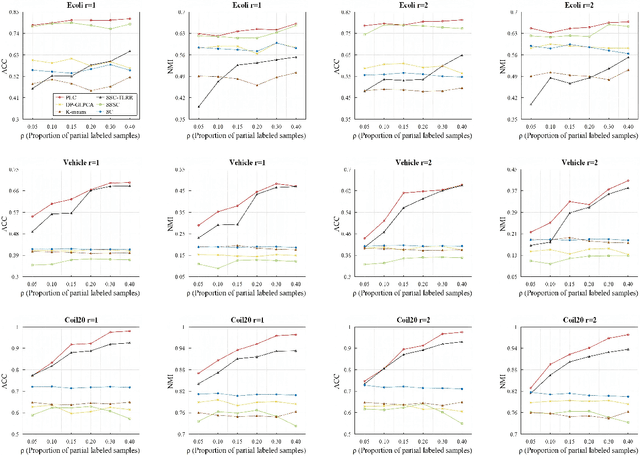
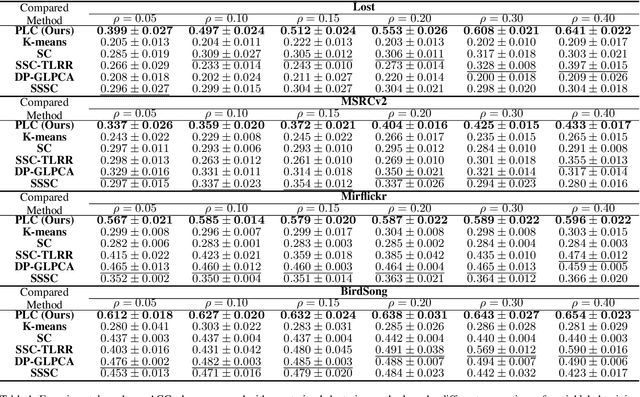
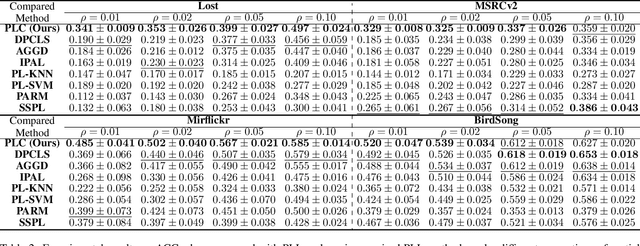
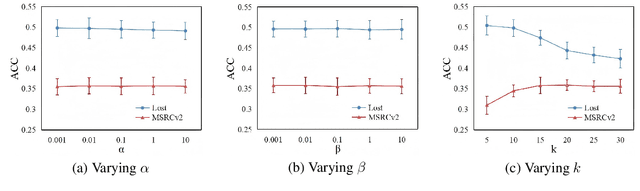
Partial label learning (PLL) is a significant weakly supervised learning framework, where each training example corresponds to a set of candidate labels and only one label is the ground-truth label. For the first time, this paper investigates the partial label clustering problem, which takes advantage of the limited available partial labels to improve the clustering performance. Specifically, we first construct a weight matrix of examples based on their relationships in the feature space and disambiguate the candidate labels to estimate the ground-truth label based on the weight matrix. Then, we construct a set of must-link and cannot-link constraints based on the disambiguation results. Moreover, we propagate the initial must-link and cannot-link constraints based on an adversarial prior promoted dual-graph learning approach. Finally, we integrate weight matrix construction, label disambiguation, and pairwise constraints propagation into a joint model to achieve mutual enhancement. We also theoretically prove that a better disambiguated label matrix can help improve clustering performance. Comprehensive experiments demonstrate our method realizes superior performance when comparing with state-of-the-art constrained clustering methods, and outperforms PLL and semi-supervised PLL methods when only limited samples are annotated. The code is publicly available at https://github.com/xyt-ml/PLC.
Mixed Blessing: Class-Wise Embedding guided Instance-Dependent Partial Label Learning
Dec 06, 2024In partial label learning (PLL), every sample is associated with a candidate label set comprising the ground-truth label and several noisy labels. The conventional PLL assumes the noisy labels are randomly generated (instance-independent), while in practical scenarios, the noisy labels are always instance-dependent and are highly related to the sample features, leading to the instance-dependent partial label learning (IDPLL) problem. Instance-dependent noisy label is a double-edged sword. On one side, it may promote model training as the noisy labels can depict the sample to some extent. On the other side, it brings high label ambiguity as the noisy labels are quite undistinguishable from the ground-truth label. To leverage the nuances of IDPLL effectively, for the first time we create class-wise embeddings for each sample, which allow us to explore the relationship of instance-dependent noisy labels, i.e., the class-wise embeddings in the candidate label set should have high similarity, while the class-wise embeddings between the candidate label set and the non-candidate label set should have high dissimilarity. Moreover, to reduce the high label ambiguity, we introduce the concept of class prototypes containing global feature information to disambiguate the candidate label set. Extensive experimental comparisons with twelve methods on six benchmark data sets, including four fine-grained data sets, demonstrate the effectiveness of the proposed method. The code implementation is publicly available at https://github.com/Yangfc-ML/CEL.