 Add to Chrome
 Add to Firefox
 Add to Edge
Spatial4D-Bench: A Versatile 4D Spatial Intelligence Benchmark
Dec 31, 2025
4D spatial intelligence involves perceiving and processing how objects move or change over time. Humans naturally possess 4D spatial intelligence, supporting a broad spectrum of spatial reasoning abilities. To what extent can Multimodal Large Language Models (MLLMs) achieve human-level 4D spatial intelligence? In this work, we present Spatial4D-Bench, a versatile 4D spatial intelligence benchmark designed to comprehensively assess the 4D spatial reasoning abilities of MLLMs. Unlike existing spatial intelligence benchmarks that are often small-scale or limited in diversity, Spatial4D-Bench provides a large-scale, multi-task evaluation benchmark consisting of ~40,000 question-answer pairs covering 18 well-defined tasks. We systematically organize these tasks into six cognitive categories: object understanding, scene understanding, spatial relationship understanding, spatiotemporal relationship understanding, spatial reasoning and spatiotemporal reasoning. Spatial4D-Bench thereby offers a structured and comprehensive benchmark for evaluating the spatial cognition abilities of MLLMs, covering a broad spectrum of tasks that parallel the versatility of human spatial intelligence. We benchmark various state-of-the-art open-source and proprietary MLLMs on Spatial4D-Bench and reveal their substantial limitations in a wide variety of 4D spatial reasoning aspects, such as route plan, action recognition, and physical plausibility reasoning. We hope that the findings provided in this work offer valuable insights to the community and that our benchmark can facilitate the development of more capable MLLMs toward human-level 4D spatial intelligence. More resources can be found on our project page.

HybridPoint: Point Cloud Registration Based on Hybrid Point Sampling and Matching
Apr 23, 2023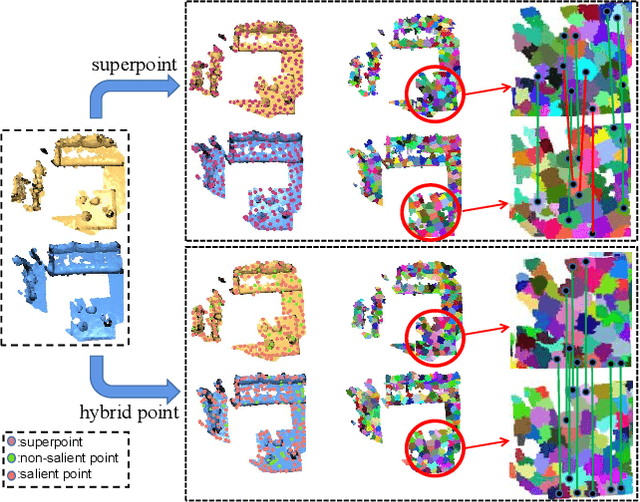
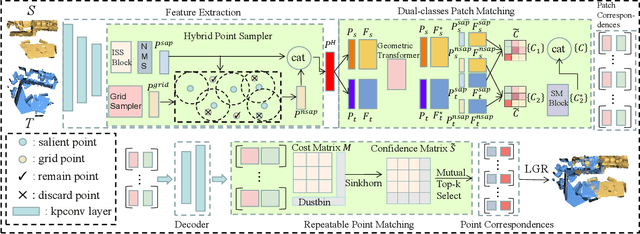
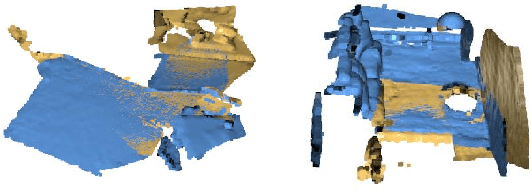
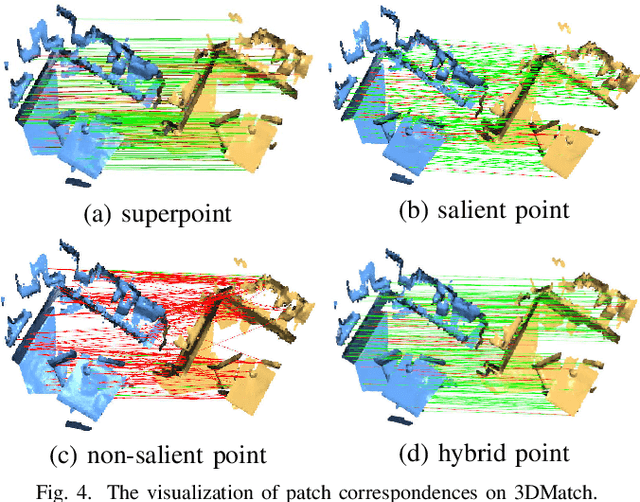
Patch-to-point matching has become a robust way of point cloud registration. However, previous patch-matching methods employ superpoints with poor localization precision as nodes, which may lead to ambiguous patch partitions. In this paper, we propose a HybridPoint-based network to find more robust and accurate correspondences. Firstly, we propose to use salient points with prominent local features as nodes to increase patch repeatability, and introduce some uniformly distributed points to complete the point cloud, thus constituting hybrid points. Hybrid points not only have better localization precision but also give a complete picture of the whole point cloud. Furthermore, based on the characteristic of hybrid points, we propose a dual-classes patch matching module, which leverages the matching results of salient points and filters the matching noise of non-salient points. Experiments show that our model achieves state-of-the-art performance on 3DMatch, 3DLoMatch, and KITTI odometry, especially with 93.0% Registration Recall on the 3DMatch dataset. Our code and models are available at https://github.com/liyih/HybridPoint.