 Add to Chrome
 Add to Firefox
 Add to Edge
VISTA-Bench: Do Vision-Language Models Really Understand Visualized Text as Well as Pure Text?
Feb 04, 2026
Vision-Language Models (VLMs) have achieved impressive performance in cross-modal understanding across textual and visual inputs, yet existing benchmarks predominantly focus on pure-text queries. In real-world scenarios, language also frequently appears as visualized text embedded in images, raising the question of whether current VLMs handle such input requests comparably. We introduce VISTA-Bench, a systematic benchmark from multimodal perception, reasoning, to unimodal understanding domains. It evaluates visualized text understanding by contrasting pure-text and visualized-text questions under controlled rendering conditions. Extensive evaluation of over 20 representative VLMs reveals a pronounced modality gap: models that perform well on pure-text queries often degrade substantially when equivalent semantic content is presented as visualized text. This gap is further amplified by increased perceptual difficulty, highlighting sensitivity to rendering variations despite unchanged semantics. Overall, VISTA-Bench provides a principled evaluation framework to diagnose this limitation and to guide progress toward more unified language representations across tokenized text and pixels. The source dataset is available at https://github.com/QingAnLiu/VISTA-Bench.

Quantum-enhanced long short-term memory with attention for spatial permeability prediction in oilfield reservoirs
Jan 08, 2026Spatial prediction of reservoir parameters, especially permeability, is crucial for oil and gas exploration and development. However, the wide range and high variability of permeability prevent existing methods from providing reliable predictions. For the first time in subsurface spatial prediction, this study presents a quantum-enhanced long short-term memory with attention (QLSTMA) model that incorporates variational quantum circuits (VQCs) into the recurrent cell. Using quantum entanglement and superposition principles, the QLSTMA significantly improves the ability to predict complex geological parameters such as permeability. Two quantization structures, QLSTMA with Shared Gates (QLSTMA-SG) and with Independent Gates (QLSTMA-IG), are designed to investigate and evaluate the effects of quantum structure configurations and the number of qubits on model performance. Experimental results demonstrate that the 8-qubit QLSTMA-IG model significantly outperforms the traditional long short-term memory with attention (LSTMA), reducing Mean Absolute Error (MAE) by 19% and Root Mean Squared Error (RMSE) by 20%, with particularly strong performance in regions featuring complex well-logging data. These findings validate the potential of quantum-classical hybrid neural networks for reservoir prediction, indicating that increasing the number of qubits yields further accuracy gains despite the reliance on classical simulations. This study establishes a foundational framework for the eventual deployment of such models on real quantum hardware and their extension to broader applications in petroleum engineering and geoscience.
* Published in Engineering Applications of Artificial Intelligence. DOI: https://doi.org/10.1016/j.engappai.2025.113605
An Outline of Prognostics and Health Management Large Model: Concepts, Paradigms, and Challenges
Jul 01, 2024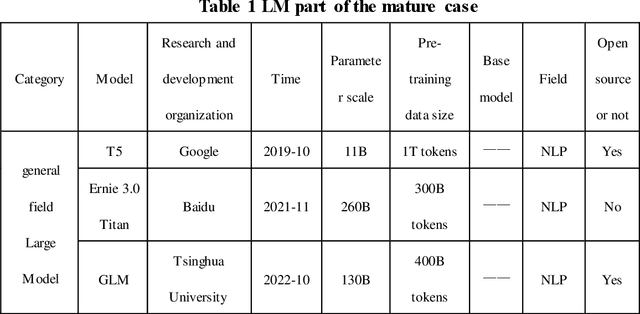
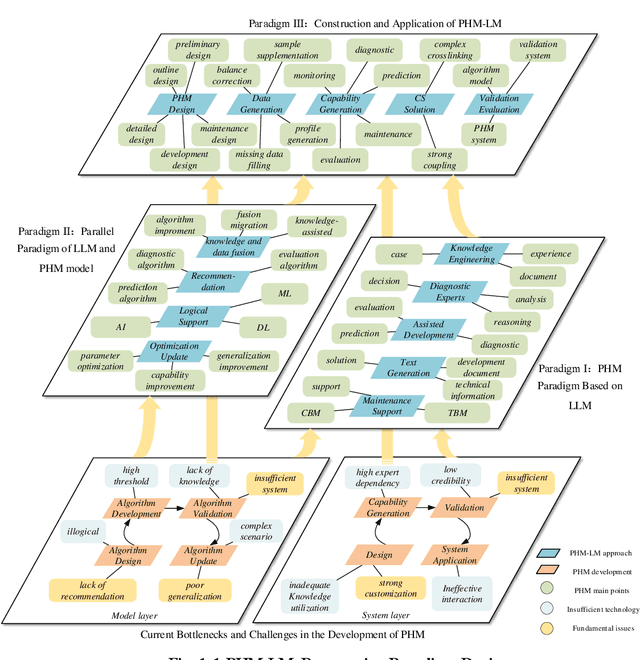
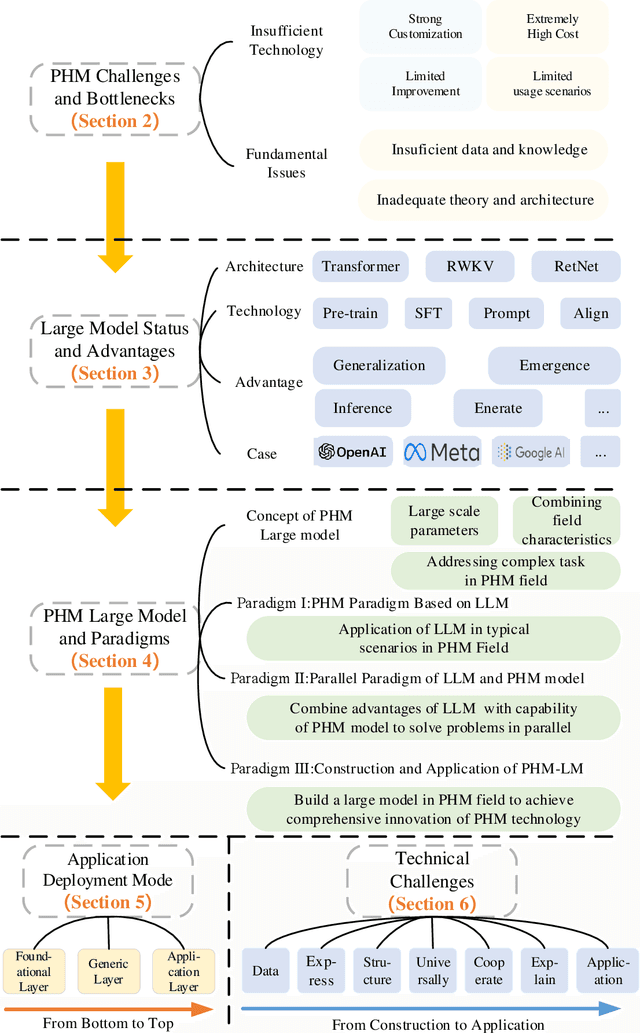
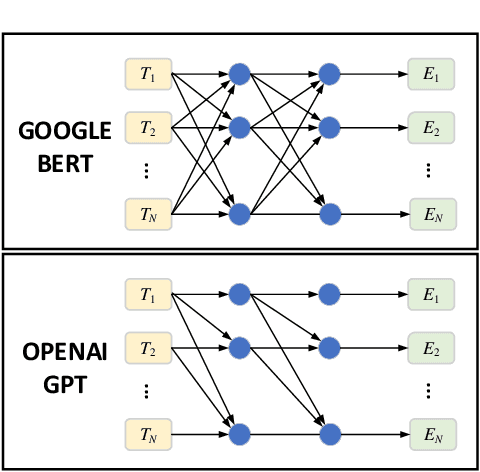
Prognosis and Health Management (PHM), critical for ensuring task completion by complex systems and preventing unexpected failures, is widely adopted in aerospace, manufacturing, maritime, rail, energy, etc. However, PHM's development is constrained by bottlenecks like generalization, interpretation and verification abilities. Presently, generative artificial intelligence (AI), represented by Large Model, heralds a technological revolution with the potential to fundamentally reshape traditional technological fields and human production methods. Its capabilities, including strong generalization, reasoning, and generative attributes, present opportunities to address PHM's bottlenecks. To this end, based on a systematic analysis of the current challenges and bottlenecks in PHM, as well as the research status and advantages of Large Model, we propose a novel concept and three progressive paradigms of Prognosis and Health Management Large Model (PHM-LM) through the integration of the Large Model with PHM. Subsequently, we provide feasible technical approaches for PHM-LM to bolster PHM's core capabilities within the framework of the three paradigms. Moreover, to address core issues confronting PHM, we discuss a series of technical challenges of PHM-LM throughout the entire process of construction and application. This comprehensive effort offers a holistic PHM-LM technical framework, and provides avenues for new PHM technologies, methodologies, tools, platforms and applications, which also potentially innovates design, research & development, verification and application mode of PHM. And furthermore, a new generation of PHM with AI will also capably be realized, i.e., from custom to generalized, from discriminative to generative, and from theoretical conditions to practical applications.
Detecting Mitosis against Domain Shift using a Fused Detector and Deep Ensemble Classification Model for MIDOG Challenge
Aug 31, 2021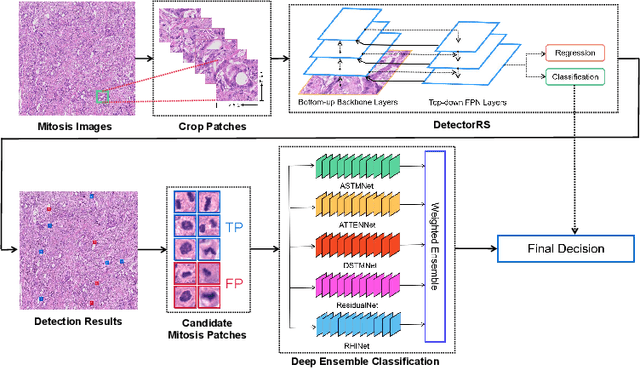
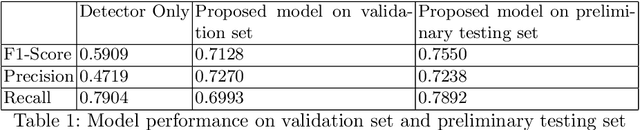
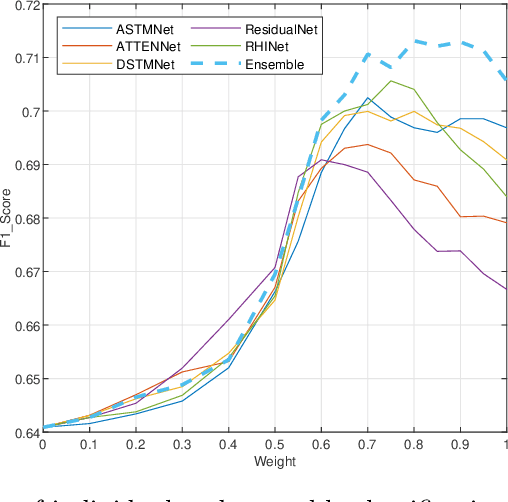
Mitotic figure count is an important marker of tumor proliferation and has been shown to be associated with patients' prognosis. Deep learning based mitotic figure detection methods have been utilized to automatically locate the cell in mitosis using hematoxylin \& eosin (H\&E) stained images. However, the model performance deteriorates due to the large variation of color tone and intensity in H\&E images. In this work, we proposed a two stage mitotic figure detection framework by fusing a detector and a deep ensemble classification model. To alleviate the impact of color variation in H\&E images, we utilize both stain normalization and data augmentation, aiding model to learn color irrelevant features. The proposed model obtains an F1 score of 0.7550 on the preliminary testing set released by the MIDOG challenge.