 Add to Chrome
 Add to Firefox
 Add to Edge
LongCat-Flash-Thinking-2601 Technical Report
Jan 23, 2026
We introduce LongCat-Flash-Thinking-2601, a 560-billion-parameter open-source Mixture-of-Experts (MoE) reasoning model with superior agentic reasoning capability. LongCat-Flash-Thinking-2601 achieves state-of-the-art performance among open-source models on a wide range of agentic benchmarks, including agentic search, agentic tool use, and tool-integrated reasoning. Beyond benchmark performance, the model demonstrates strong generalization to complex tool interactions and robust behavior under noisy real-world environments. Its advanced capability stems from a unified training framework that combines domain-parallel expert training with subsequent fusion, together with an end-to-end co-design of data construction, environments, algorithms, and infrastructure spanning from pre-training to post-training. In particular, the model's strong generalization capability in complex tool-use are driven by our in-depth exploration of environment scaling and principled task construction. To optimize long-tailed, skewed generation and multi-turn agentic interactions, and to enable stable training across over 10,000 environments spanning more than 20 domains, we systematically extend our asynchronous reinforcement learning framework, DORA, for stable and efficient large-scale multi-environment training. Furthermore, recognizing that real-world tasks are inherently noisy, we conduct a systematic analysis and decomposition of real-world noise patterns, and design targeted training procedures to explicitly incorporate such imperfections into the training process, resulting in improved robustness for real-world applications. To further enhance performance on complex reasoning tasks, we introduce a Heavy Thinking mode that enables effective test-time scaling by jointly expanding reasoning depth and width through intensive parallel thinking.

StrucTexT: Structured Text Understanding with Multi-Modal Transformers
Aug 10, 2021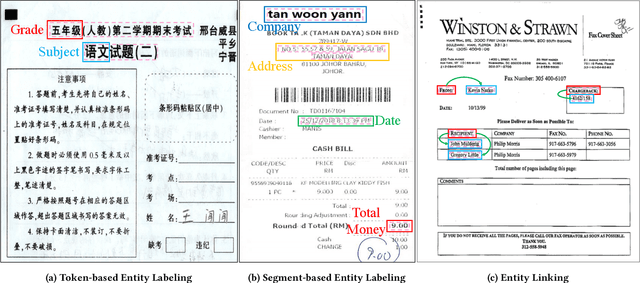
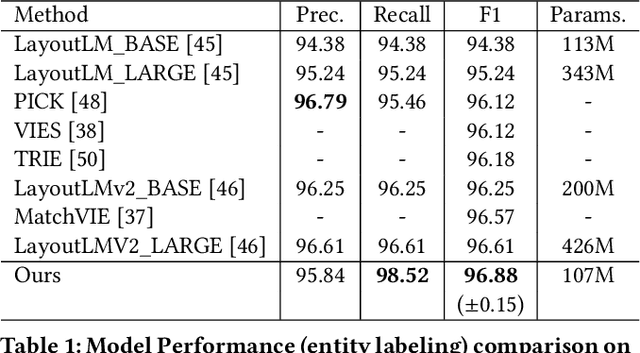
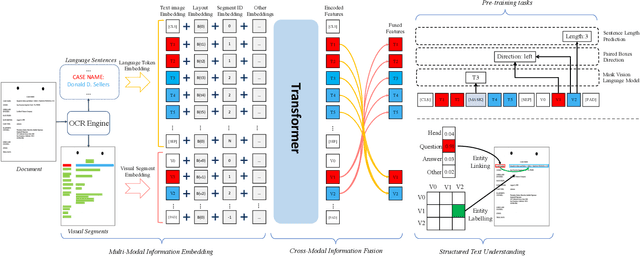
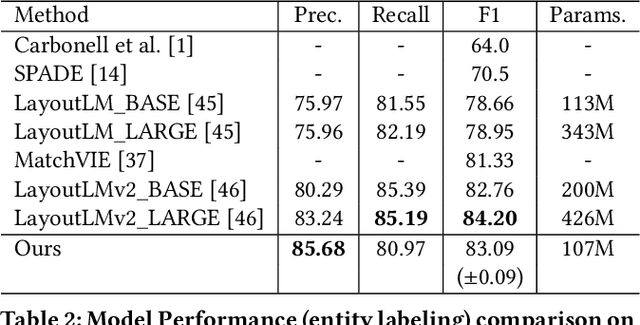
Structured text understanding on Visually Rich Documents (VRDs) is a crucial part of Document Intelligence. Due to the complexity of content and layout in VRDs, structured text understanding has been a challenging task. Most existing studies decoupled this problem into two sub-tasks: entity labeling and entity linking, which require an entire understanding of the context of documents at both token and segment levels. However, little work has been concerned with the solutions that efficiently extract the structured data from different levels. This paper proposes a unified framework named StrucTexT, which is flexible and effective for handling both sub-tasks. Specifically, based on the transformer, we introduce a segment-token aligned encoder to deal with the entity labeling and entity linking tasks at different levels of granularity. Moreover, we design a novel pre-training strategy with three self-supervised tasks to learn a richer representation. StrucTexT uses the existing Masked Visual Language Modeling task and the new Sentence Length Prediction and Paired Boxes Direction tasks to incorporate the multi-modal information across text, image, and layout. We evaluate our method for structured text understanding at segment-level and token-level and show it outperforms the state-of-the-art counterparts with significantly superior performance on the FUNSD, SROIE, and EPHOIE datasets.