 Add to Chrome
 Add to Firefox
 Add to Edge
HY-Motion 1.0: Scaling Flow Matching Models for Text-To-Motion Generation
Dec 29, 2025
We present HY-Motion 1.0, a series of state-of-the-art, large-scale, motion generation models capable of generating 3D human motions from textual descriptions. HY-Motion 1.0 represents the first successful attempt to scale up Diffusion Transformer (DiT)-based flow matching models to the billion-parameter scale within the motion generation domain, delivering instruction-following capabilities that significantly outperform current open-source benchmarks. Uniquely, we introduce a comprehensive, full-stage training paradigm -- including large-scale pretraining on over 3,000 hours of motion data, high-quality fine-tuning on 400 hours of curated data, and reinforcement learning from both human feedback and reward models -- to ensure precise alignment with the text instruction and high motion quality. This framework is supported by our meticulous data processing pipeline, which performs rigorous motion cleaning and captioning. Consequently, our model achieves the most extensive coverage, spanning over 200 motion categories across 6 major classes. We release HY-Motion 1.0 to the open-source community to foster future research and accelerate the transition of 3D human motion generation models towards commercial maturity.

DriveDreamer4D: World Models Are Effective Data Machines for 4D Driving Scene Representation
Oct 17, 2024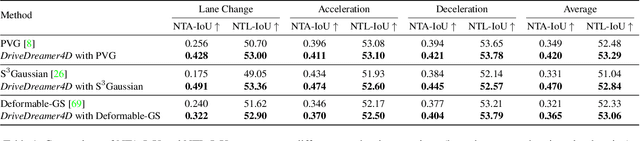
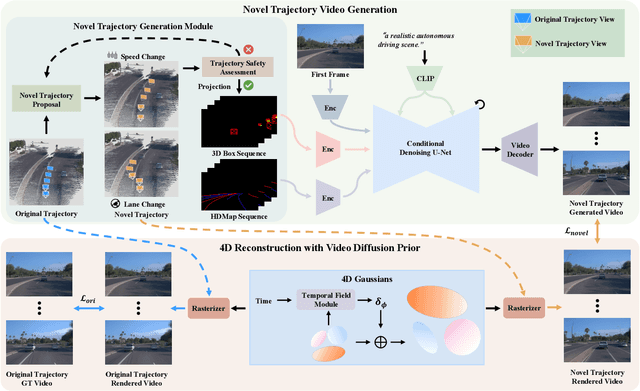
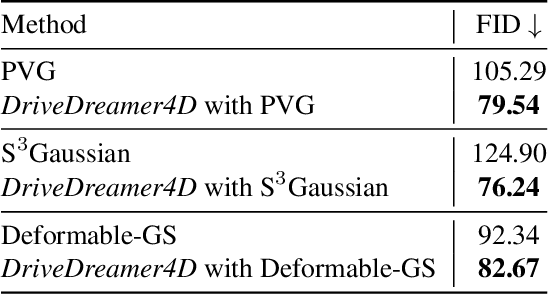
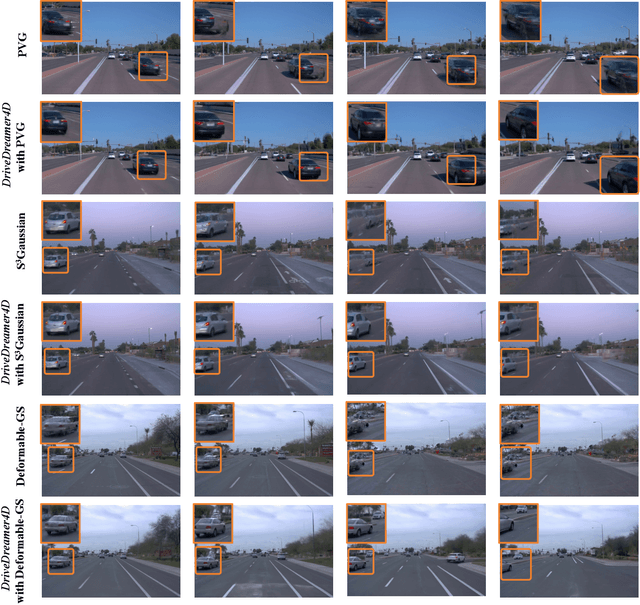
Closed-loop simulation is essential for advancing end-to-end autonomous driving systems. Contemporary sensor simulation methods, such as NeRF and 3DGS, rely predominantly on conditions closely aligned with training data distributions, which are largely confined to forward-driving scenarios. Consequently, these methods face limitations when rendering complex maneuvers (e.g., lane change, acceleration, deceleration). Recent advancements in autonomous-driving world models have demonstrated the potential to generate diverse driving videos. However, these approaches remain constrained to 2D video generation, inherently lacking the spatiotemporal coherence required to capture intricacies of dynamic driving environments. In this paper, we introduce \textit{DriveDreamer4D}, which enhances 4D driving scene representation leveraging world model priors. Specifically, we utilize the world model as a data machine to synthesize novel trajectory videos based on real-world driving data. Notably, we explicitly leverage structured conditions to control the spatial-temporal consistency of foreground and background elements, thus the generated data adheres closely to traffic constraints. To our knowledge, \textit{DriveDreamer4D} is the first to utilize video generation models for improving 4D reconstruction in driving scenarios. Experimental results reveal that \textit{DriveDreamer4D} significantly enhances generation quality under novel trajectory views, achieving a relative improvement in FID by 24.5\%, 39.0\%, and 10.5\% compared to PVG, $\text{S}^3$Gaussian, and Deformable-GS. Moreover, \textit{DriveDreamer4D} markedly enhances the spatiotemporal coherence of driving agents, which is verified by a comprehensive user study and the relative increases of 20.3\%, 42.0\%, and 13.7\% in the NTA-IoU metric.