 Add to Chrome
 Add to Firefox
 Add to Edge
FactNet: A Billion-Scale Knowledge Graph for Multilingual Factual Grounding
Feb 03, 2026
While LLMs exhibit remarkable fluency, their utility is often compromised by factual hallucinations and a lack of traceable provenance. Existing resources for grounding mitigate this but typically enforce a dichotomy: they offer either structured knowledge without textual context (e.g., knowledge bases) or grounded text with limited scale and linguistic coverage. To bridge this gap, we introduce FactNet, a massive, open-source resource designed to unify 1.7 billion atomic assertions with 3.01 billion auditable evidence pointers derived exclusively from 316 Wikipedia editions. Unlike recent synthetic approaches, FactNet employs a strictly deterministic construction pipeline, ensuring that every evidence unit is recoverable with byte-level precision. Extensive auditing confirms a high grounding precision of 92.1%, even in long-tail languages. Furthermore, we establish FactNet-Bench, a comprehensive evaluation suite for Knowledge Graph Completion, Question Answering, and Fact Checking. FactNet provides the community with a foundational, reproducible resource for training and evaluating trustworthy, verifiable multilingual systems.

MiniCPM4: Ultra-Efficient LLMs on End Devices
Jun 09, 2025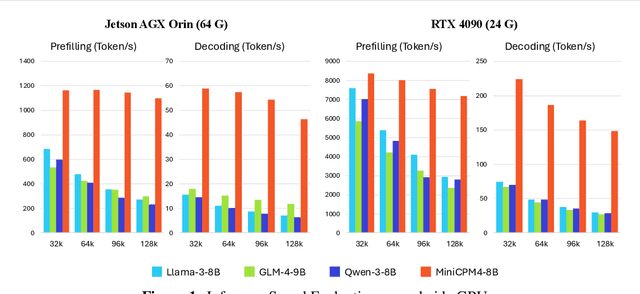

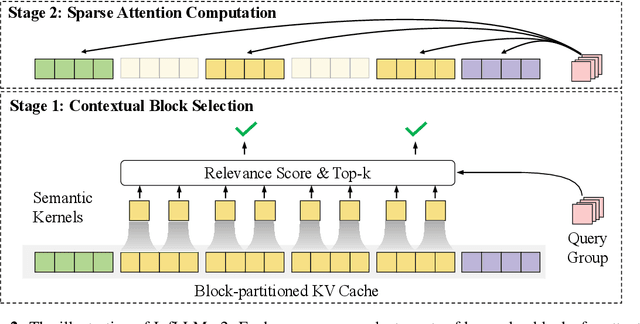
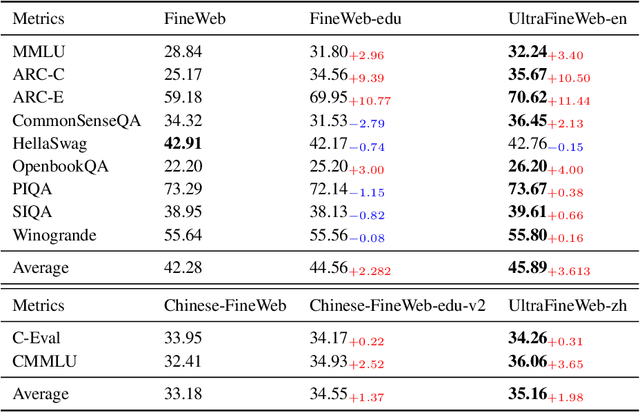
This paper introduces MiniCPM4, a highly efficient large language model (LLM) designed explicitly for end-side devices. We achieve this efficiency through systematic innovation in four key dimensions: model architecture, training data, training algorithms, and inference systems. Specifically, in terms of model architecture, we propose InfLLM v2, a trainable sparse attention mechanism that accelerates both prefilling and decoding phases for long-context processing. Regarding training data, we propose UltraClean, an efficient and accurate pre-training data filtering and generation strategy, and UltraChat v2, a comprehensive supervised fine-tuning dataset. These datasets enable satisfactory model performance to be achieved using just 8 trillion training tokens. Regarding training algorithms, we propose ModelTunnel v2 for efficient pre-training strategy search, and improve existing post-training methods by introducing chunk-wise rollout for load-balanced reinforcement learning and data-efficient tenary LLM, BitCPM. Regarding inference systems, we propose CPM.cu that integrates sparse attention, model quantization, and speculative sampling to achieve efficient prefilling and decoding. To meet diverse on-device requirements, MiniCPM4 is available in two versions, with 0.5B and 8B parameters, respectively. Sufficient evaluation results show that MiniCPM4 outperforms open-source models of similar size across multiple benchmarks, highlighting both its efficiency and effectiveness. Notably, MiniCPM4-8B demonstrates significant speed improvements over Qwen3-8B when processing long sequences. Through further adaptation, MiniCPM4 successfully powers diverse applications, including trustworthy survey generation and tool use with model context protocol, clearly showcasing its broad usability.
DCAD-2000: A Multilingual Dataset across 2000+ Languages with Data Cleaning as Anomaly Detection
Feb 17, 2025The rapid development of multilingual large language models (LLMs) highlights the need for high-quality, diverse, and clean multilingual datasets. In this paper, we introduce DCAD-2000 (Data Cleaning as Anomaly Detection), a large-scale multilingual corpus built using newly extracted Common Crawl data and existing multilingual datasets. DCAD-2000 includes over 2,282 languages, 46.72TB of data, and 8.63 billion documents, spanning 155 high- and medium-resource languages and 159 writing scripts. To overcome the limitations of current data cleaning methods, which rely on manual heuristic thresholds, we propose reframing data cleaning as an anomaly detection task. This dynamic filtering approach significantly enhances data quality by identifying and removing noisy or anomalous content. We evaluate the quality of DCAD-2000 on the FineTask benchmark, demonstrating substantial improvements in multilingual dataset quality and task performance.