 Add to Chrome
 Add to Firefox
 Add to Edge
Climber-Pilot: A Non-Myopic Generative Recommendation Model Towards Better Instruction-Following
Feb 14, 2026
Generative retrieval has emerged as a promising paradigm in recommender systems, offering superior sequence modeling capabilities over traditional dual-tower architectures. However, in large-scale industrial scenarios, such models often suffer from inherent myopia: due to single-step inference and strict latency constraints, they tend to collapse diverse user intents into locally optimal predictions, failing to capture long-horizon and multi-item consumption patterns. Moreover, real-world retrieval systems must follow explicit retrieval instructions, such as category-level control and policy constraints. Incorporating such instruction-following behavior into generative retrieval remains challenging, as existing conditioning or post-hoc filtering approaches often compromise relevance or efficiency. In this work, we present Climber-Pilot, a unified generative retrieval framework to address both limitations. First, we introduce Time-Aware Multi-Item Prediction (TAMIP), a novel training paradigm designed to mitigate inherent myopia in generative retrieval. By distilling long-horizon, multi-item foresight into model parameters through time-aware masking, TAMIP alleviates locally optimal predictions while preserving efficient single-step inference. Second, to support flexible instruction-following retrieval, we propose Condition-Guided Sparse Attention (CGSA), which incorporates business constraints directly into the generative process via sparse attention, without introducing additional inference steps. Extensive offline experiments and online A/B testing at NetEase Cloud Music, one of the largest music streaming platforms, demonstrate that Climber-Pilot significantly outperforms state-of-the-art baselines, achieving a 4.24\% lift of the core business metric.

Towards Scalable Semantic Representation for Recommendation
Oct 12, 2024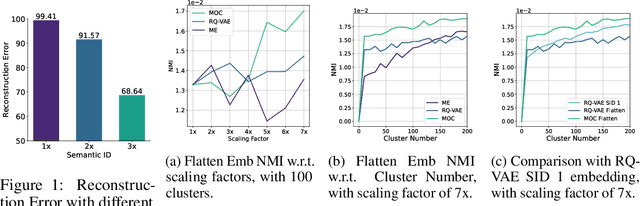
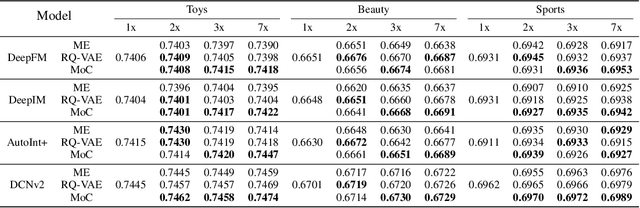
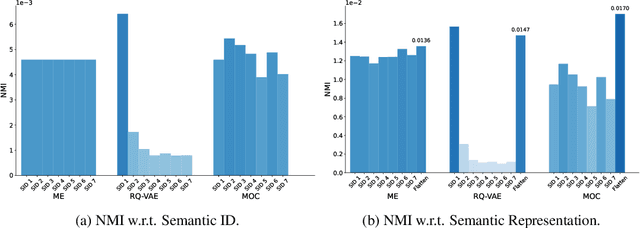
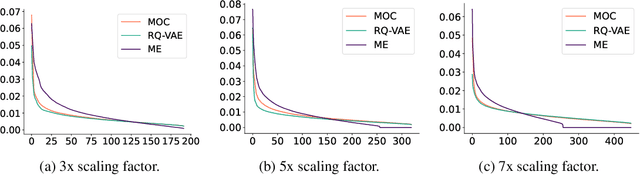
With recent advances in large language models (LLMs), there has been emerging numbers of research in developing Semantic IDs based on LLMs to enhance the performance of recommendation systems. However, the dimension of these embeddings needs to match that of the ID embedding in recommendation, which is usually much smaller than the original length. Such dimension compression results in inevitable losses in discriminability and dimension robustness of the LLM embeddings, which motivates us to scale up the semantic representation. In this paper, we propose Mixture-of-Codes, which first constructs multiple independent codebooks for LLM representation in the indexing stage, and then utilizes the Semantic Representation along with a fusion module for the downstream recommendation stage. Extensive analysis and experiments demonstrate that our method achieves superior discriminability and dimension robustness scalability, leading to the best scale-up performance in recommendations.