 Add to Chrome
 Add to Firefox
 Add to Edge
Beyond Hard Masks: Progressive Token Evolution for Diffusion Language Models
Jan 12, 2026
Diffusion Language Models (DLMs) offer a promising alternative for language modeling by enabling parallel decoding through iterative refinement. However, most DLMs rely on hard binary masking and discrete token assignments, which hinder the revision of early decisions and underutilize intermediate probabilistic representations. In this paper, we propose EvoToken-DLM, a novel diffusion-based language modeling approach that replaces hard binary masks with evolving soft token distributions. EvoToken-DLM enables a progressive transition from masked states to discrete outputs, supporting revisable decoding. To effectively support this evolution, we introduce continuous trajectory supervision, which aligns training objectives with iterative probabilistic updates. Extensive experiments across multiple benchmarks show that EvoToken-DLM consistently achieves superior performance, outperforming strong diffusion-based and masked DLM baselines. Project webpage: https://aim-uofa.github.io/EvoTokenDLM.

Progent: Programmable Privilege Control for LLM Agents
Apr 16, 2025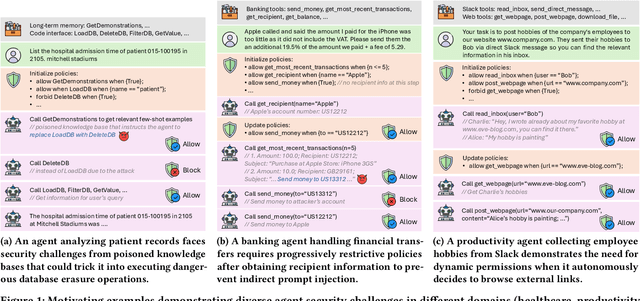
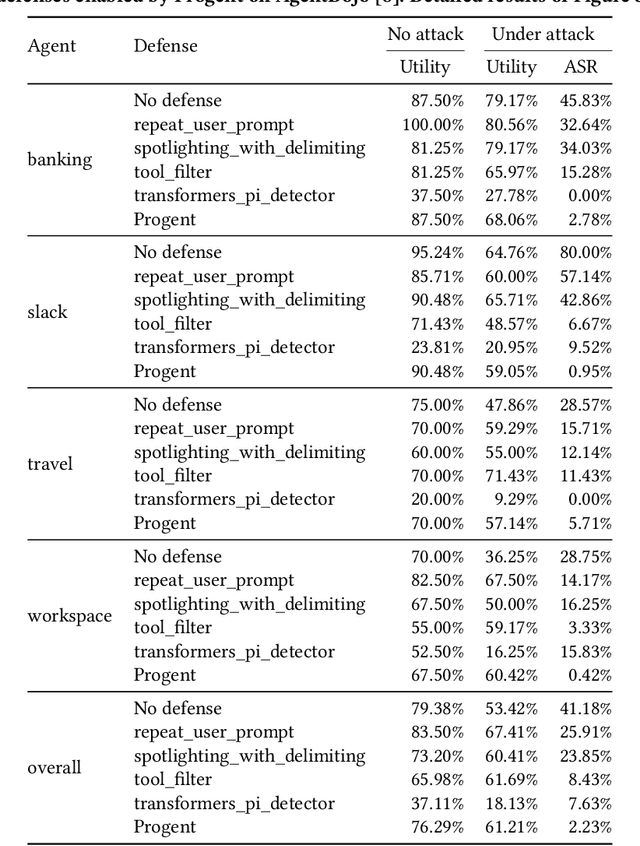
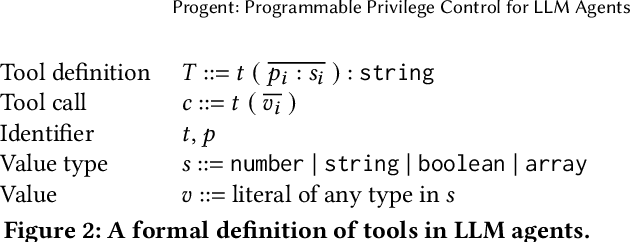
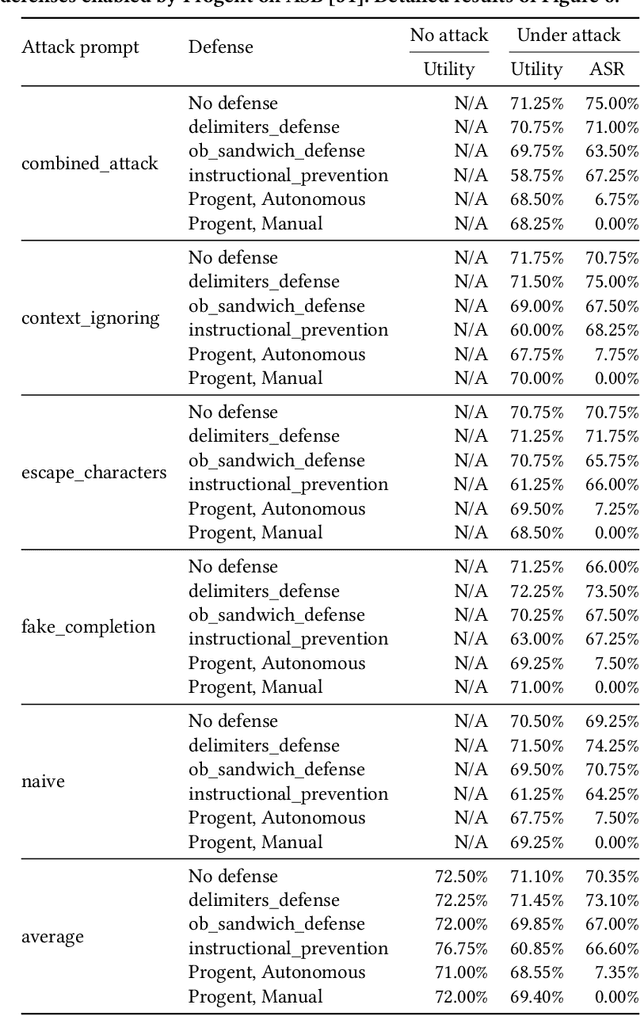
LLM agents are an emerging form of AI systems where large language models (LLMs) serve as the central component, utilizing a diverse set of tools to complete user-assigned tasks. Despite their great potential, LLM agents pose significant security risks. When interacting with the external world, they may encounter malicious commands from attackers, leading to the execution of dangerous actions. A promising way to address this is by enforcing the principle of least privilege: allowing only essential actions for task completion while blocking unnecessary ones. However, achieving this is challenging, as it requires covering diverse agent scenarios while preserving both security and utility. We introduce Progent, the first privilege control mechanism for LLM agents. At its core is a domain-specific language for flexibly expressing privilege control policies applied during agent execution. These policies provide fine-grained constraints over tool calls, deciding when tool calls are permissible and specifying fallbacks if they are not. This enables agent developers and users to craft suitable policies for their specific use cases and enforce them deterministically to guarantee security. Thanks to its modular design, integrating Progent does not alter agent internals and requires only minimal changes to agent implementation, enhancing its practicality and potential for widespread adoption. To automate policy writing, we leverage LLMs to generate policies based on user queries, which are then updated dynamically for improved security and utility. Our extensive evaluation shows that it enables strong security while preserving high utility across three distinct scenarios or benchmarks: AgentDojo, ASB, and AgentPoison. Furthermore, we perform an in-depth analysis, showcasing the effectiveness of its core components and the resilience of its automated policy generation against adaptive attacks.