 Add to Chrome
 Add to Firefox
 Add to Edge
Generalizable Multimodal Large Language Model Editing via Invariant Trajectory Learning
Jan 30, 2026
Knowledge editing emerges as a crucial technique for efficiently correcting incorrect or outdated knowledge in large language models (LLM). Existing editing methods rely on a rigid mapping from parameter or module modifications to output, which causes the generalization limitation in Multimodal LLM (MLLM). In this paper, we reformulate MLLM editing as an out-of-distribution (OOD) generalization problem, where the goal is to discern semantic shift with factual shift and thus achieve robust editing among diverse cross-modal prompting. The key challenge of this OOD problem lies in identifying invariant causal trajectories that generalize accurately while suppressing spurious correlations. To address it, we propose ODEdit, a plug-and-play invariant learning based framework that optimizes the tripartite OOD risk objective to simultaneously enhance editing reliability, locality, and generality.We further introduce an edit trajectory invariant learning method, which integrates a total variation penalty into the risk minimization objective to stabilize edit trajectories against environmental variations. Theoretical analysis and extensive experiments demonstrate the effectiveness of ODEdit.

FairSort: Learning to Fair Rank for Personalized Recommendations in Two-Sided Platforms
Nov 30, 2024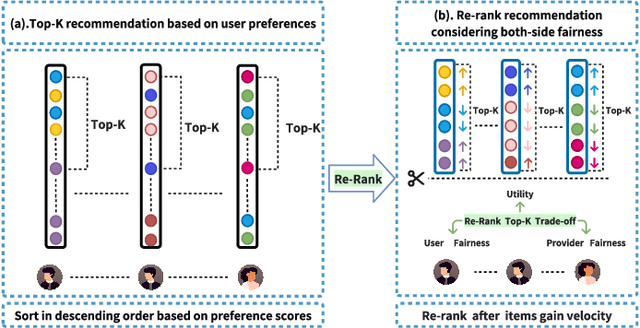
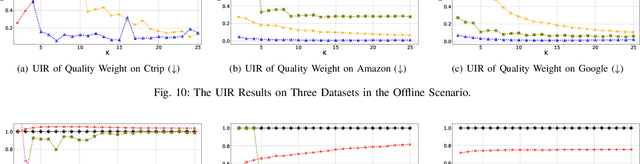
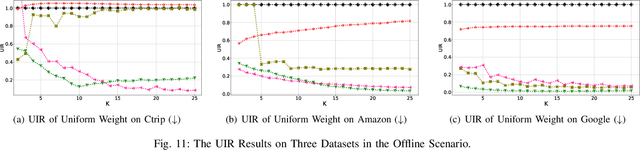
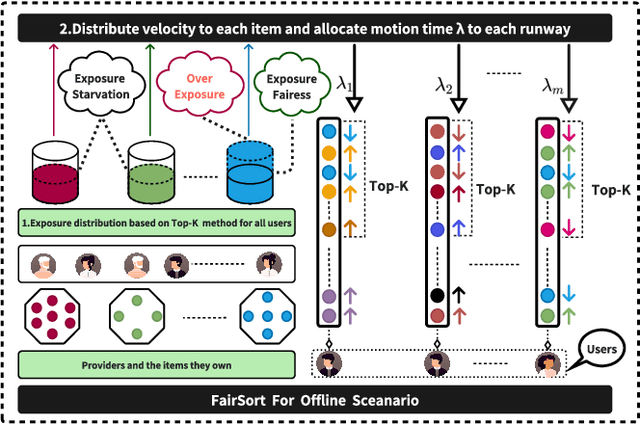
Traditional recommendation systems focus on maximizing user satisfaction by suggesting their favorite items. This user-centric approach may lead to unfair exposure distribution among the providers. On the contrary, a provider-centric design might become unfair to the users. Therefore, this paper proposes a re-ranking model FairSort\footnote{\textbf{Reproducibility:}The code and datasets are available at \url{https://github.com/13543024276/FairSort}} to find a trade-off solution among user-side fairness, provider-side fairness, and personalized recommendations utility. Previous works habitually treat this issue as a knapsack problem, incorporating both-side fairness as constraints. In this paper, we adopt a novel perspective, treating each recommendation list as a runway rather than a knapsack. In this perspective, each item on the runway gains a velocity and runs within a specific time, achieving re-ranking for both-side fairness. Meanwhile, we ensure the Minimum Utility Guarantee for personalized recommendations by designing a Binary Search approach. This can provide more reliable recommendations compared to the conventional greedy strategy based on the knapsack problem. We further broaden the applicability of FairSort, designing two versions for online and offline recommendation scenarios. Theoretical analysis and extensive experiments on real-world datasets indicate that FairSort can ensure more reliable personalized recommendations while considering fairness for both the provider and user.