 Add to Chrome
 Add to Firefox
 Add to Edge
Towards Engineering Scaling Laws with Pretraining Data Composition
Jun 18, 2026
Neural scaling laws describe how model performance improves as a power law in compute, model size, and dataset size. While well-established for large language models, these relationships are emerging for large models in particle physics. As with language, empirical studies show that the performance scales as a power law. However, unlike natural language or image domains, fundamental physics has high-fidelity simulators that produce synthetic data cheaply. This favors scaling regimes where additional data is cheaper than additional parameters, and allows the pretraining dataset itself to be engineered to influence the scaling. For the task of classifying hadronic jets produced in collisions of high-energy particle beams, we show that the scaling behavior can be engineered towards requiring more data rather than larger models by inclusion of pretraining data which is more diverse and better aligned with the downstream classification task.

Terminal-Bench: Benchmarking Agents on Hard, Realistic Tasks in Command Line Interfaces
Jan 17, 2026AI agents may soon become capable of autonomously completing valuable, long-horizon tasks in diverse domains. Current benchmarks either do not measure real-world tasks, or are not sufficiently difficult to meaningfully measure frontier models. To this end, we present Terminal-Bench 2.0: a carefully curated hard benchmark composed of 89 tasks in computer terminal environments inspired by problems from real workflows. Each task features a unique environment, human-written solution, and comprehensive tests for verification. We show that frontier models and agents score less than 65\% on the benchmark and conduct an error analysis to identify areas for model and agent improvement. We publish the dataset and evaluation harness to assist developers and researchers in future work at https://www.tbench.ai/ .
MaskTerial: A Foundation Model for Automated 2D Material Flake Detection
Dec 12, 2024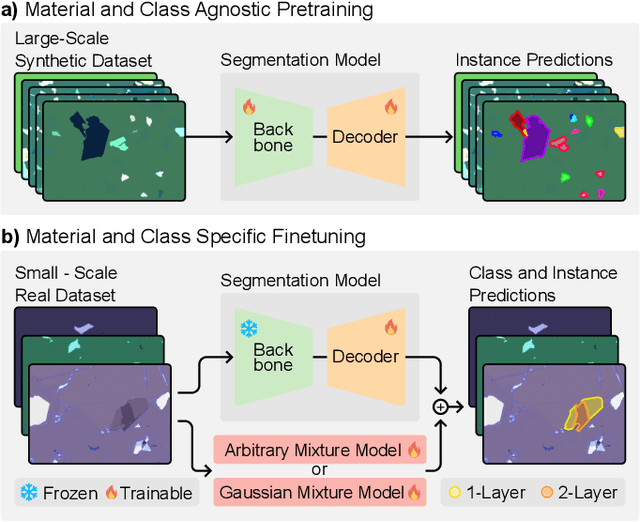
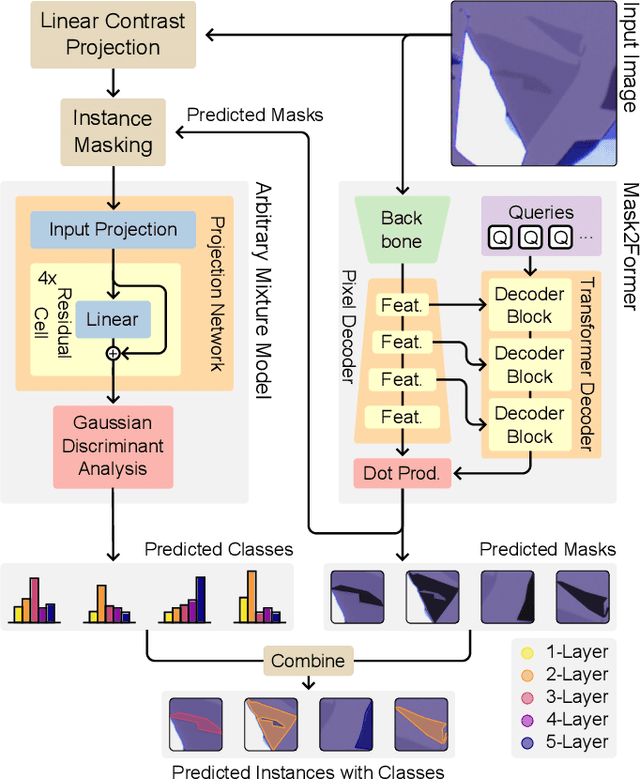
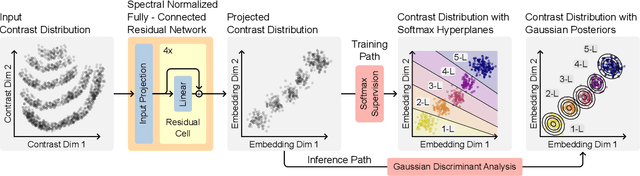
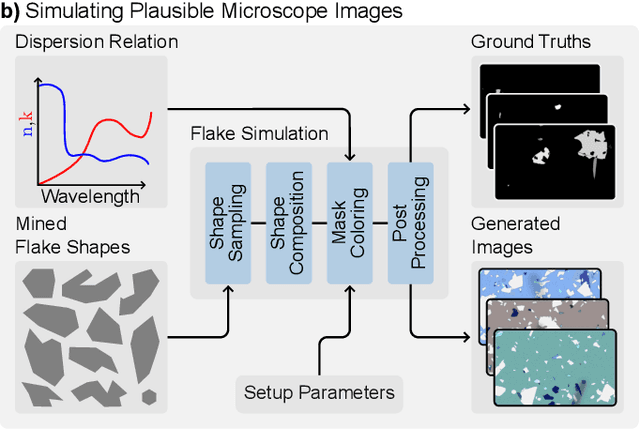
The detection and classification of exfoliated two-dimensional (2D) material flakes from optical microscope images can be automated using computer vision algorithms. This has the potential to increase the accuracy and objectivity of classification and the efficiency of sample fabrication, and it allows for large-scale data collection. Existing algorithms often exhibit challenges in identifying low-contrast materials and typically require large amounts of training data. Here, we present a deep learning model, called MaskTerial, that uses an instance segmentation network to reliably identify 2D material flakes. The model is extensively pre-trained using a synthetic data generator, that generates realistic microscopy images from unlabeled data. This results in a model that can to quickly adapt to new materials with as little as 5 to 10 images. Furthermore, an uncertainty estimation model is used to finally classify the predictions based on optical contrast. We evaluate our method on eight different datasets comprising five different 2D materials and demonstrate significant improvements over existing techniques in the detection of low-contrast materials such as hexagonal boron nitride.