 Add to Chrome
 Add to Firefox
 Add to Edge
SQL-Trail: Multi-Turn Reinforcement Learning with Interleaved Feedback for Text-to-SQL
Jan 25, 2026
While large language models (LLMs) have substantially improved Text-to-SQL generation, a pronounced gap remains between AI systems and human experts on challenging benchmarks such as BIRD-SQL. We argue this gap stems largely from the prevailing single-pass paradigm, which lacks the iterative reasoning, schema exploration, and error-correction behaviors that humans naturally employ. To address this limitation, we introduce SQL-Trail, a multi-turn reinforcement learning (RL) agentic framework for Text-to-SQL. Rather than producing a query in one shot, SQL-Trail interacts with the database environment and uses execution feedback to iteratively refine its predictions. Our approach centers on two key ideas: (i) an adaptive turn-budget allocation mechanism that scales the agent's interaction depth to match question difficulty, and (ii) a composite reward panel that jointly incentivizes SQL correctness and efficient exploration. Across benchmarks, SQL-Trail sets a new state of the art and delivers strong data efficiency--up to 18x higher than prior single-pass RL state-of-the-art methods. Notably, our 7B and 14B models outperform substantially larger proprietary systems by 5% on average, underscoring the effectiveness of interactive, agentic workflows for robust Text-to-SQL generation.

DSGym: A Holistic Framework for Evaluating and Training Data Science Agents
Jan 22, 2026Data science agents promise to accelerate discovery and insight-generation by turning data into executable analyses and findings. Yet existing data science benchmarks fall short due to fragmented evaluation interfaces that make cross-benchmark comparison difficult, narrow task coverage and a lack of rigorous data grounding. In particular, we show that a substantial portion of tasks in current benchmarks can be solved without using the actual data. To address these limitations, we introduce DSGym, a standardized framework for evaluating and training data science agents in self-contained execution environments. Unlike static benchmarks, DSGym provides a modular architecture that makes it easy to add tasks, agent scaffolds, and tools, positioning it as a live, extensible testbed. We curate DSGym-Tasks, a holistic task suite that standardizes and refines existing benchmarks via quality and shortcut solvability filtering. We further expand coverage with (1) DSBio: expert-derived bioinformatics tasks grounded in literature and (2) DSPredict: challenging prediction tasks spanning domains such as computer vision, molecular prediction, and single-cell perturbation. Beyond evaluation, DSGym enables agent training via execution-verified data synthesis pipeline. As a case study, we build a 2,000-example training set and trained a 4B model in DSGym that outperforms GPT-4o on standardized analysis benchmarks. Overall, DSGym enables rigorous end-to-end measurement of whether agents can plan, implement, and validate data analyses in realistic scientific context.
TabDiff: a Multi-Modal Diffusion Model for Tabular Data Generation
Oct 29, 2024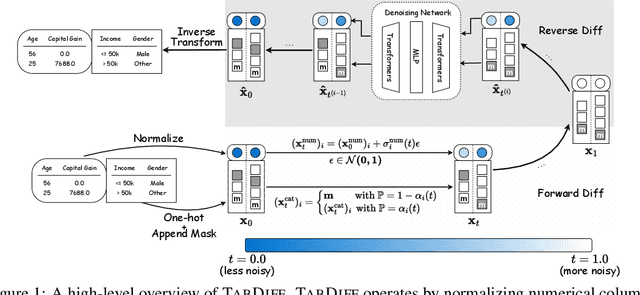
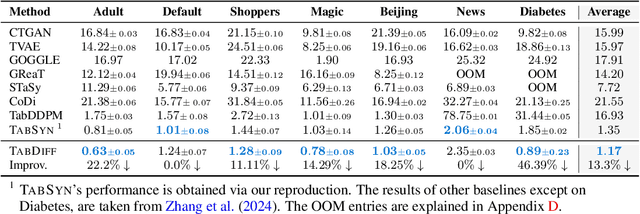
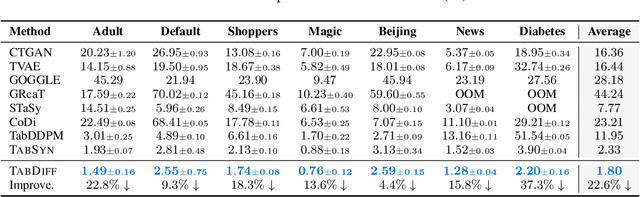
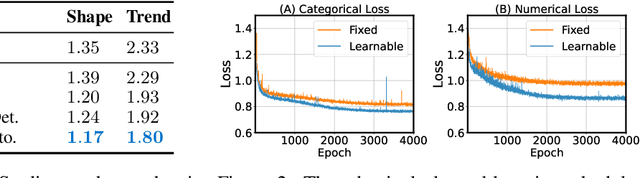
Synthesizing high-quality tabular data is an important topic in many data science tasks, ranging from dataset augmentation to privacy protection. However, developing expressive generative models for tabular data is challenging due to its inherent heterogeneous data types, complex inter-correlations, and intricate column-wise distributions. In this paper, we introduce TabDiff, a joint diffusion framework that models all multi-modal distributions of tabular data in one model. Our key innovation is the development of a joint continuous-time diffusion process for numerical and categorical data, where we propose feature-wise learnable diffusion processes to counter the high disparity of different feature distributions. TabDiff is parameterized by a transformer handling different input types, and the entire framework can be efficiently optimized in an end-to-end fashion. We further introduce a multi-modal stochastic sampler to automatically correct the accumulated decoding error during sampling, and propose classifier-free guidance for conditional missing column value imputation. Comprehensive experiments on seven datasets demonstrate that TabDiff achieves superior average performance over existing competitive baselines across all eight metrics, with up to $22.5\%$ improvement over the state-of-the-art model on pair-wise column correlation estimations. Code is available at https://github.com/MinkaiXu/TabDiff.