 Add to Chrome
 Add to Firefox
 Add to Edge
Beyond Monolingual Deep Research: Evaluating Agents and Retrievers with Cross-Lingual BrowseComp-Plus
Jun 17, 2026
Deep research agents are increasingly evaluated on their ability to search for evidence, reason over retrieved sources, and produce grounded answers. Existing browsing benchmarks, however, largely assume that the user's query and the supporting evidence are written in the same language, leaving open whether agentic search systems can operate when relevant evidence appears in another language. We introduce XBCP (Cross-lingual BrowseComp-Plus), a controlled benchmark that preserves the English question-and-answer space of BrowseComp-Plus but varies the languages of the supporting documents. XBCP instantiates two complementary settings: in the cross-lingual setting, each query is paired with evidence in a single assigned language. In the multilingual setting, the full evidence corpus is distributed equally and randomly across 12 languages spanning high-resource and low-resource regimes. We evaluate four deep research agents using sparse and dense multilingual retrievers, measuring answer accuracy, evidence recall, search behavior, calibration, citation fidelity, and oracle retrieval. Results reveal substantial degradation when evidence is translated. Even strong, dense retrievers lose evidence recall, and agents become less calibrated and cite evidence less reliably. Notably, accuracy remains lower even when all gold evidence is supplied directly. These findings suggest that cross-lingual deep research exposes both retrieval failures and an independent, agent-side difficulty in integrating language-mismatched evidence.

Larch: Learned Query Optimization for Semantic Predicates
Jun 06, 2026With the advent of Large Language Models (LLMs), many database systems introduced semantic operators that enabled analytical queries over unstructured data (e.g. text, images, videos). Semantic operators typically incur high inference costs and latencies making semantic (AI) SQL queries challenging to apply on large scale datasets. At the same time, their semantic nature leads database engines to treat them as black boxes, making AISQL queries difficult to optimize. In this paper, we introduce Larch, a framework for optimizing the execution of semantic filters in AI SQL queries. Larch was inspired by two key observations: i) the high latency of semantic operators leaves significant room for computationally-heavy runtime optimization techniques, ii) unstructured data are typically accompanied by semantic information in the form of embeddings allowing for efficient semantic comparisons between AI_FILTER prompts and data values. Based on these two key observations, we present two Larch variants: Larch-A2C and Larch-Sel. Larch-A2C encodes arbitrary semantic filters expression tree using an embedding-augmented Gated Graph Neural Network and formulates the filter evaluation order as a Markov decision process. In contrast, Larch-Sel leverages a supervised learning model to predict filter selectivities, subsequently applying dynamic programming to find a near-optimal evaluation order for each input row. Evaluated across diverse real-world datasets and comprehensive synthetic workloads, both Larch variants always outperform existing semantic filter optimization techniques in terms of token usage. Our results demonstrate that Larch is robust across diverse workloads, reducing total token cost overhead by 3x-19x compared to Palimpzest and Quest.
AvalancheBench: Evaluating Enterprise Data Agents Through Latent World Recovery
May 22, 2026We introduce AvalancheBench, a benchmark for evaluating enterprise data agents through \emph{latent world recovery}. AvalancheBench improves on existing benchmarks in three ways. First, it evaluates analytical understanding rather than pipeline completion: systems are scored on whether they recover the segments, drivers, temporal events, and relationships that explain the data, not merely on whether they execute a workflow or produce a plausible report. Second, it provides ground truth for goal-driven analytics by generating observations from a known latent world, enabling partial credit for incomplete but valid recoveries. Third, it exposes how early analytical mistakes propagate into later conclusions: missed segments, merged events, or wrong attributions can lead to systematically wrong recommendations. In this sense, AvalancheBench complements real-data benchmarks by providing a controlled setting for diagnosing whether agents recover the analytical structure behind enterprise data. On a first e-commerce use case, the strongest configuration of a leading coding agent recovers only 26\% of the rubric, with failures concentrated in generic customer segmentations and merged temporal events.
Dual-View Training for Instruction-Following Information Retrieval
Apr 20, 2026Instruction-following information retrieval (IF-IR) studies retrieval systems that must not only find documents relevant to a query, but also obey explicit user constraints such as required attributes, exclusions, or output preferences. However, most retrievers are trained primarily for semantic relevance and often fail to distinguish documents that match the topic from those that satisfy the instruction. We propose a dual-view data synthesis strategy based on polarity reversal: given a query, a document that is relevant under the instruction, and a hard negative that matches the query but violates the instruction, we prompt an LLM to generate a complementary instruction under which the two documents swap relevance labels. By presenting the same document pair under complementary instructions that invert their relevance labels, the training signal forces the retriever to reconsider the same candidate set through the instruction, rather than relying on fixed topical cues. On a 305M-parameter encoder, our method improves performance on the FollowIR benchmark by 45%, surpassing general-purpose embedding models of comparable or larger scale. Through head-to-head comparisons at matched data budgets, we further show that data diversity and instruction supervision play complementary roles: the former preserves general retrieval quality, while the latter improves instruction sensitivity. These results highlight the value of targeted data synthesis for building retrieval systems that are both broadly capable and instruction-aware.
Code-Switching Information Retrieval: Benchmarks, Analysis, and the Limits of Current Retrievers
Apr 19, 2026Code-switching is a pervasive linguistic phenomenon in global communication, yet modern information retrieval systems remain predominantly designed for, and evaluated within, monolingual contexts. To bridge this critical disconnect, we present a holistic study dedicated to code-switching IR. We introduce CSR-L (Code-Switching Retrieval benchmark-Lite), constructing a dataset via human annotation to capture the authentic naturalness of mixed-language queries. Our evaluation across statistical, dense, and late-interaction paradigms reveals that code-switching acts as a fundamental performance bottleneck, degrading the effectiveness of even robust multilingual models. We demonstrate that this failure stems from substantial divergence in the embedding space between pure and code-switched text. Scaling this investigation, we propose CS-MTEB, a comprehensive benchmark covering 11 diverse tasks, where we observe performance declines of up to 27%. Finally, we show that standard multilingual techniques like vocabulary expansion are insufficient to resolve these deficits completely. These findings underscore the fragility of current systems and establish code-switching as a crucial frontier for future IR optimization.
Hold Onto That Thought: Assessing KV Cache Compression On Reasoning
Dec 12, 2025Large language models (LLMs) have demonstrated remarkable performance on long-context tasks, but are often bottlenecked by memory constraints. Namely, the KV cache, which is used to significantly speed up attention computations, grows linearly with context length. A suite of compression algorithms has been introduced to alleviate cache growth by evicting unimportant tokens. However, several popular strategies are targeted towards the prefill phase, i.e., processing long prompt context, and their performance is rarely assessed on reasoning tasks requiring long decoding. In particular, short but complex prompts, such as those in benchmarks like GSM8K and MATH500, often benefit from multi-step reasoning and self-reflection, resulting in thinking sequences thousands of tokens long. In this work, we benchmark the performance of several popular compression strategies on long-reasoning tasks. For the non-reasoning Llama-3.1-8B-Instruct, we determine that no singular strategy fits all, and that performance is heavily influenced by dataset type. However, we discover that H2O and our decoding-enabled variant of SnapKV are dominant strategies for reasoning models, indicating the utility of heavy-hitter tracking for reasoning traces. We also find that eviction strategies at low budgets can produce longer reasoning traces, revealing a tradeoff between cache size and inference costs.
Hybrid Querying Over Relational Databases and Large Language Models
Aug 01, 2024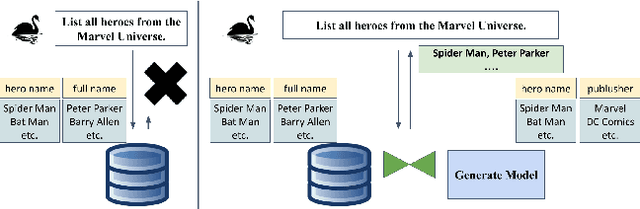
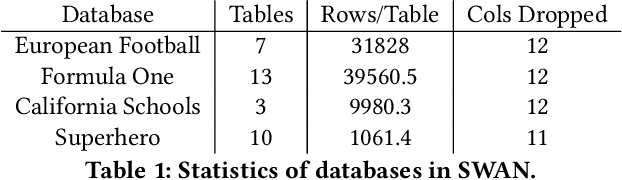

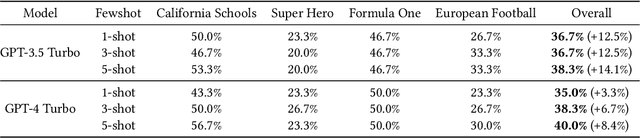
Database queries traditionally operate under the closed-world assumption, providing no answers to questions that require information beyond the data stored in the database. Hybrid querying using SQL offers an alternative by integrating relational databases with large language models (LLMs) to answer beyond-database questions. In this paper, we present the first cross-domain benchmark, SWAN, containing 120 beyond-database questions over four real-world databases. To leverage state-of-the-art language models in addressing these complex questions in SWAN, we present, HQDL, a preliminary solution for hybrid querying, and also discuss potential future directions. Our evaluation demonstrates that HQDL using GPT-4 Turbo with few-shot prompts, achieves 40.0\% in execution accuracy and 48.2\% in data factuality. These results highlights both the potential and challenges for hybrid querying. We believe that our work will inspire further research in creating more efficient and accurate data systems that seamlessly integrate relational databases and large language models to address beyond-database questions.
LLM-SQL-Solver: Can LLMs Determine SQL Equivalence?
Dec 16, 2023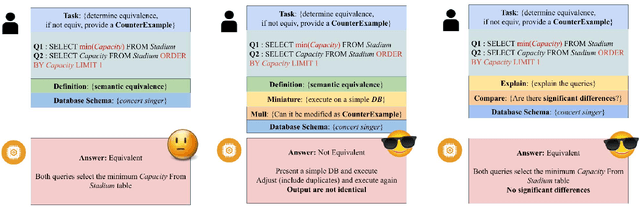
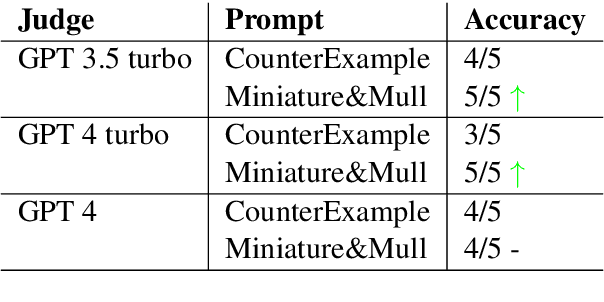
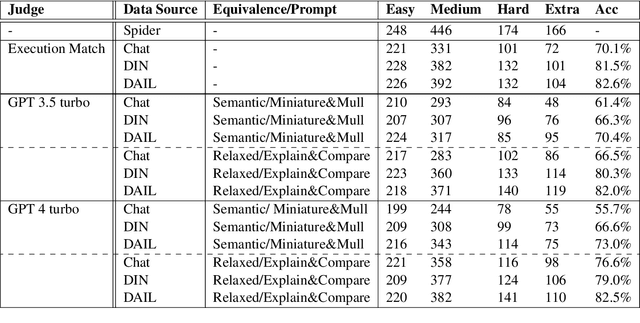
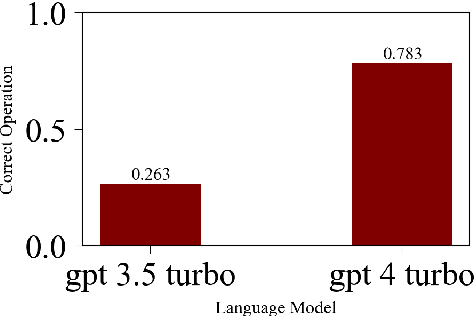
Judging the equivalence between two SQL queries is a fundamental problem with many practical applications in data management and SQL generation (i.e., evaluating the quality of generated SQL queries in text-to-SQL task). While the research community has reasoned about SQL equivalence for decades, it poses considerable difficulties and no complete solutions exist. Recently, Large Language Models (LLMs) have shown strong reasoning capability in conversation, question answering and solving mathematics challenges. In this paper, we study if LLMs can be used to determine the equivalence between SQL queries under two notions of SQL equivalence (semantic equivalence and relaxed equivalence). To assist LLMs in generating high quality responses, we present two prompting techniques: Miniature & Mull and Explain & Compare. The former technique is used to evaluate the semantic equivalence in which it asks LLMs to execute a query on a simple database instance and then explore if a counterexample exists by modifying the database. The latter technique is used to evaluate the relaxed equivalence in which it asks LLMs to explain the queries and then compare if they contain significant logical differences. Our experiments demonstrate using our techniques, LLMs is a promising tool to help data engineers in writing semantically equivalent SQL queries, however challenges still persist, and is a better metric for evaluating SQL generation than the popular execution accuracy.
Autumn: A Scalable Read Optimized LSM-tree based Key-Value Stores with Fast Point and Range Read Speed
May 08, 2023The Log Structured Merge Trees (LSM-tree) based key-value stores are widely used in many storage systems to support a variety of operations such as updates, point reads, and range reads. Traditionally, LSM-tree's merge policy organizes data into multiple levels of exponentially increasing capacity to support high-speed writes. However, we contend that the traditional merge policies are not optimized for reads. In this work, we present Autumn, a scalable and read optimized LSM-tree based key-value stores with minimal point and range read cost. The key idea in improving the read performance is to dynamically adjust the capacity ratio between two adjacent levels as more data are stored. As a result, smaller levels gradually increase their capacities and merge more often. In particular, the point and range read cost improves from the previous best known $O(logN)$ complexity to $O(\sqrt{logN})$ in Autumn by applying the new novel Garnering merge policy. While Garnering merge policy optimizes for both point reads and range reads, it maintains high performance for updates. Moreover, to further improve the update costs, Autumn uses a small amount of bounded space of DRAM to pin/keep the first level of LSM-tree. We implemented Autumn on top of LevelDB and experimentally showcases the gain in performance for real world workloads.