 Add to Chrome
 Add to Firefox
 Add to Edge
Learning to Discover at Test Time
Jan 22, 2026
How can we use AI to discover a new state of the art for a scientific problem? Prior work in test-time scaling, such as AlphaEvolve, performs search by prompting a frozen LLM. We perform reinforcement learning at test time, so the LLM can continue to train, but now with experience specific to the test problem. This form of continual learning is quite special, because its goal is to produce one great solution rather than many good ones on average, and to solve this very problem rather than generalize to other problems. Therefore, our learning objective and search subroutine are designed to prioritize the most promising solutions. We call this method Test-Time Training to Discover (TTT-Discover). Following prior work, we focus on problems with continuous rewards. We report results for every problem we attempted, across mathematics, GPU kernel engineering, algorithm design, and biology. TTT-Discover sets the new state of the art in almost all of them: (i) Erdős' minimum overlap problem and an autocorrelation inequality; (ii) a GPUMode kernel competition (up to $2\times$ faster than prior art); (iii) past AtCoder algorithm competitions; and (iv) denoising problem in single-cell analysis. Our solutions are reviewed by experts or the organizers. All our results are achieved with an open model, OpenAI gpt-oss-120b, and can be reproduced with our publicly available code, in contrast to previous best results that required closed frontier models. Our test-time training runs are performed using Tinker, an API by Thinking Machines, with a cost of only a few hundred dollars per problem.

End-to-End Test-Time Training for Long Context
Dec 31, 2025We formulate long-context language modeling as a problem in continual learning rather than architecture design. Under this formulation, we only use a standard architecture -- a Transformer with sliding-window attention. However, our model continues learning at test time via next-token prediction on the given context, compressing the context it reads into its weights. In addition, we improve the model's initialization for learning at test time via meta-learning at training time. Overall, our method, a form of Test-Time Training (TTT), is End-to-End (E2E) both at test time (via next-token prediction) and training time (via meta-learning), in contrast to previous forms. We conduct extensive experiments with a focus on scaling properties. In particular, for 3B models trained with 164B tokens, our method (TTT-E2E) scales with context length in the same way as Transformer with full attention, while others, such as Mamba 2 and Gated DeltaNet, do not. However, similar to RNNs, TTT-E2E has constant inference latency regardless of context length, making it 2.7 times faster than full attention for 128K context. Our code is publicly available.
One-Minute Video Generation with Test-Time Training
Apr 07, 2025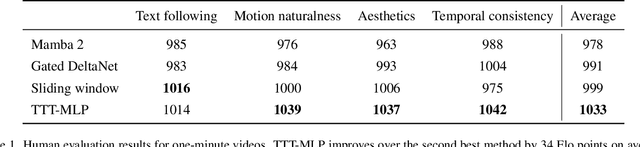

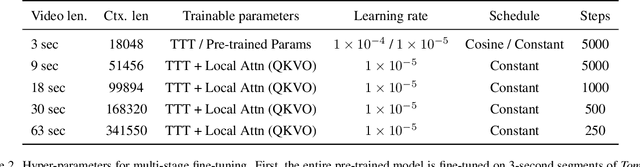
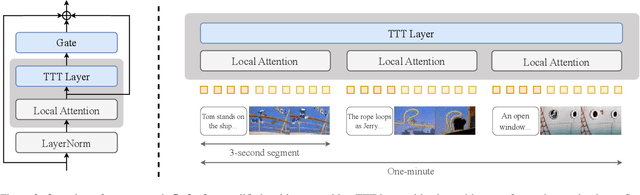
Transformers today still struggle to generate one-minute videos because self-attention layers are inefficient for long context. Alternatives such as Mamba layers struggle with complex multi-scene stories because their hidden states are less expressive. We experiment with Test-Time Training (TTT) layers, whose hidden states themselves can be neural networks, therefore more expressive. Adding TTT layers into a pre-trained Transformer enables it to generate one-minute videos from text storyboards. For proof of concept, we curate a dataset based on Tom and Jerry cartoons. Compared to baselines such as Mamba~2, Gated DeltaNet, and sliding-window attention layers, TTT layers generate much more coherent videos that tell complex stories, leading by 34 Elo points in a human evaluation of 100 videos per method. Although promising, results still contain artifacts, likely due to the limited capability of the pre-trained 5B model. The efficiency of our implementation can also be improved. We have only experimented with one-minute videos due to resource constraints, but the approach can be extended to longer videos and more complex stories. Sample videos, code and annotations are available at: https://test-time-training.github.io/video-dit