 Add to Chrome
 Add to Firefox
 Add to Edge
Blockchain-Based Spectrum Resource Securitization via Semi-Fungible Token-Lock
Jan 22, 2026
As 6G networks evolve, spectrum assets require flexible, dynamic, and efficient utilization, motivating blockchain based spectrum securitization. Existing approaches based on ERC404 style hybrid token models rely on frequent minting and burning during asset transfers, which disrupt token identity continuity and increase on chain overhead. This paper proposes the Semi Fungible Token Lock (SFT Lock) method, a lock/unlock based mechanism that preserves NFT identity and historical traceability while enabling fractional ownership and transferability. By replacing mint/burn operations with deterministic state transitions, SFT Lock ensures consistent lifecycle representation of spectrum assets and significantly reduces on chain operations. Based on this mechanism, a modular smart contract architecture is designed to support spectrum authorization, securitization, and sharing, and a staking mechanism is introduced to enhance asset liquidity. Experimental results on a private Ethereum network demonstrate that, compared with ERC404 style hybrid token models, the proposed method achieves substantial gas savings while maintaining functional correctness and traceability.

LearnAlign: Reasoning Data Selection for Reinforcement Learning in Large Language Models Based on Improved Gradient Alignment
Jun 13, 2025Reinforcement learning (RL) has become a key technique for enhancing LLMs' reasoning abilities, yet its data inefficiency remains a major bottleneck. To address this critical yet challenging issue, we present a novel gradient-alignment-based method, named LearnAlign, which intelligently selects the learnable and representative training reasoning data for RL post-training. To overcome the well-known issue of response-length bias in gradient norms, we introduce the data learnability based on the success rate, which can indicate the learning potential of each data point. Experiments across three mathematical reasoning benchmarks demonstrate that our method significantly reduces training data requirements while achieving minor performance degradation or even improving performance compared to full-data training. For example, it reduces data requirements by up to 1,000 data points with better performance (77.53%) than that on the full dataset on GSM8K benchmark (77.04%). Furthermore, we show its effectiveness in the staged RL setting. This work provides valuable insights into data-efficient RL post-training and establishes a foundation for future research in optimizing reasoning data selection.To facilitate future work, we will release code.
Mobile Augmented Reality Framework with Fusional Localization and Pose Estimation
Jan 06, 2025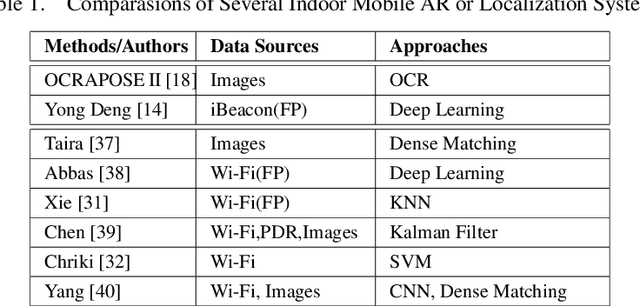
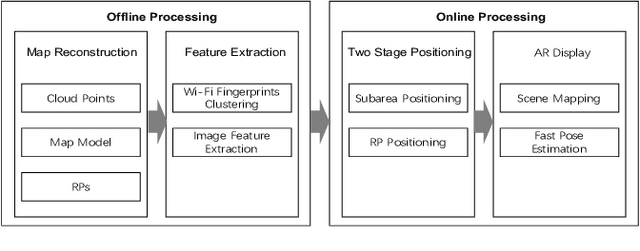
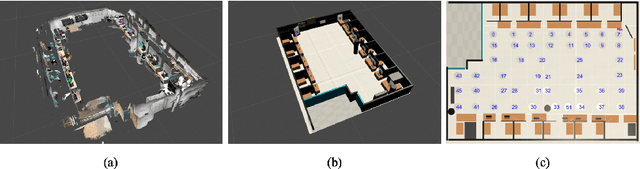
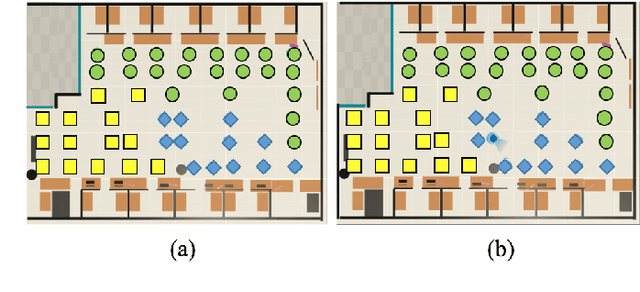
As a novel way of presenting information, augmented reality (AR) enables people to interact with the physical world in a direct and intuitive way. While there are some mobile AR products implemented with specific hardware at a high cost, the software approaches of AR implementation on mobile platforms(such as smartphones, tablet PC, etc.) are still far from practical use. GPS-based mobile AR systems usually perform poorly due to the inaccurate positioning in the indoor environment. Previous vision-based pose estimation methods need to continuously track predefined markers within a short distance, which greatly degrade user experience. This paper first conducts a comprehensive study of the state-of-the-art AR and localization systems on mobile platforms. Then, we propose an effective indoor mobile AR framework. In the framework, a fusional localization method and a new pose estimation implementation are developed to increase the overall matching rate and thus improving AR display accuracy. Experiments show that our framework has higher performance than approaches purely based on images or Wi-Fi signals. We achieve low average error distances (0.61-0.81m) and accurate matching rates (77%-82%) when the average sampling grid length is set to 0.5m.