 Add to Chrome
 Add to Firefox
 Add to Edge
Can Legislation Be Made Machine-Readable in PROLEG?
Jan 04, 2026
The anticipated positive social impact of regulatory processes requires both the accuracy and efficiency of their application. Modern artificial intelligence technologies, including natural language processing and machine-assisted reasoning, hold great promise for addressing this challenge. We present a framework to address the challenge of tools for regulatory application, based on current state-of-the-art (SOTA) methods for natural language processing (large language models or LLMs) and formalization of legal reasoning (the legal representation system PROLEG). As an example, we focus on Article 6 of the European General Data Protection Regulation (GDPR). In our framework, a single LLM prompt simultaneously transforms legal text into if-then rules and a corresponding PROLEG encoding, which are then validated and refined by legal domain experts. The final output is an executable PROLEG program that can produce human-readable explanations for instances of GDPR decisions. We describe processes to support the end-to-end transformation of a segment of a regulatory document (Article 6 from GDPR), including the prompting frame to guide an LLM to "compile" natural language text to if-then rules, then to further "compile" the vetted if-then rules to PROLEG. Finally, we produce an instance that shows the PROLEG execution. We conclude by summarizing the value of this approach and note observed limitations with suggestions to further develop such technologies for capturing and deploying regulatory frameworks.

BERP: A Blind Estimator of Room Acoustic and Physical Parameters for Single-Channel Noisy Speech Signals
May 07, 2024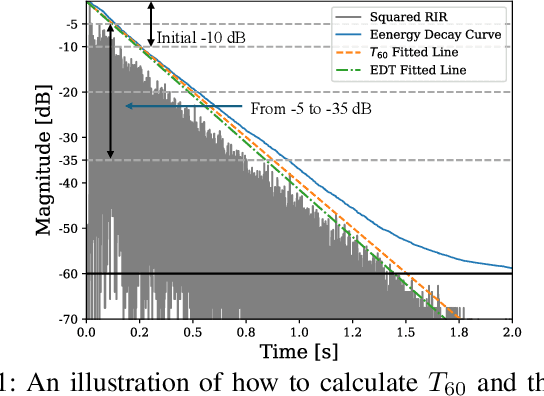
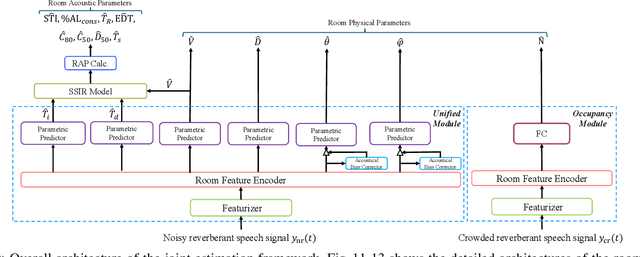
Room acoustic parameters (RAPs) and room physical parameters ( RPPs) are essential metrics for parameterizing the room acoustical characteristics (RAC) of a sound field around a listener's local environment, offering comprehensive indications for various applications. The current RAPs and RPPs estimation methods either fall short of covering broad real-world acoustic environments in the context of real background noise or lack universal frameworks for blindly estimating RAPs and RPPs from noisy single-channel speech signals, particularly sound source distances, direction-of-arrival (DOA) of sound sources, and occupancy levels. On the other hand, in this paper, we propose a novel universal blind estimation framework called the blind estimator of room acoustical and physical parameters (BERP), by introducing a new stochastic room impulse response (RIR) model, namely, the sparse stochastic impulse response (SSIR) model, and endowing the BERP with a unified encoder and multiple separate predictors to estimate RPPs and SSIR parameters in parallel. This estimation framework enables the computationally efficient and universal estimation of room parameters by solely using noisy single-channel speech signals. Finally, all the RAPs can be simultaneously derived from the RIRs synthesized from SSIR model with the estimated parameters. To evaluate the effectiveness of the proposed BERP and SSIR models, we compile a task-specific dataset from several publicly available datasets. The results reveal that the BERP achieves state-of-the-art (SOTA) performance. Moreover, the evaluation results pertaining to the SSIR RIR model also demonstrated its efficacy. The code is available on GitHub.