 Add to Chrome
 Add to Firefox
 Add to Edge
DanQing: An Up-to-Date Large-Scale Chinese Vision-Language Pre-training Dataset
Jan 15, 2026
Vision-Language Pre-training (VLP) models demonstrate strong performance across various downstream tasks by learning from large-scale image-text pairs through contrastive pretraining. The release of extensive English image-text datasets (e.g., COYO-700M and LAION-400M) has enabled widespread adoption of models such as CLIP and SigLIP in tasks including cross-modal retrieval and image captioning. However, the advancement of Chinese vision-language pretraining has substantially lagged behind, due to the scarcity of high-quality Chinese image-text data. To address this gap, we develop a comprehensive pipeline for constructing a high-quality Chinese cross-modal dataset. As a result, we propose DanQing, which contains 100 million image-text pairs collected from Common Crawl. Different from existing datasets, DanQing is curated through a more rigorous selection process, yielding superior data quality. Moreover, DanQing is primarily built from 2024-2025 web data, enabling models to better capture evolving semantic trends and thus offering greater practical utility. We compare DanQing with existing datasets by continual pre-training of the SigLIP2 model. Experimental results show that DanQing consistently achieves superior performance across a range of Chinese downstream tasks, including zero-shot classification, cross-modal retrieval, and LMM-based evaluations. To facilitate further research in Chinese vision-language pre-training, we will open-source the DanQing dataset under the Creative Common CC-BY 4.0 license.

Video-Bench: Human-Aligned Video Generation Benchmark
Apr 07, 2025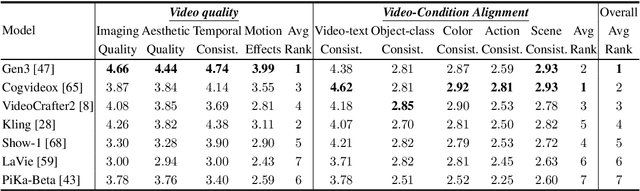
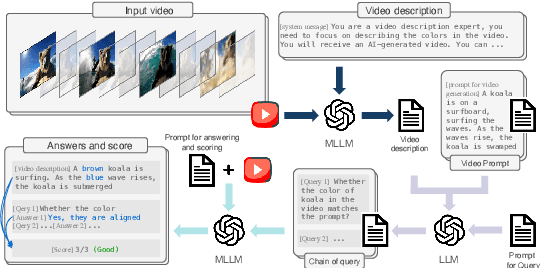
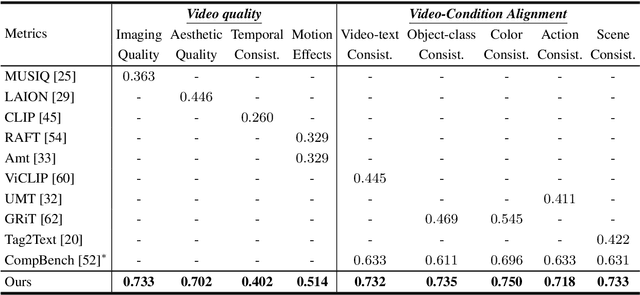
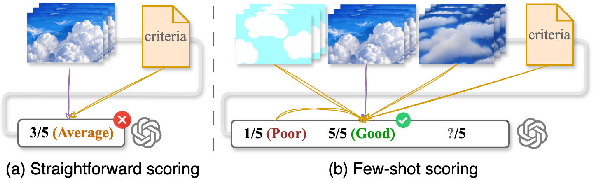
Video generation assessment is essential for ensuring that generative models produce visually realistic, high-quality videos while aligning with human expectations. Current video generation benchmarks fall into two main categories: traditional benchmarks, which use metrics and embeddings to evaluate generated video quality across multiple dimensions but often lack alignment with human judgments; and large language model (LLM)-based benchmarks, though capable of human-like reasoning, are constrained by a limited understanding of video quality metrics and cross-modal consistency. To address these challenges and establish a benchmark that better aligns with human preferences, this paper introduces Video-Bench, a comprehensive benchmark featuring a rich prompt suite and extensive evaluation dimensions. This benchmark represents the first attempt to systematically leverage MLLMs across all dimensions relevant to video generation assessment in generative models. By incorporating few-shot scoring and chain-of-query techniques, Video-Bench provides a structured, scalable approach to generated video evaluation. Experiments on advanced models including Sora demonstrate that Video-Bench achieves superior alignment with human preferences across all dimensions. Moreover, in instances where our framework's assessments diverge from human evaluations, it consistently offers more objective and accurate insights, suggesting an even greater potential advantage over traditional human judgment.