 Add to Chrome
 Add to Firefox
 Add to Edge
FlashInfer-Bench: Building the Virtuous Cycle for AI-driven LLM Systems
Jan 01, 2026
Recent advances show that large language models (LLMs) can act as autonomous agents capable of generating GPU kernels, but integrating these AI-generated kernels into real-world inference systems remains challenging. FlashInfer-Bench addresses this gap by establishing a standardized, closed-loop framework that connects kernel generation, benchmarking, and deployment. At its core, FlashInfer Trace provides a unified schema describing kernel definitions, workloads, implementations, and evaluations, enabling consistent communication between agents and systems. Built on real serving traces, FlashInfer-Bench includes a curated dataset, a robust correctness- and performance-aware benchmarking framework, a public leaderboard to track LLM agents' GPU programming capabilities, and a dynamic substitution mechanism (apply()) that seamlessly injects the best-performing kernels into production LLM engines such as SGLang and vLLM. Using FlashInfer-Bench, we further evaluate the performance and limitations of LLM agents, compare the trade-offs among different GPU programming languages, and provide insights for future agent design. FlashInfer-Bench thus establishes a practical, reproducible pathway for continuously improving AI-generated kernels and deploying them into large-scale LLM inference.

1+1>2: A Synergistic Sparse and Low-Rank Compression Method for Large Language Models
Oct 30, 2025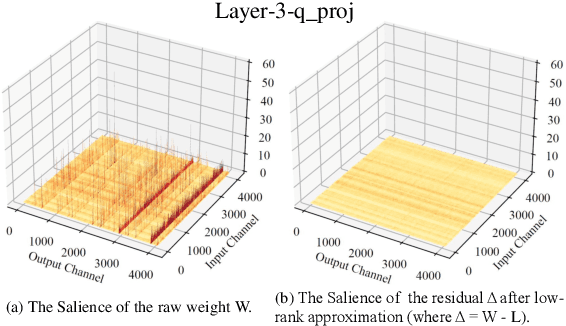
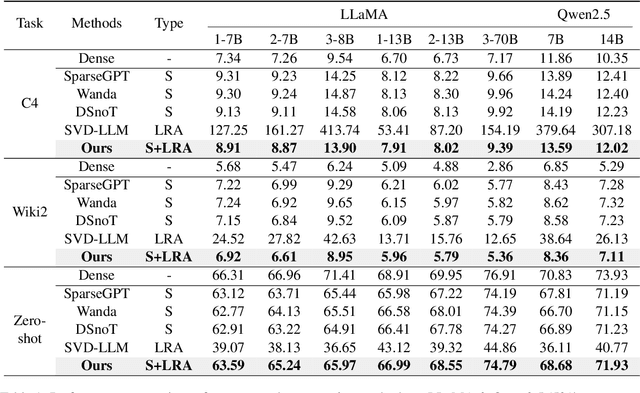
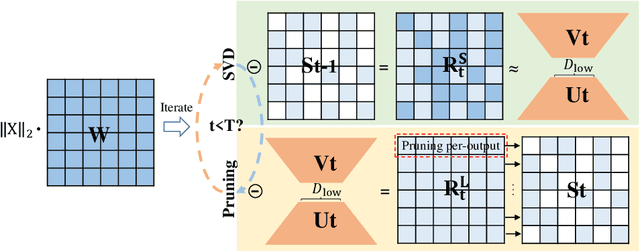
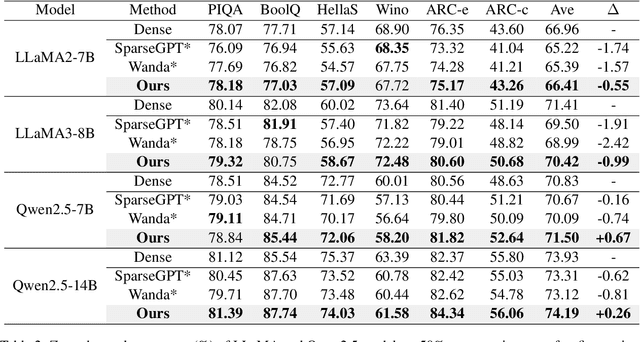
Large Language Models (LLMs) have demonstrated remarkable proficiency in language comprehension and generation; however, their widespread adoption is constrained by substantial bandwidth and computational demands. While pruning and low-rank approximation have each demonstrated promising performance individually, their synergy for LLMs remains underexplored. We introduce \underline{S}ynergistic \underline{S}parse and \underline{L}ow-Rank \underline{C}ompression (SSLC) methods for LLMs, which leverages the strengths of both techniques: low-rank approximation compresses the model by retaining its essential structure with minimal information loss, whereas sparse optimization eliminates non-essential weights, preserving those crucial for generalization. Based on theoretical analysis, we first formulate the low-rank approximation and sparse optimization as a unified problem and solve it by iterative optimization algorithm. Experiments on LLaMA and Qwen2.5 models (7B-70B) show that SSLC, without any additional training steps, consistently surpasses standalone methods, achieving state-of-the-arts results. Notably, SSLC compresses Qwen2.5 by 50\% with no performance drop and achieves at least 1.63$\times$ speedup, offering a practical solution for efficient LLM deployment.
WebLLM: A High-Performance In-Browser LLM Inference Engine
Dec 20, 2024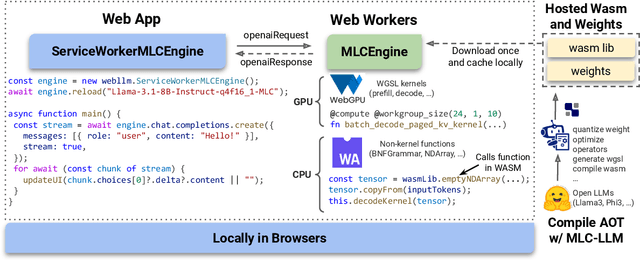

Advancements in large language models (LLMs) have unlocked remarkable capabilities. While deploying these models typically requires server-grade GPUs and cloud-based inference, the recent emergence of smaller open-source models and increasingly powerful consumer devices have made on-device deployment practical. The web browser as a platform for on-device deployment is universally accessible, provides a natural agentic environment, and conveniently abstracts out the different backends from diverse device vendors. To address this opportunity, we introduce WebLLM, an open-source JavaScript framework that enables high-performance LLM inference entirely within web browsers. WebLLM provides an OpenAI-style API for seamless integration into web applications, and leverages WebGPU for efficient local GPU acceleration and WebAssembly for performant CPU computation. With machine learning compilers MLC-LLM and Apache TVM, WebLLM leverages optimized WebGPU kernels, overcoming the absence of performant WebGPU kernel libraries. Evaluations show that WebLLM can retain up to 80% native performance on the same device, with room to further close the gap. WebLLM paves the way for universally accessible, privacy-preserving, personalized, and locally powered LLM applications in web browsers. The code is available at: https://github.com/mlc-ai/web-llm.