 Add to Chrome
 Add to Firefox
 Add to Edge
On the Spectral Flattening of Quantized Embeddings
Feb 01, 2026
Training Large Language Models (LLMs) at ultra-low precision is critically impeded by instability rooted in the conflict between discrete quantization constraints and the intrinsic heavy-tailed spectral nature of linguistic data. By formalizing the connection between Zipfian statistics and random matrix theory, we prove that the power-law decay in the singular value spectra of embeddings is a fundamental requisite for semantic encoding. We derive theoretical bounds showing that uniform quantization introduces a noise floor that disproportionately truncates this spectral tail, which induces spectral flattening and a strictly provable increase in the stable rank of representations. Empirical validation across diverse architectures including GPT-2 and TinyLlama corroborates that this geometric degradation precipitates representational collapse. This work not only quantifies the spectral sensitivity of LLMs but also establishes spectral fidelity as a necessary condition for stable low-bit optimization.

FusionLLM: A Decentralized LLM Training System on Geo-distributed GPUs with Adaptive Compression
Oct 16, 2024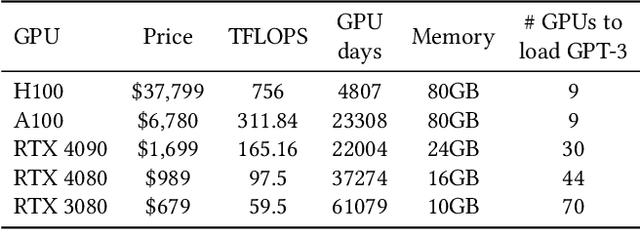
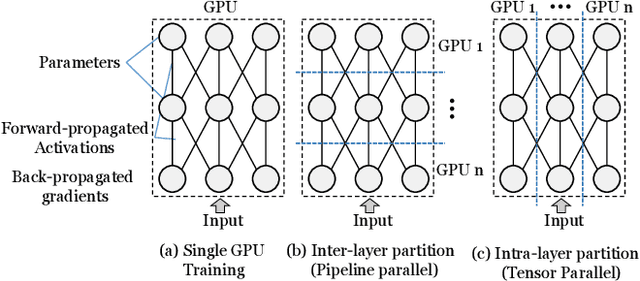
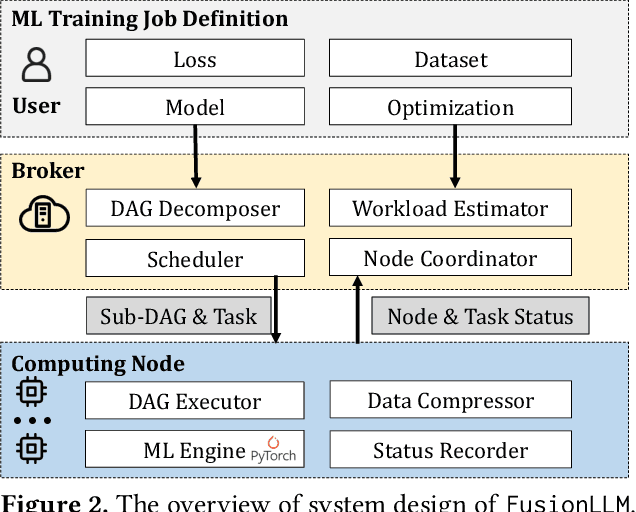
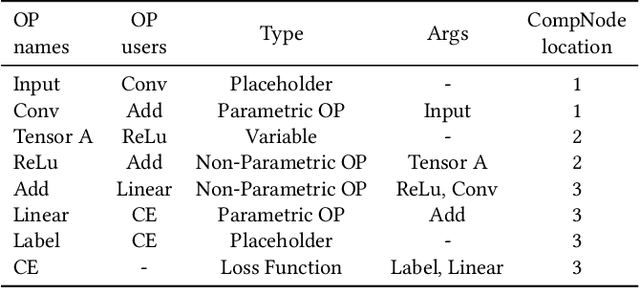
To alleviate hardware scarcity in training large deep neural networks (DNNs), particularly large language models (LLMs), we present FusionLLM, a decentralized training system designed and implemented for training DNNs using geo-distributed GPUs across different computing clusters or individual devices. Decentralized training faces significant challenges regarding system design and efficiency, including: 1) the need for remote automatic differentiation (RAD), 2) support for flexible model definitions and heterogeneous software, 3) heterogeneous hardware leading to low resource utilization or the straggler problem, and 4) slow network communication. To address these challenges, in the system design, we represent the model as a directed acyclic graph of operators (OP-DAG). Each node in the DAG represents the operator in the DNNs, while the edge represents the data dependency between operators. Based on this design, 1) users are allowed to customize any DNN without caring low-level operator implementation; 2) we enable the task scheduling with the more fine-grained sub-tasks, offering more optimization space; 3) a DAG runtime executor can implement RAD withour requiring the consistent low-level ML framework versions. To enhance system efficiency, we implement a workload estimator and design an OP-Fence scheduler to cluster devices with similar bandwidths together and partition the DAG to increase throughput. Additionally, we propose an AdaTopK compressor to adaptively compress intermediate activations and gradients at the slowest communication links. To evaluate the convergence and efficiency of our system and algorithms, we train ResNet-101 and GPT-2 on three real-world testbeds using 48 GPUs connected with 8 Mbps~10 Gbps networks. Experimental results demonstrate that our system and method can achieve 1.45 - 9.39x speedup compared to baseline methods while ensuring convergence.