 Add to Chrome
 Add to Firefox
 Add to Edge
FRISM: Fine-Grained Reasoning Injection via Subspace-Level Model Merging for Vision-Language Models
Jan 29, 2026
Efficiently enhancing the reasoning capabilities of Vision-Language Models (VLMs) by merging them with Large Reasoning Models (LRMs) has emerged as a promising direction. However, existing methods typically operate at a coarse-grained layer level, which often leads to a trade-off between injecting reasoning capabilities and preserving visual capabilities. To address this limitation, we propose {FRISM} (Fine-grained Reasoning Injection via Subspace-level model Merging), a fine-grained reasoning injection framework based on subspace-level model merging. Observing that reasoning capabilities are encoded in distinct subspaces, FRISM decomposes LRM task vectors via Singular Value Decomposition (SVD) and adaptively tunes the scaling coefficients of each subspace through learning to realize fine-grained reasoning injection. Furthermore, we introduce a label-free self-distillation learning strategy with a dual-objective optimization using common vision-language perception datasets. Extensive experiments demonstrate that FRISM effectively improves reasoning capabilities without compromising the model's original visual capabilities by consistently achieving state-of-the-art performance across diverse visual reasoning benchmarks.

Think Twice, Act Once: Token-Aware Compression and Action Reuse for Efficient Inference in Vision-Language-Action Models
May 27, 2025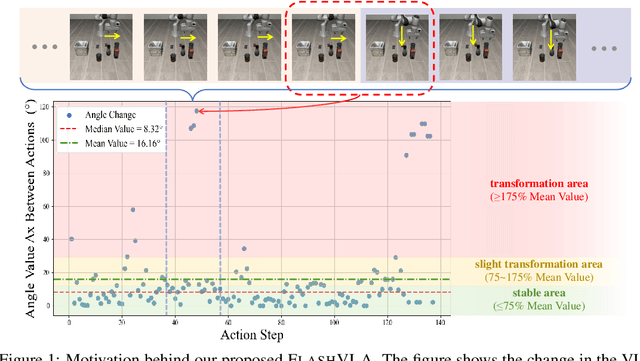
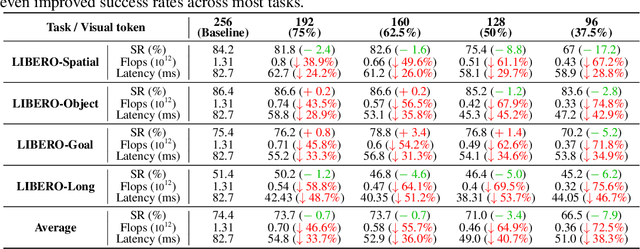
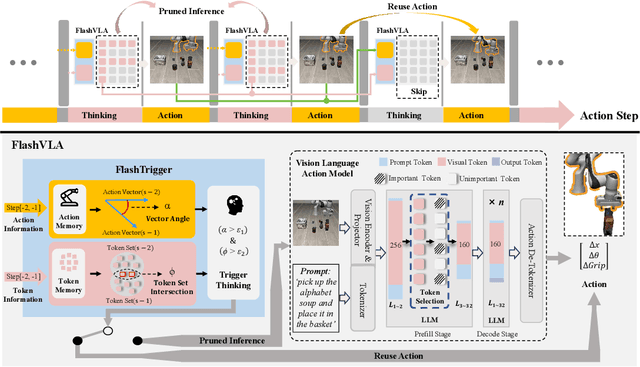
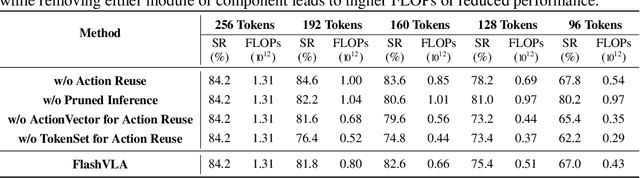
Vision-Language-Action (VLA) models have emerged as a powerful paradigm for general-purpose robot control through natural language instructions. However, their high inference cost-stemming from large-scale token computation and autoregressive decoding-poses significant challenges for real-time deployment and edge applications. While prior work has primarily focused on architectural optimization, we take a different perspective by identifying a dual form of redundancy in VLA models: (i) high similarity across consecutive action steps, and (ii) substantial redundancy in visual tokens. Motivated by these observations, we propose FlashVLA, the first training-free and plug-and-play acceleration framework that enables action reuse in VLA models. FlashVLA improves inference efficiency through a token-aware action reuse mechanism that avoids redundant decoding across stable action steps, and an information-guided visual token selection strategy that prunes low-contribution tokens. Extensive experiments on the LIBERO benchmark show that FlashVLA reduces FLOPs by 55.7% and latency by 36.0%, with only a 0.7% drop in task success rate. These results demonstrate the effectiveness of FlashVLA in enabling lightweight, low-latency VLA inference without retraining.
Pioneering 4-Bit FP Quantization for Diffusion Models: Mixup-Sign Quantization and Timestep-Aware Fine-Tuning
May 27, 2025Model quantization reduces the bit-width of weights and activations, improving memory efficiency and inference speed in diffusion models. However, achieving 4-bit quantization remains challenging. Existing methods, primarily based on integer quantization and post-training quantization fine-tuning, struggle with inconsistent performance. Inspired by the success of floating-point (FP) quantization in large language models, we explore low-bit FP quantization for diffusion models and identify key challenges: the failure of signed FP quantization to handle asymmetric activation distributions, the insufficient consideration of temporal complexity in the denoising process during fine-tuning, and the misalignment between fine-tuning loss and quantization error. To address these challenges, we propose the mixup-sign floating-point quantization (MSFP) framework, first introducing unsigned FP quantization in model quantization, along with timestep-aware LoRA (TALoRA) and denoising-factor loss alignment (DFA), which ensure precise and stable fine-tuning. Extensive experiments show that we are the first to achieve superior performance in 4-bit FP quantization for diffusion models, outperforming existing PTQ fine-tuning methods in 4-bit INT quantization.
TokenCarve: Information-Preserving Visual Token Compression in Multimodal Large Language Models
Mar 13, 2025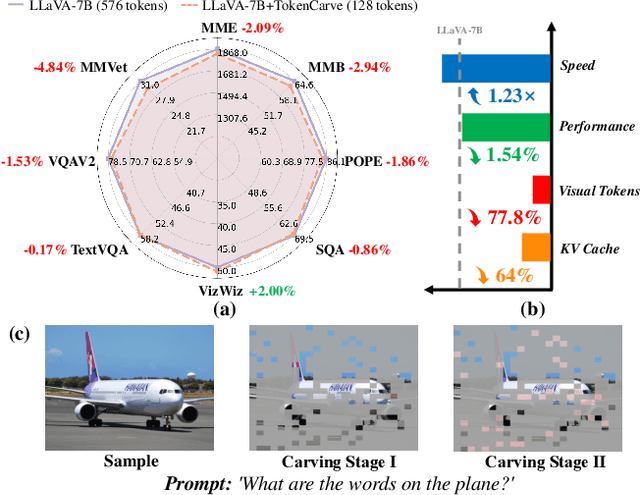
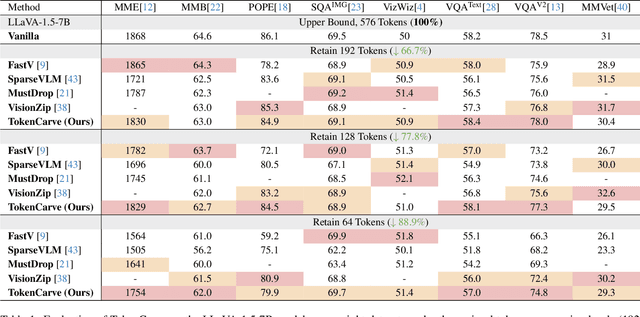
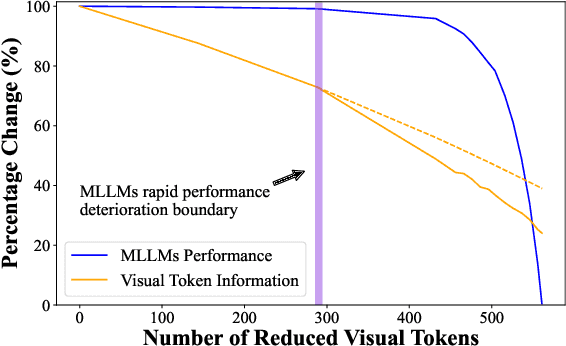
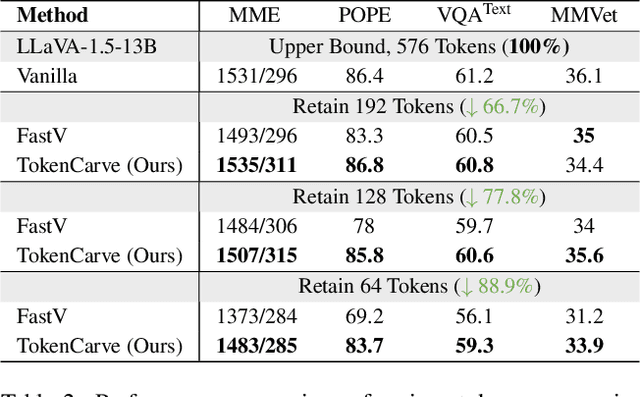
Multimodal Large Language Models (MLLMs) are becoming increasingly popular, while the high computational cost associated with multimodal data input, particularly from visual tokens, poses a significant challenge. Existing training-based token compression methods improve inference efficiency but require costly retraining, while training-free methods struggle to maintain performance when aggressively reducing token counts. In this study, we reveal that the performance degradation of MLLM closely correlates with the accelerated loss of information in the attention output matrix. This insight introduces a novel information-preserving perspective, making it possible to maintain performance even under extreme token compression. Based on this finding, we propose TokenCarve, a training-free, plug-and-play, two-stage token compression framework. The first stage employs an Information-Preservation-Guided Selection (IPGS) strategy to prune low-information tokens, while the second stage further leverages IPGS to guide token merging, minimizing information loss. Extensive experiments on 11 datasets and 2 model variants demonstrate the effectiveness of TokenCarve. It can even reduce the number of visual tokens to 22.2% of the original count, achieving a 1.23x speedup in inference, a 64% reduction in KV cache storage, and only a 1.54% drop in accuracy. Our code is available at https://github.com/ShawnTan86/TokenCarve.