 Add to Chrome
 Add to Firefox
 Add to Edge
The Molecular Structure of Thought: Mapping the Topology of Long Chain-of-Thought Reasoning
Jan 13, 2026
Large language models (LLMs) often fail to learn effective long chain-of-thought (Long CoT) reasoning from human or non-Long-CoT LLMs imitation. To understand this, we propose that effective and learnable Long CoT trajectories feature stable molecular-like structures in unified view, which are formed by three interaction types: Deep-Reasoning (covalent-like), Self-Reflection (hydrogen-bond-like), and Self-Exploration (van der Waals-like). Analysis of distilled trajectories reveals these structures emerge from Long CoT fine-tuning, not keyword imitation. We introduce Effective Semantic Isomers and show that only bonds promoting fast entropy convergence support stable Long CoT learning, while structural competition impairs training. Drawing on these findings, we present Mole-Syn, a distribution-transfer-graph method that guides synthesis of effective Long CoT structures, boosting performance and RL stability across benchmarks.

GenCRF: Generative Clustering and Reformulation Framework for Enhanced Intent-Driven Information Retrieval
Sep 17, 2024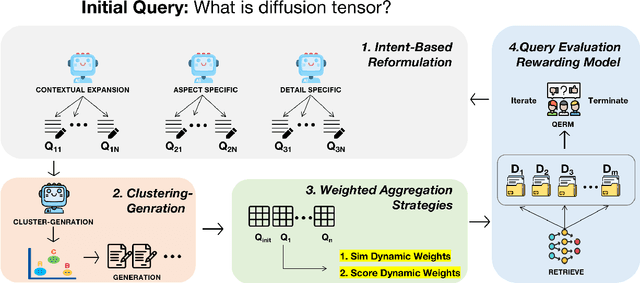
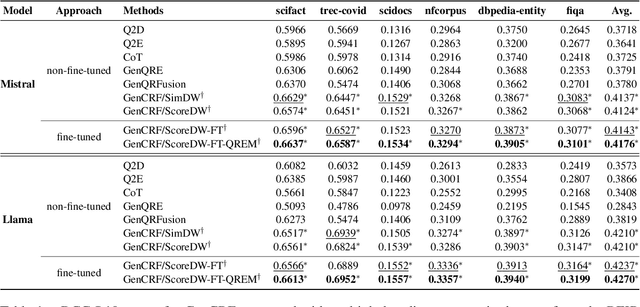
Query reformulation is a well-known problem in Information Retrieval (IR) aimed at enhancing single search successful completion rate by automatically modifying user's input query. Recent methods leverage Large Language Models (LLMs) to improve query reformulation, but often generate limited and redundant expansions, potentially constraining their effectiveness in capturing diverse intents. In this paper, we propose GenCRF: a Generative Clustering and Reformulation Framework to capture diverse intentions adaptively based on multiple differentiated, well-generated queries in the retrieval phase for the first time. GenCRF leverages LLMs to generate variable queries from the initial query using customized prompts, then clusters them into groups to distinctly represent diverse intents. Furthermore, the framework explores to combine diverse intents query with innovative weighted aggregation strategies to optimize retrieval performance and crucially integrates a novel Query Evaluation Rewarding Model (QERM) to refine the process through feedback loops. Empirical experiments on the BEIR benchmark demonstrate that GenCRF achieves state-of-the-art performance, surpassing previous query reformulation SOTAs by up to 12% on nDCG@10. These techniques can be adapted to various LLMs, significantly boosting retriever performance and advancing the field of Information Retrieval.