 Add to Chrome
 Add to Firefox
 Add to Edge
Training LLMs with Fault Tolerant HSDP on 100,000 GPUs
Jan 30, 2026
Large-scale training systems typically use synchronous training, requiring all GPUs to be healthy simultaneously. In our experience training on O(100K) GPUs, synchronous training results in a low efficiency due to frequent failures and long recovery time. To address this problem, we propose a novel training paradigm, Fault Tolerant Hybrid-Shared Data Parallelism (FT-HSDP). FT-HSDP uses data parallel replicas as units of fault tolerance. When failures occur, only a single data-parallel replica containing the failed GPU or server is taken offline and restarted, while the other replicas continue training. To realize this idea at scale, FT-HSDP incorporates several techniques: 1) We introduce a Fault Tolerant All Reduce (FTAR) protocol for gradient exchange across data parallel replicas. FTAR relies on the CPU to drive the complex control logic for tasks like adding or removing participants dynamically, and relies on GPU to perform data transfer for best performance. 2) We introduce a non-blocking catch-up protocol, allowing a recovering replica to join training with minimal stall. Compared with fully synchronous training at O(100K) GPUs, FT-HSDP can reduce the stall time due to failure recovery from 10 minutes to 3 minutes, increasing effective training time from 44\% to 80\%. We further demonstrate that FT-HSDP's asynchronous recovery does not bring any meaning degradation to the accuracy of the result model.

The Llama 4 Herd: Architecture, Training, Evaluation, and Deployment Notes
Jan 15, 2026This document consolidates publicly reported technical details about Metas Llama 4 model family. It summarizes (i) released variants (Scout and Maverick) and the broader herd context including the previewed Behemoth teacher model, (ii) architectural characteristics beyond a high-level MoE description covering routed/shared-expert structure, early-fusion multimodality, and long-context design elements reported for Scout (iRoPE and length generalization strategies), (iii) training disclosures spanning pre-training, mid-training for long-context extension, and post-training methodology (lightweight SFT, online RL, and lightweight DPO) as described in release materials, (iv) developer-reported benchmark results for both base and instruction-tuned checkpoints, and (v) practical deployment constraints observed across major serving environments, including provider-specific context limits and quantization packaging. The manuscript also summarizes licensing obligations relevant to redistribution and derivative naming, and reviews publicly described safeguards and evaluation practices. The goal is to provide a compact technical reference for researchers and practitioners who need precise, source-backed facts about Llama 4.
Chakra: Advancing Performance Benchmarking and Co-design using Standardized Execution Traces
May 26, 2023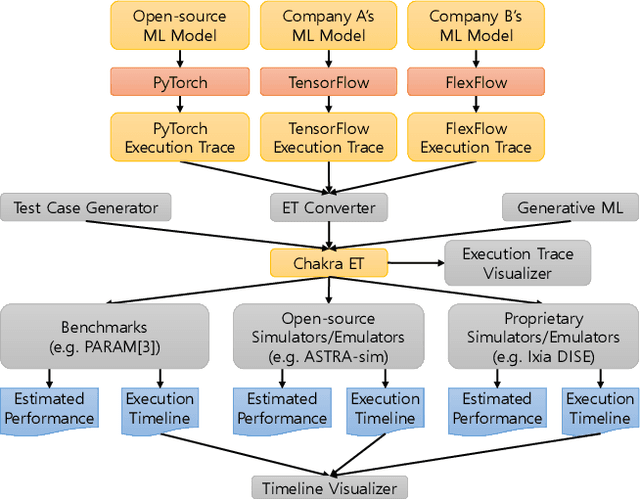
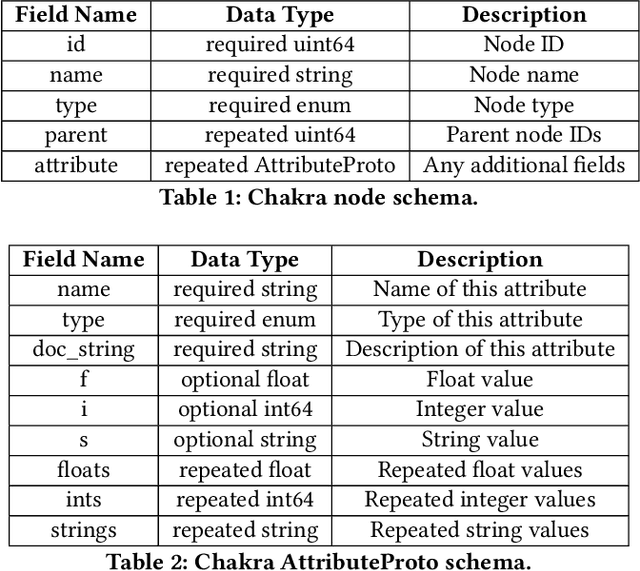

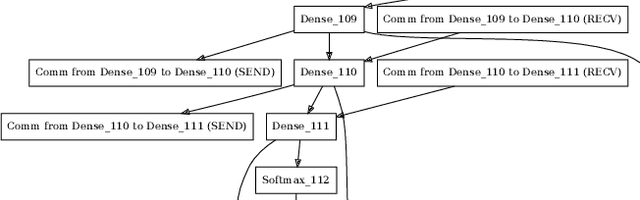
Benchmarking and co-design are essential for driving optimizations and innovation around ML models, ML software, and next-generation hardware. Full workload benchmarks, e.g. MLPerf, play an essential role in enabling fair comparison across different software and hardware stacks especially once systems are fully designed and deployed. However, the pace of AI innovation demands a more agile methodology to benchmark creation and usage by simulators and emulators for future system co-design. We propose Chakra, an open graph schema for standardizing workload specification capturing key operations and dependencies, also known as Execution Trace (ET). In addition, we propose a complementary set of tools/capabilities to enable collection, generation, and adoption of Chakra ETs by a wide range of simulators, emulators, and benchmarks. For instance, we use generative AI models to learn latent statistical properties across thousands of Chakra ETs and use these models to synthesize Chakra ETs. These synthetic ETs can obfuscate key proprietary information and also target future what-if scenarios. As an example, we demonstrate an end-to-end proof-of-concept that converts PyTorch ETs to Chakra ETs and uses this to drive an open-source training system simulator (ASTRA-sim). Our end-goal is to build a vibrant industry-wide ecosystem of agile benchmarks and tools to drive future AI system co-design.