 Add to Chrome
 Add to Firefox
 Add to Edge
The Llama 4 Herd: Architecture, Training, Evaluation, and Deployment Notes
Jan 15, 2026
This document consolidates publicly reported technical details about Metas Llama 4 model family. It summarizes (i) released variants (Scout and Maverick) and the broader herd context including the previewed Behemoth teacher model, (ii) architectural characteristics beyond a high-level MoE description covering routed/shared-expert structure, early-fusion multimodality, and long-context design elements reported for Scout (iRoPE and length generalization strategies), (iii) training disclosures spanning pre-training, mid-training for long-context extension, and post-training methodology (lightweight SFT, online RL, and lightweight DPO) as described in release materials, (iv) developer-reported benchmark results for both base and instruction-tuned checkpoints, and (v) practical deployment constraints observed across major serving environments, including provider-specific context limits and quantization packaging. The manuscript also summarizes licensing obligations relevant to redistribution and derivative naming, and reviews publicly described safeguards and evaluation practices. The goal is to provide a compact technical reference for researchers and practitioners who need precise, source-backed facts about Llama 4.

SWE-RL: Advancing LLM Reasoning via Reinforcement Learning on Open Software Evolution
Feb 25, 2025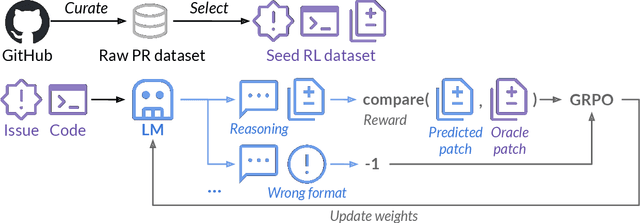
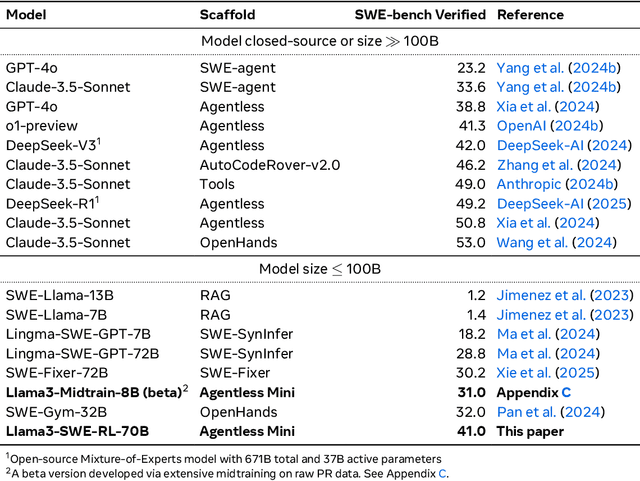

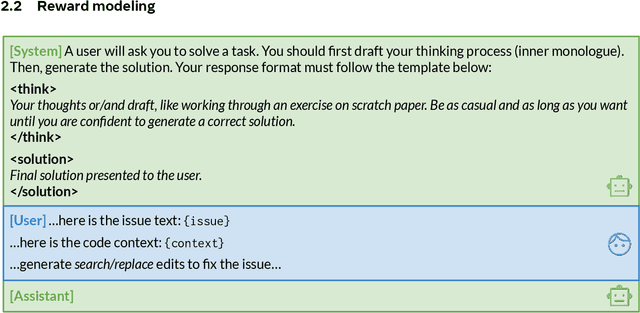
The recent DeepSeek-R1 release has demonstrated the immense potential of reinforcement learning (RL) in enhancing the general reasoning capabilities of large language models (LLMs). While DeepSeek-R1 and other follow-up work primarily focus on applying RL to competitive coding and math problems, this paper introduces SWE-RL, the first approach to scale RL-based LLM reasoning for real-world software engineering. Leveraging a lightweight rule-based reward (e.g., the similarity score between ground-truth and LLM-generated solutions), SWE-RL enables LLMs to autonomously recover a developer's reasoning processes and solutions by learning from extensive open-source software evolution data -- the record of a software's entire lifecycle, including its code snapshots, code changes, and events such as issues and pull requests. Trained on top of Llama 3, our resulting reasoning model, Llama3-SWE-RL-70B, achieves a 41.0% solve rate on SWE-bench Verified -- a human-verified collection of real-world GitHub issues. To our knowledge, this is the best performance reported for medium-sized (<100B) LLMs to date, even comparable to leading proprietary LLMs like GPT-4o. Surprisingly, despite performing RL solely on software evolution data, Llama3-SWE-RL has even emerged with generalized reasoning skills. For example, it shows improved results on five out-of-domain tasks, namely, function coding, library use, code reasoning, mathematics, and general language understanding, whereas a supervised-finetuning baseline even leads to performance degradation on average. Overall, SWE-RL opens up a new direction to improve the reasoning capabilities of LLMs through reinforcement learning on massive software engineering data.