 Add to Chrome
 Add to Firefox
 Add to Edge
Advances and Innovations in the Multi-Agent Robotic System (MARS) Challenge
Jan 26, 2026
Recent advancements in multimodal large language models and vision-languageaction models have significantly driven progress in Embodied AI. As the field transitions toward more complex task scenarios, multi-agent system frameworks are becoming essential for achieving scalable, efficient, and collaborative solutions. This shift is fueled by three primary factors: increasing agent capabilities, enhancing system efficiency through task delegation, and enabling advanced human-agent interactions. To address the challenges posed by multi-agent collaboration, we propose the Multi-Agent Robotic System (MARS) Challenge, held at the NeurIPS 2025 Workshop on SpaVLE. The competition focuses on two critical areas: planning and control, where participants explore multi-agent embodied planning using vision-language models (VLMs) to coordinate tasks and policy execution to perform robotic manipulation in dynamic environments. By evaluating solutions submitted by participants, the challenge provides valuable insights into the design and coordination of embodied multi-agent systems, contributing to the future development of advanced collaborative AI systems.

G3Flow: Generative 3D Semantic Flow for Pose-aware and Generalizable Object Manipulation
Nov 27, 2024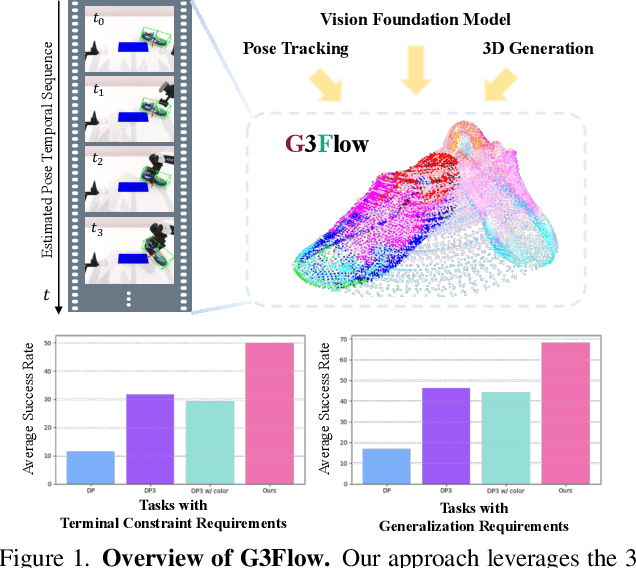

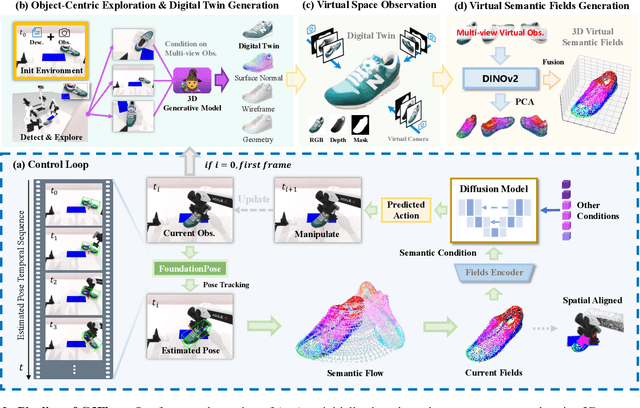
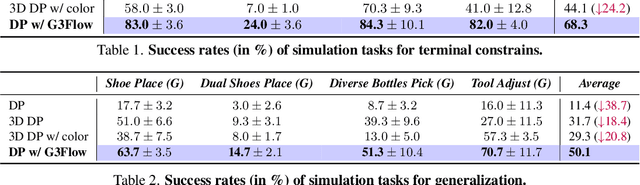
Recent advances in imitation learning for 3D robotic manipulation have shown promising results with diffusion-based policies. However, achieving human-level dexterity requires seamless integration of geometric precision and semantic understanding. We present G3Flow, a novel framework that constructs real-time semantic flow, a dynamic, object-centric 3D semantic representation by leveraging foundation models. Our approach uniquely combines 3D generative models for digital twin creation, vision foundation models for semantic feature extraction, and robust pose tracking for continuous semantic flow updates. This integration enables complete semantic understanding even under occlusions while eliminating manual annotation requirements. By incorporating semantic flow into diffusion policies, we demonstrate significant improvements in both terminal-constrained manipulation and cross-object generalization. Extensive experiments across five simulation tasks show that G3Flow consistently outperforms existing approaches, achieving up to 68.3% and 50.1% average success rates on terminal-constrained manipulation and cross-object generalization tasks respectively. Our results demonstrate the effectiveness of G3Flow in enhancing real-time dynamic semantic feature understanding for robotic manipulation policies.