 Add to Chrome
 Add to Firefox
 Add to Edge
Agri-R1: Empowering Generalizable Agricultural Reasoning in Vision-Language Models with Reinforcement Learning
Jan 08, 2026
Agricultural disease diagnosis challenges VLMs, as conventional fine-tuning requires extensive labels, lacks interpretability, and generalizes poorly. While reasoning improves model robustness, existing methods rely on costly expert annotations and rarely address the open-ended, diverse nature of agricultural queries. To address these limitations, we propose \textbf{Agri-R1}, a reasoning-enhanced large model for agriculture. Our framework automates high-quality reasoning data generation via vision-language synthesis and LLM-based filtering, using only 19\% of available samples. Training employs Group Relative Policy Optimization (GRPO) with a novel proposed reward function that integrates domain-specific lexicons and fuzzy matching to assess both correctness and linguistic flexibility in open-ended responses. Evaluated on CDDMBench, our resulting 3B-parameter model achieves performance competitive with 7B- to 13B-parameter baselines, showing a +23.2\% relative gain in disease recognition accuracy, +33.3\% in agricultural knowledge QA, and a +26.10-point improvement in cross-domain generalization over standard fine-tuning. Ablation studies confirm that the synergy between structured reasoning data and GRPO-driven exploration underpins these gains, with benefits scaling as question complexity increases.

CPJ: Explainable Agricultural Pest Diagnosis via Caption-Prompt-Judge with LLM-Judged Refinement
Dec 31, 2025Accurate and interpretable crop disease diagnosis is essential for agricultural decision-making, yet existing methods often rely on costly supervised fine-tuning and perform poorly under domain shifts. We propose Caption--Prompt--Judge (CPJ), a training-free few-shot framework that enhances Agri-Pest VQA through structured, interpretable image captions. CPJ employs large vision-language models to generate multi-angle captions, refined iteratively via an LLM-as-Judge module, which then inform a dual-answer VQA process for both recognition and management responses. Evaluated on CDDMBench, CPJ significantly improves performance: using GPT-5-mini captions, GPT-5-Nano achieves \textbf{+22.7} pp in disease classification and \textbf{+19.5} points in QA score over no-caption baselines. The framework provides transparent, evidence-based reasoning, advancing robust and explainable agricultural diagnosis without fine-tuning. Our code and data are publicly available at: https://github.com/CPJ-Agricultural/CPJ-Agricultural-Diagnosis.
Cross-Fundus Transformer for Multi-modal Diabetic Retinopathy Grading with Cataract
Nov 01, 2024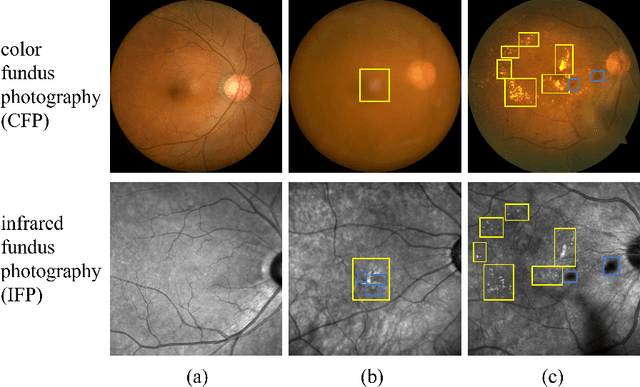
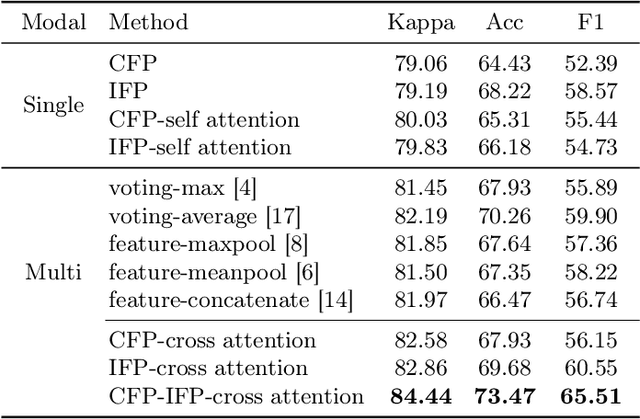
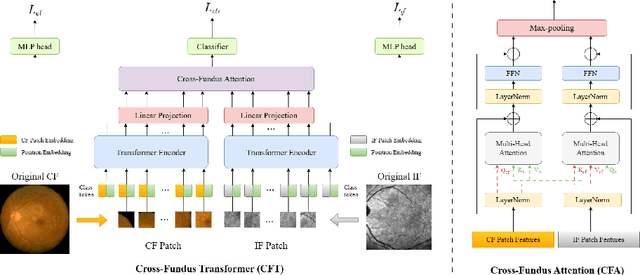
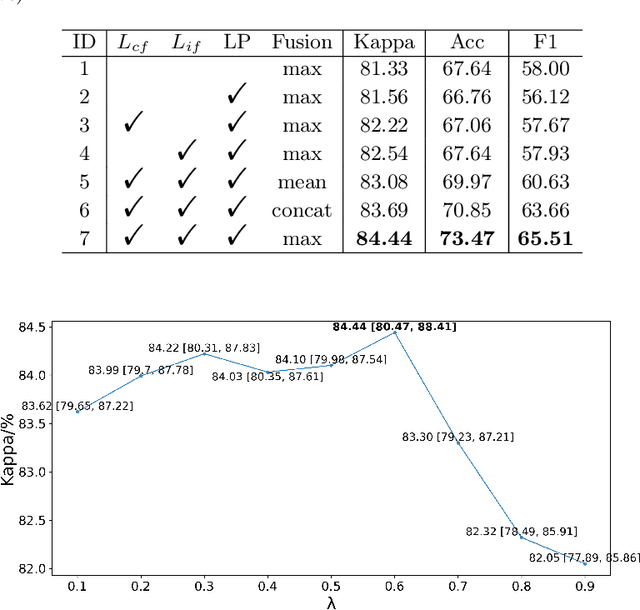
Diabetic retinopathy (DR) is a leading cause of blindness worldwide and a common complication of diabetes. As two different imaging tools for DR grading, color fundus photography (CFP) and infrared fundus photography (IFP) are highly-correlated and complementary in clinical applications. To the best of our knowledge, this is the first study that explores a novel multi-modal deep learning framework to fuse the information from CFP and IFP towards more accurate DR grading. Specifically, we construct a dual-stream architecture Cross-Fundus Transformer (CFT) to fuse the ViT-based features of two fundus image modalities. In particular, a meticulously engineered Cross-Fundus Attention (CFA) module is introduced to capture the correspondence between CFP and IFP images. Moreover, we adopt both the single-modality and multi-modality supervisions to maximize the overall performance for DR grading. Extensive experiments on a clinical dataset consisting of 1,713 pairs of multi-modal fundus images demonstrate the superiority of our proposed method. Our code will be released for public access.
Cross-Field Transformer for Diabetic Retinopathy Grading on Two-field Fundus Images
Dec 01, 2022Automatic diabetic retinopathy (DR) grading based on fundus photography has been widely explored to benefit the routine screening and early treatment. Existing researches generally focus on single-field fundus images, which have limited field of view for precise eye examinations. In clinical applications, ophthalmologists adopt two-field fundus photography as the dominating tool, where the information from each field (i.e.,macula-centric and optic disc-centric) is highly correlated and complementary, and benefits comprehensive decisions. However, automatic DR grading based on two-field fundus photography remains a challenging task due to the lack of publicly available datasets and effective fusion strategies. In this work, we first construct a new benchmark dataset (DRTiD) for DR grading, consisting of 3,100 two-field fundus images. To the best of our knowledge, it is the largest public DR dataset with diverse and high-quality two-field images. Then, we propose a novel DR grading approach, namely Cross-Field Transformer (CrossFiT), to capture the correspondence between two fields as well as the long-range spatial correlations within each field. Considering the inherent two-field geometric constraints, we particularly define aligned position embeddings to preserve relative consistent position in fundus. Besides, we perform masked cross-field attention during interaction to flter the noisy relations between fields. Extensive experiments on our DRTiD dataset and a public DeepDRiD dataset demonstrate the effectiveness of our CrossFiT network. The new dataset and the source code of CrossFiT will be publicly available at https://github.com/FDU-VTS/DRTiD.