 Add to Chrome
 Add to Firefox
 Add to Edge
SurGE: Surrogate Gradient-guided Evolution for Co-design of Legged Robots with Parallel Elasticity
Jun 20, 2026
Co-design of legged robots with elastic elements is challenging due to the non-differentiability of contact dynamics and mechanism engagement. This paper presents SurGE, a framework that computes surrogate gradients of the design objective through a differentiable pipeline consisting of a kinodynamic single-rigid-body (Kino-SRB) model and a design-aware control policy, and injects them into CMA-ES via mean shift with cosine-annealed step decay. On a 4-DOF design space of a hopping robot with unidirectional parallel spring, SurGE achieves 6 times lower cross-seed standard deviation and 18% tighter population concentration compared to vanilla CMA-ES, while matching or improving the best objective. Hardware experiments on a 2D design subspace show that, starting from a hand-tuned initial design, SurGE reduces the design objective by 37.65% on hardware, with the improvement trend identified in simulation transferring consistently to the physical system. SurGE provides the potential to accelerate non-differentiable co-design problems in legged robots via surrogate model gradients.

Replacing Human Audio with Synthetic Audio for On-device Unspoken Punctuation Prediction
Oct 20, 2020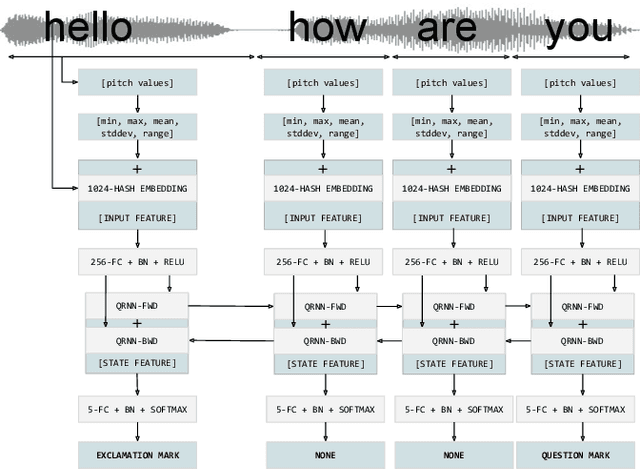

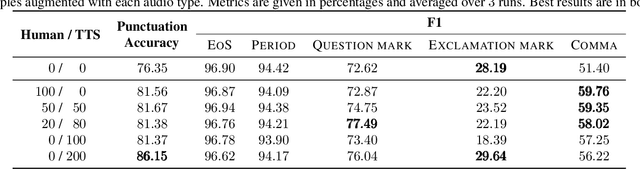

We present a novel multi-modal unspoken punctuation prediction system for the English language which combines acoustic and text features. We demonstrate for the first time, that by relying exclusively on synthetic data generated using a prosody-aware text-to-speech system, we can outperform a model trained with expensive human audio recordings on the unspoken punctuation prediction problem. Our model architecture is well suited for on-device use. This is achieved by leveraging hash-based embeddings of automatic speech recognition text output in conjunction with acoustic features as input to a quasi-recurrent neural network, keeping the model size small and latency low.
Gmail Smart Compose: Real-Time Assisted Writing
May 17, 2019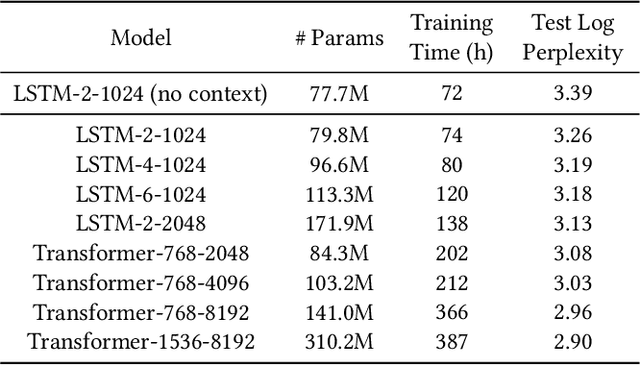
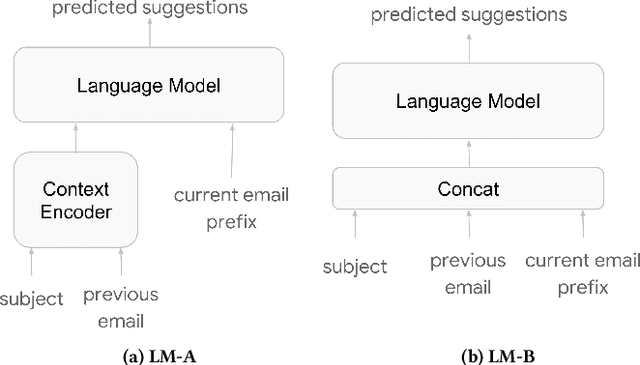
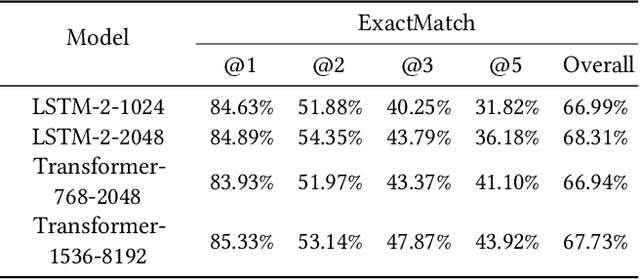
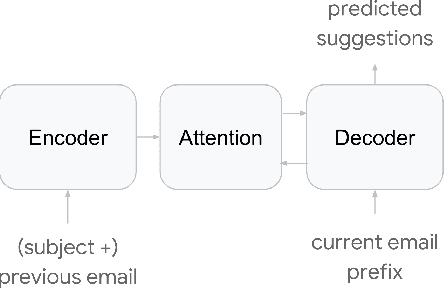
In this paper, we present Smart Compose, a novel system for generating interactive, real-time suggestions in Gmail that assists users in writing mails by reducing repetitive typing. In the design and deployment of such a large-scale and complicated system, we faced several challenges including model selection, performance evaluation, serving and other practical issues. At the core of Smart Compose is a large-scale neural language model. We leveraged state-of-the-art machine learning techniques for language model training which enabled high-quality suggestion prediction, and constructed novel serving infrastructure for high-throughput and real-time inference. Experimental results show the effectiveness of our proposed system design and deployment approach. This system is currently being served in Gmail.