 Add to Chrome
 Add to Firefox
 Add to Edge
Towards End-to-End Alignment of User Satisfaction via Questionnaire in Video Recommendation
Jan 28, 2026
Short-video recommender systems typically optimize ranking models using dense user behavioral signals, such as clicks and watch time. However, these signals are only indirect proxies of user satisfaction and often suffer from noise and bias. Recently, explicit satisfaction feedback collected through questionnaires has emerged as a high-quality direct alignment supervision, but is extremely sparse and easily overwhelmed by abundant behavioral data, making it difficult to incorporate into online recommendation models. To address these challenges, we propose a novel framework which is towards End-to-End Alignment of user Satisfaction via Questionaire, named EASQ, to enable real-time alignment of ranking models with true user satisfaction. Specifically, we first construct an independent parameter pathway for sparse questionnaire signals by combining a multi-task architecture and a lightweight LoRA module. The multi-task design separates sparse satisfaction supervision from dense behavioral signals, preventing the former from being overwhelmed. The LoRA module pre-inject these preferences in a parameter-isolated manner, ensuring stability in the backbone while optimizing user satisfaction. Furthermore, we employ a DPO-based optimization objective tailored for online learning, which aligns the main model outputs with sparse satisfaction signals in real time. This design enables end-to-end online learning, allowing the model to continuously adapt to new questionnaire feedback while maintaining the stability and effectiveness of the backbone. Extensive offline experiments and large-scale online A/B tests demonstrate that EASQ consistently improves user satisfaction metrics across multiple scenarios. EASQ has been successfully deployed in a production short-video recommendation system, delivering significant and stable business gains.

An End-to-End Multi-objective Ensemble Ranking Framework for Video Recommendation
Aug 07, 2025We propose a novel End-to-end Multi-objective Ensemble Ranking framework (EMER) for the multi-objective ensemble ranking module, which is the most critical component of the short video recommendation system. EMER enhances personalization by replacing manually-designed heuristic formulas with an end-to-end modeling paradigm. EMER introduces a meticulously designed loss function to address the fundamental challenge of defining effective supervision for ensemble ranking, where no single ground-truth signal can fully capture user satisfaction. Moreover, EMER introduces novel sample organization method and transformer-based network architecture to capture the comparative relationships among candidates, which are critical for effective ranking. Additionally, we have proposed an offline-online consistent evaluation system to enhance the efficiency of offline model optimization, which is an established yet persistent challenge within the multi-objective ranking domain in industry. Abundant empirical tests are conducted on a real industrial dataset, and the results well demonstrate the effectiveness of our proposed framework. In addition, our framework has been deployed in the primary scenarios of Kuaishou, a short video recommendation platform with hundreds of millions of daily active users, achieving a 1.39% increase in overall App Stay Time and a 0.196% increase in 7-day user Lifetime(LT7), which are substantial improvements.
DREAM: Domain-agnostic Reverse Engineering Attributes of Black-box Model
Dec 08, 2024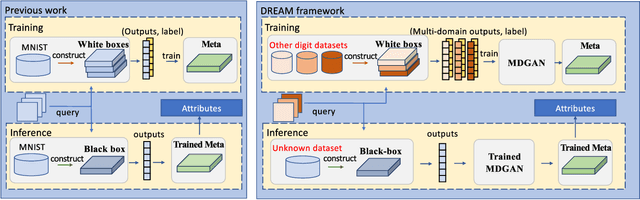
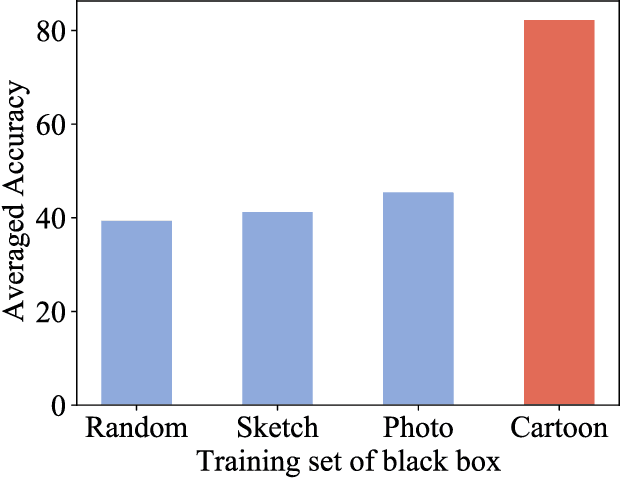
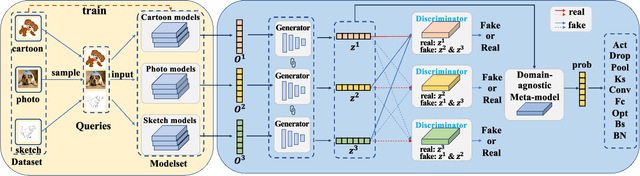
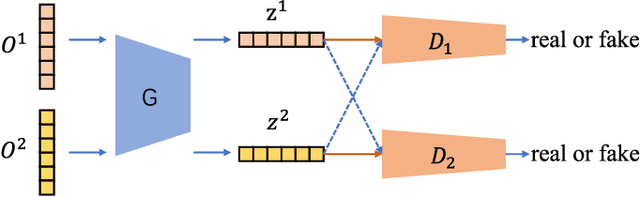
Deep learning models are usually black boxes when deployed on machine learning platforms. Prior works have shown that the attributes (e.g., the number of convolutional layers) of a target black-box model can be exposed through a sequence of queries. There is a crucial limitation: these works assume the training dataset of the target model is known beforehand and leverage this dataset for model attribute attack. However, it is difficult to access the training dataset of the target black-box model in reality. Therefore, whether the attributes of a target black-box model could be still revealed in this case is doubtful. In this paper, we investigate a new problem of black-box reverse engineering, without requiring the availability of the target model's training dataset. We put forward a general and principled framework DREAM, by casting this problem as out-of-distribution (OOD) generalization. In this way, we can learn a domain-agnostic meta-model to infer the attributes of the target black-box model with unknown training data. This makes our method one of the kinds that can gracefully apply to an arbitrary domain for model attribute reverse engineering with strong generalization ability. Extensive experimental results demonstrate the superiority of our proposed method over the baselines.
* arXiv admin note: substantial text overlap with arXiv:2307.10997
DREAM: Domain-free Reverse Engineering Attributes of Black-box Model
Jul 20, 2023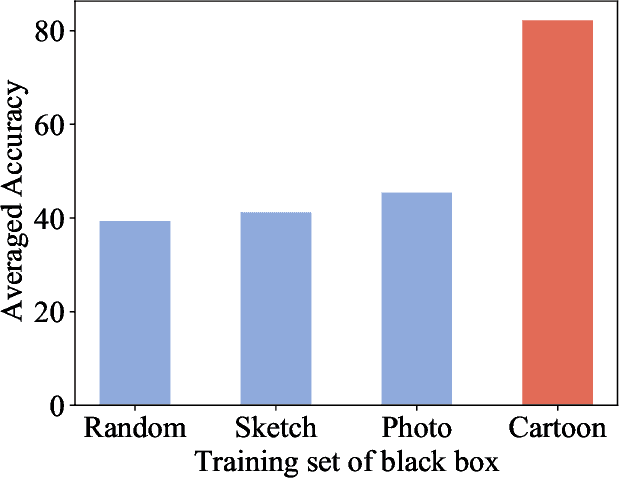

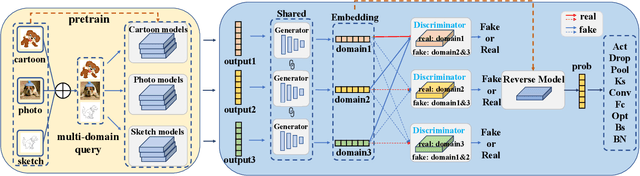
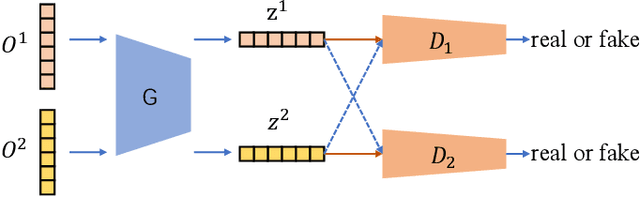
Deep learning models are usually black boxes when deployed on machine learning platforms. Prior works have shown that the attributes ($e.g.$, the number of convolutional layers) of a target black-box neural network can be exposed through a sequence of queries. There is a crucial limitation: these works assume the dataset used for training the target model to be known beforehand and leverage this dataset for model attribute attack. However, it is difficult to access the training dataset of the target black-box model in reality. Therefore, whether the attributes of a target black-box model could be still revealed in this case is doubtful. In this paper, we investigate a new problem of Domain-agnostic Reverse Engineering the Attributes of a black-box target Model, called DREAM, without requiring the availability of the target model's training dataset, and put forward a general and principled framework by casting this problem as an out of distribution (OOD) generalization problem. In this way, we can learn a domain-agnostic model to inversely infer the attributes of a target black-box model with unknown training data. This makes our method one of the kinds that can gracefully apply to an arbitrary domain for model attribute reverse engineering with strong generalization ability. Extensive experimental studies are conducted and the results validate the superiority of our proposed method over the baselines.