 Add to Chrome
 Add to Firefox
 Add to Edge
Multi-Modal LLM based Image Captioning in ICT: Bridging the Gap Between General and Industry Domain
Jan 14, 2026
In the information and communications technology (ICT) industry, training a domain-specific large language model (LLM) or constructing a retrieval-augmented generation system requires a substantial amount of high-value domain knowledge. However, the knowledge is not only hidden in the textual modality but also in the image modality. Traditional methods can parse text from domain documents but dont have image captioning ability. Multi-modal LLM (MLLM) can understand images, but they do not have sufficient domain knowledge. To address the above issues, this paper proposes a multi-stage progressive training strategy to train a Domain-specific Image Captioning Model (DICModel) in ICT, and constructs a standard evaluation system to validate the performance of DICModel. Specifically, this work first synthesizes about 7K image-text pairs by combining the Mermaid tool and LLMs, which are used for the first-stage supervised-fine-tuning (SFT) of DICModel. Then, ICT-domain experts manually annotate about 2K image-text pairs for the second-stage SFT of DICModel. Finally, experts and LLMs jointly synthesize about 1.5K visual question answering data for the instruction-based SFT. Experimental results indicate that our DICModel with only 7B parameters performs better than other state-of-the-art models with 32B parameters. Compared to the SOTA models with 7B and 32B parameters, our DICModel increases the BLEU metric by approximately 56.8% and 20.8%, respectively. On the objective questions constructed by ICT domain experts, our DICModel outperforms Qwen2.5-VL 32B by 1% in terms of accuracy rate. In summary, this work can efficiently and accurately extract the logical text from images, which is expected to promote the development of multimodal models in the ICT domain.

EDCO: Dynamic Curriculum Orchestration for Domain-specific Large Language Model Fine-tuning
Jan 07, 2026Domain-specific large language models (LLMs), typically developed by fine-tuning a pre-trained general-purpose LLM on specialized datasets, represent a significant advancement in applied AI. A common strategy in LLM fine-tuning is curriculum learning, which pre-orders training samples based on metrics like difficulty to improve learning efficiency compared to a random sampling strategy. However, most existing methods for LLM fine-tuning rely on a static curriculum, designed prior to training, which lacks adaptability to the model's evolving needs during fine-tuning. To address this, we propose EDCO, a novel framework based on two key concepts: inference entropy and dynamic curriculum orchestration. Inspired by recent findings that maintaining high answer entropy benefits long-term reasoning gains, EDCO prioritizes samples with high inference entropy in a continuously adapted curriculum. EDCO integrates three core components: an efficient entropy estimator that uses prefix tokens to approximate full-sequence entropy, an entropy-based curriculum generator that selects data points with the highest inference entropy, and an LLM trainer that optimizes the model on the selected curriculum. Comprehensive experiments in communication, medicine and law domains, EDCO outperforms traditional curriculum strategies for fine-tuning Qwen3-4B and Llama3.2-3B models under supervised and reinforcement learning settings. Furthermore, the proposed efficient entropy estimation reduces computational time by 83.5% while maintaining high accuracy.
HARIVO: Harnessing Text-to-Image Models for Video Generation
Oct 10, 2024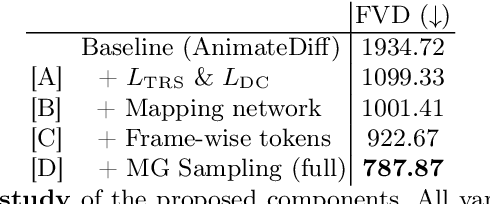
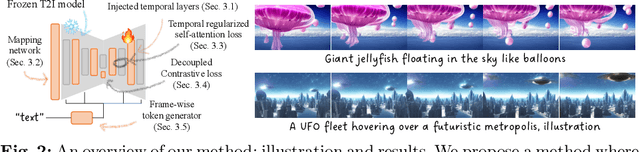
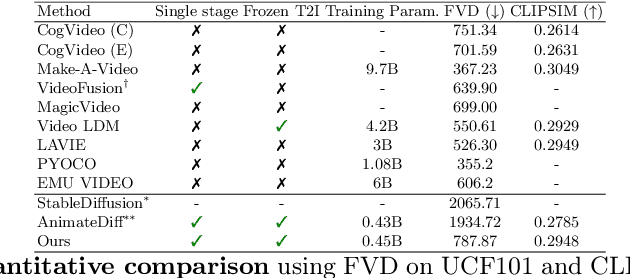
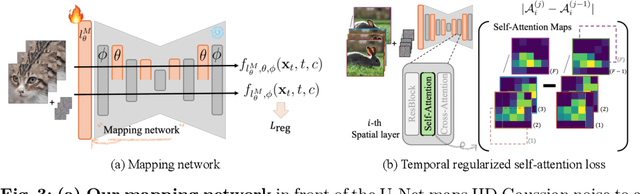
We present a method to create diffusion-based video models from pretrained Text-to-Image (T2I) models. Recently, AnimateDiff proposed freezing the T2I model while only training temporal layers. We advance this method by proposing a unique architecture, incorporating a mapping network and frame-wise tokens, tailored for video generation while maintaining the diversity and creativity of the original T2I model. Key innovations include novel loss functions for temporal smoothness and a mitigating gradient sampling technique, ensuring realistic and temporally consistent video generation despite limited public video data. We have successfully integrated video-specific inductive biases into the architecture and loss functions. Our method, built on the frozen StableDiffusion model, simplifies training processes and allows for seamless integration with off-the-shelf models like ControlNet and DreamBooth. project page: https://kwonminki.github.io/HARIVO