 Add to Chrome
 Add to Firefox
 Add to Edge
SARE: Sample-wise Adaptive Reasoning for Training-free Fine-grained Visual Recognition
Mar 18, 2026
Recent advances in Large Vision-Language Models (LVLMs) have enabled training-free Fine-Grained Visual Recognition (FGVR). However, effectively exploiting LVLMs for FGVR remains challenging due to the inherent visual ambiguity of subordinate-level categories. Existing methods predominantly adopt either retrieval-oriented or reasoning-oriented paradigms to tackle this challenge, but both are constrained by two fundamental limitations:(1) They apply the same inference pipeline to all samples without accounting for uneven recognition difficulty, thereby leading to suboptimal accuracy and efficiency; (2) The lack of mechanisms to consolidate and reuse error-specific experience causes repeated failures on similar challenging cases. To address these limitations, we propose SARE, a Sample-wise Adaptive textbfREasoning framework for training-free FGVR. Specifically, SARE adopts a cascaded design that combines fast candidate retrieval with fine-grained reasoning, invoking the latter only when necessary. In the reasoning process, SARE incorporates a self-reflective experience mechanism that leverages past failures to provide transferable discriminative guidance during inference, without any parameter updates. Extensive experiments across 14 datasets substantiate that SARE achieves state-of-the-art performance while substantially reducing computational overhead.

Faithful Bi-Directional Model Steering via Distribution Matching and Distributed Interchange Interventions
Feb 05, 2026Intervention-based model steering offers a lightweight and interpretable alternative to prompting and fine-tuning. However, by adapting strong optimization objectives from fine-tuning, current methods are susceptible to overfitting and often underperform, sometimes generating unnatural outputs. We hypothesize that this is because effective steering requires the faithful identification of internal model mechanisms, not the enforcement of external preferences. To this end, we build on the principles of distributed alignment search (DAS), the standard for causal variable localization, to propose a new steering method: Concept DAS (CDAS). While we adopt the core mechanism of DAS, distributed interchange intervention (DII), we introduce a novel distribution matching objective tailored for the steering task by aligning intervened output distributions with counterfactual distributions. CDAS differs from prior work in two main ways: first, it learns interventions via weak-supervised distribution matching rather than probability maximization; second, it uses DIIs that naturally enable bi-directional steering and allow steering factors to be derived from data, reducing the effort required for hyperparameter tuning and resulting in more faithful and stable control. On AxBench, a large-scale model steering benchmark, we show that CDAS does not always outperform preference-optimization methods but may benefit more from increased model scale. In two safety-related case studies, overriding refusal behaviors of safety-aligned models and neutralizing a chain-of-thought backdoor, CDAS achieves systematic steering while maintaining general model utility. These results indicate that CDAS is complementary to preference-optimization approaches and conditionally constitutes a robust approach to intervention-based model steering. Our code is available at https://github.com/colored-dye/concept_das.
RAGFort: Dual-Path Defense Against Proprietary Knowledge Base Extraction in Retrieval-Augmented Generation
Nov 13, 2025
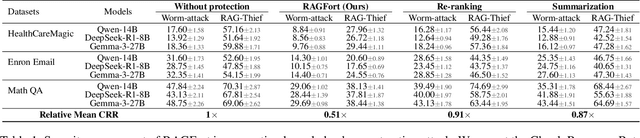
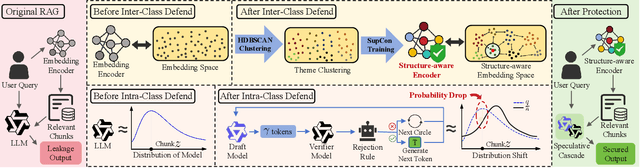
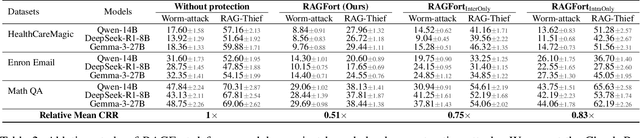
Retrieval-Augmented Generation (RAG) systems deployed over proprietary knowledge bases face growing threats from reconstruction attacks that aggregate model responses to replicate knowledge bases. Such attacks exploit both intra-class and inter-class paths, progressively extracting fine-grained knowledge within topics and diffusing it across semantically related ones, thereby enabling comprehensive extraction of the original knowledge base. However, existing defenses target only one path, leaving the other unprotected. We conduct a systematic exploration to assess the impact of protecting each path independently and find that joint protection is essential for effective defense. Based on this, we propose RAGFort, a structure-aware dual-module defense combining "contrastive reindexing" for inter-class isolation and "constrained cascade generation" for intra-class protection. Experiments across security, performance, and robustness confirm that RAGFort significantly reduces reconstruction success while preserving answer quality, offering comprehensive defense against knowledge base extraction attacks.
Do Not Merge My Model! Safeguarding Open-Source LLMs Against Unauthorized Model Merging
Nov 13, 2025Model merging has emerged as an efficient technique for expanding large language models (LLMs) by integrating specialized expert models. However, it also introduces a new threat: model merging stealing, where free-riders exploit models through unauthorized model merging. Unfortunately, existing defense mechanisms fail to provide effective protection. Specifically, we identify three critical protection properties that existing methods fail to simultaneously satisfy: (1) proactively preventing unauthorized merging; (2) ensuring compatibility with general open-source settings; (3) achieving high security with negligible performance loss. To address the above issues, we propose MergeBarrier, a plug-and-play defense that proactively prevents unauthorized merging. The core design of MergeBarrier is to disrupt the Linear Mode Connectivity (LMC) between the protected model and its homologous counterparts, thereby eliminating the low-loss path required for effective model merging. Extensive experiments show that MergeBarrier effectively prevents model merging stealing with negligible accuracy loss.
SeMi: When Imbalanced Semi-Supervised Learning Meets Mining Hard Examples
Jan 10, 2025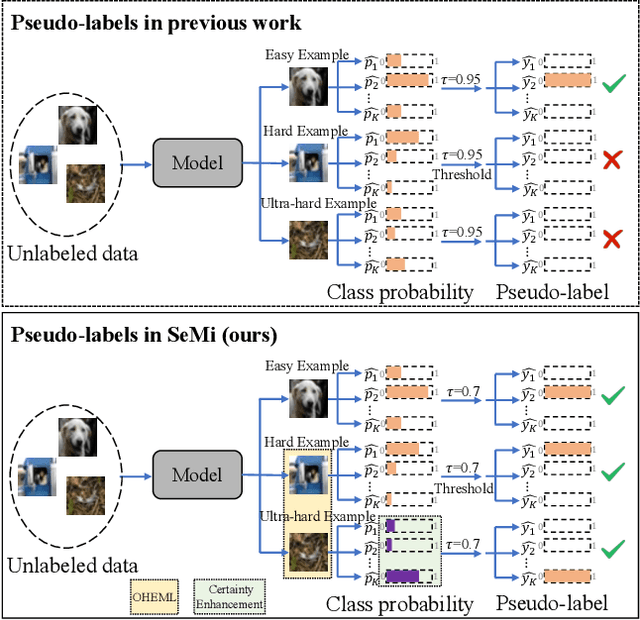
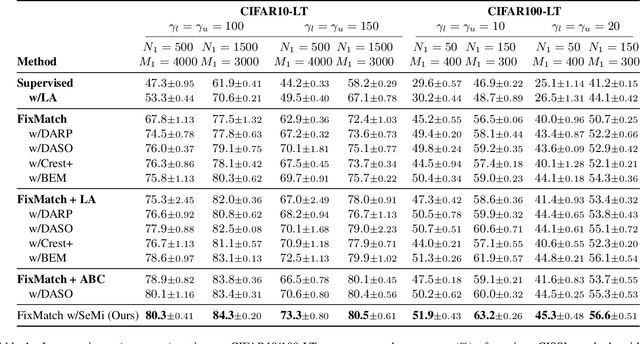
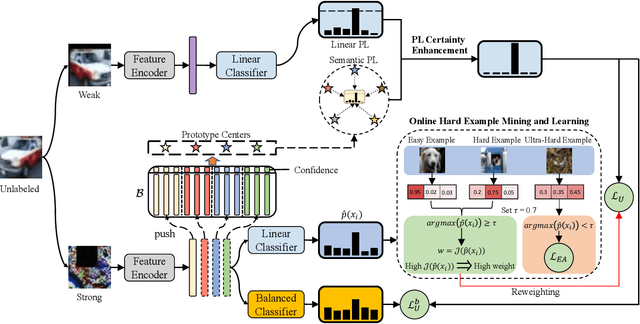
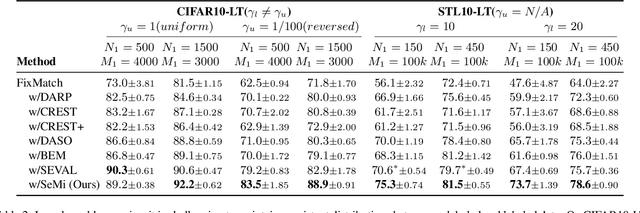
Semi-Supervised Learning (SSL) can leverage abundant unlabeled data to boost model performance. However, the class-imbalanced data distribution in real-world scenarios poses great challenges to SSL, resulting in performance degradation. Existing class-imbalanced semi-supervised learning (CISSL) methods mainly focus on rebalancing datasets but ignore the potential of using hard examples to enhance performance, making it difficult to fully harness the power of unlabeled data even with sophisticated algorithms. To address this issue, we propose a method that enhances the performance of Imbalanced Semi-Supervised Learning by Mining Hard Examples (SeMi). This method distinguishes the entropy differences among logits of hard and easy examples, thereby identifying hard examples and increasing the utility of unlabeled data, better addressing the imbalance problem in CISSL. In addition, we maintain a class-balanced memory bank with confidence decay for storing high-confidence embeddings to enhance the pseudo-labels' reliability. Although our method is simple, it is effective and seamlessly integrates with existing approaches. We perform comprehensive experiments on standard CISSL benchmarks and experimentally demonstrate that our proposed SeMi outperforms existing state-of-the-art methods on multiple benchmarks, especially in reversed scenarios, where our best result shows approximately a 54.8\% improvement over the baseline methods.
Hybrid Tracker with Pixel and Instance for Video Panoptic Segmentation
Mar 02, 2022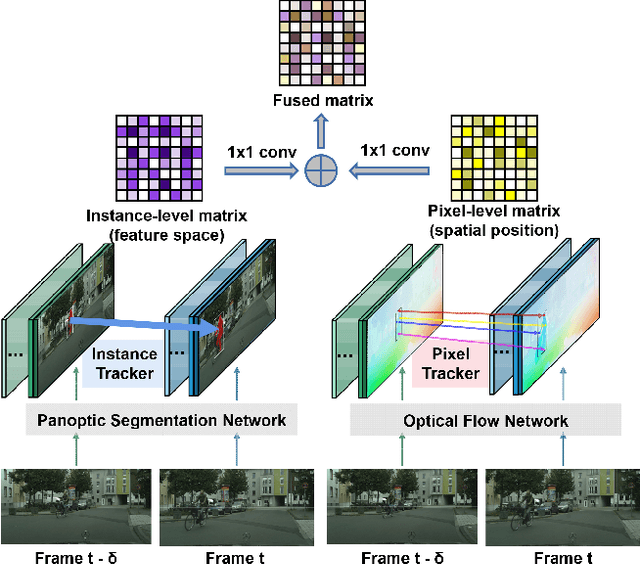
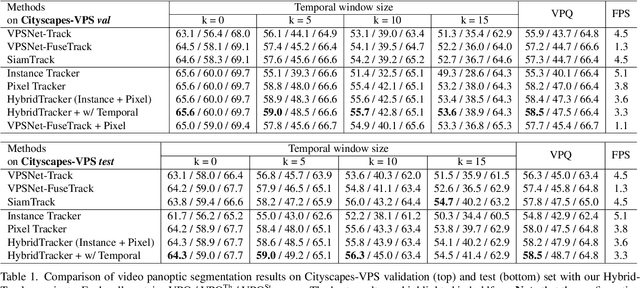
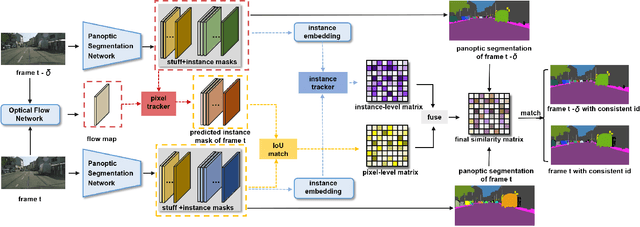
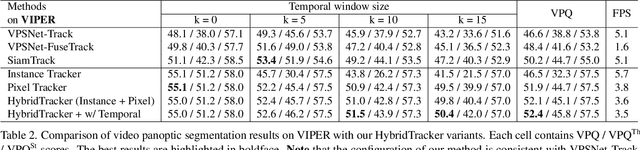
Video Panoptic Segmentation (VPS) requires generating consistent panoptic segmentation and tracking identities to all pixels across video frames. Existing methods are mainly based on the trained instance embedding to maintain consistent panoptic segmentation. However, they inevitably struggle to cope with the challenges of small objects, similar appearance but inconsistent identities, occlusion, and strong instance contour deformations. To address these problems, we present HybridTracker, a lightweight and joint tracking model attempting to eliminate the limitations of the single tracker. HybridTracker performs pixel tracker and instance tracker in parallel to obtain the association matrices, which are fused into a matching matrix. In the instance tracker, we design a differentiable matching layer, ensuring the stability of inter-frame matching. In the pixel tracker, we compute the dice coefficient of the same instance of different frames given the estimated optical flow, forming the Intersection Over Union (IoU) matrix. We additionally propose mutual check and temporal consistency constraints during inference to settle the occlusion and contour deformation challenges. Extensive experiments demonstrate that HybridTracker outperforms state-of-the-art methods on Cityscapes-VPS and VIPER datasets.