 Add to Chrome
 Add to Firefox
 Add to Edge
When Meanings Meet: Investigating the Emergence and Quality of Shared Concept Spaces during Multilingual Language Model Training
Jan 30, 2026
Training Large Language Models (LLMs) with high multilingual coverage is becoming increasingly important -- especially when monolingual resources are scarce. Recent studies have found that LLMs process multilingual inputs in shared concept spaces, thought to support generalization and cross-lingual transfer. However, these prior studies often do not use causal methods, lack deeper error analysis or focus on the final model only, leaving open how these spaces emerge during training. We investigate the development of language-agnostic concept spaces during pretraining of EuroLLM through the causal interpretability method of activation patching. We isolate cross-lingual concept representations, then inject them into a translation prompt to investigate how consistently translations can be altered, independently of the language. We find that shared concept spaces emerge early} and continue to refine, but that alignment with them is language-dependent}. Furthermore, in contrast to prior work, our fine-grained manual analysis reveals that some apparent gains in translation quality reflect shifts in behavior -- like selecting senses for polysemous words or translating instead of copying cross-lingual homographs -- rather than improved translation ability. Our findings offer new insight into the training dynamics of cross-lingual alignment and the conditions under which causal interpretability methods offer meaningful insights in multilingual contexts.

SteerEval: Inference-time Interventions Strengthen Multilingual Generalization in Neural Summarization Metrics
Jan 22, 2026An increasing body of work has leveraged multilingual language models for Natural Language Generation tasks such as summarization. A major empirical bottleneck in this area is the shortage of accurate and robust evaluation metrics for many languages, which hinders progress. Recent studies suggest that multilingual language models often use English as an internal pivot language, and that misalignment with this pivot can lead to degraded downstream performance. Motivated by the hypothesis that this mismatch could also apply to multilingual neural metrics, we ask whether steering their activations toward an English pivot can improve correlation with human judgments. We experiment with encoder- and decoder-based metrics and find that test-time intervention methods are effective across the board, increasing metric effectiveness for diverse languages.
Tracing Multilingual Factual Knowledge Acquisition in Pretraining
May 20, 2025Large Language Models (LLMs) are capable of recalling multilingual factual knowledge present in their pretraining data. However, most studies evaluate only the final model, leaving the development of factual recall and crosslingual consistency throughout pretraining largely unexplored. In this work, we trace how factual recall and crosslingual consistency evolve during pretraining, focusing on OLMo-7B as a case study. We find that both accuracy and consistency improve over time for most languages. We show that this improvement is primarily driven by the fact frequency in the pretraining corpus: more frequent facts are more likely to be recalled correctly, regardless of language. Yet, some low-frequency facts in non-English languages can still be correctly recalled. Our analysis reveals that these instances largely benefit from crosslingual transfer of their English counterparts -- an effect that emerges predominantly in the early stages of pretraining. We pinpoint two distinct pathways through which multilingual factual knowledge acquisition occurs: (1) frequency-driven learning, which is dominant and language-agnostic, and (2) crosslingual transfer, which is limited in scale and typically constrained to relation types involving named entities. We release our code and data to facilitate further research at https://github.com/cisnlp/multilingual-fact-tracing.
Add Noise, Tasks, or Layers? MaiNLP at the VarDial 2025 Shared Task on Norwegian Dialectal Slot and Intent Detection
Jan 07, 2025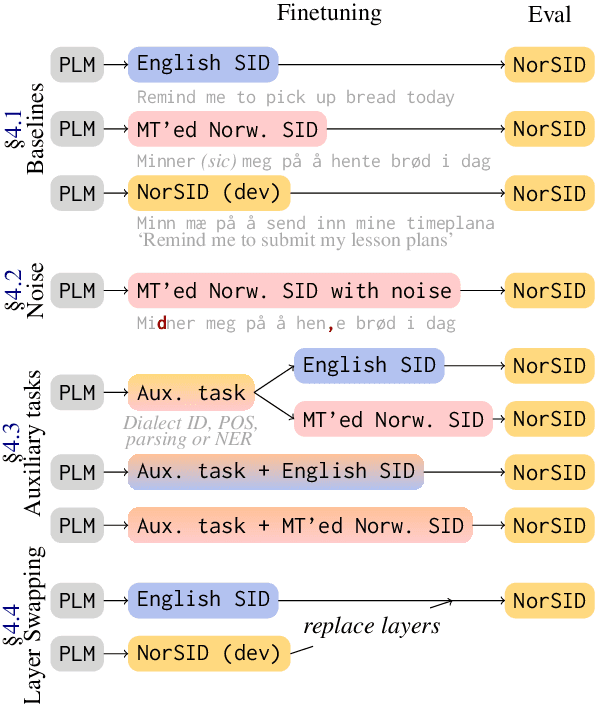
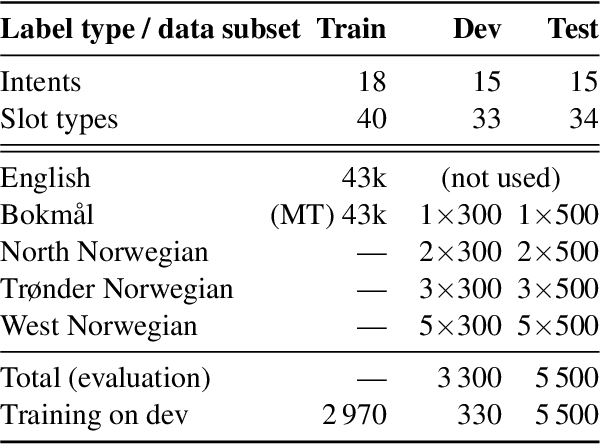
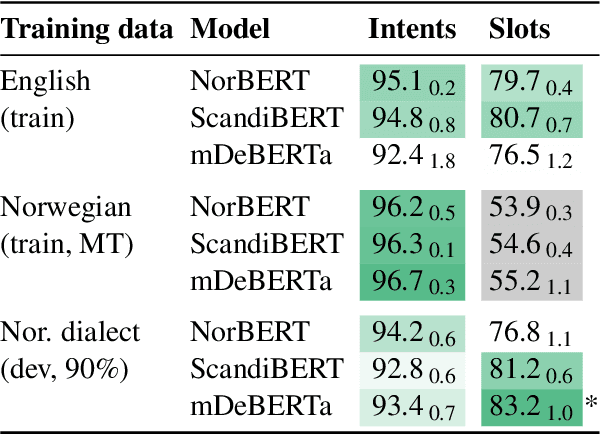
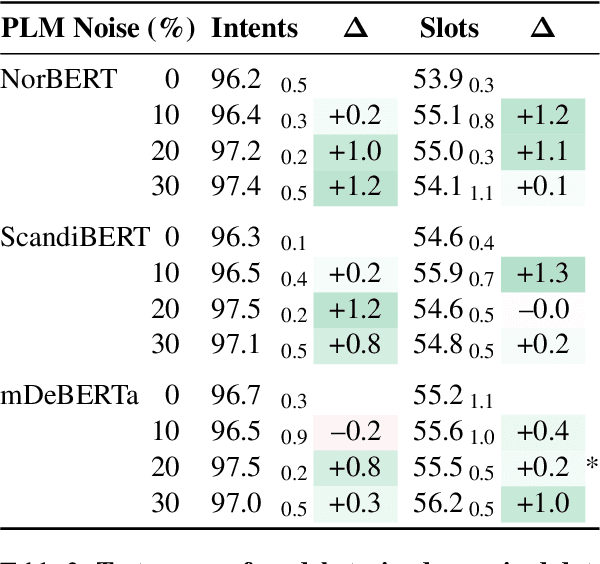
Slot and intent detection (SID) is a classic natural language understanding task. Despite this, research has only more recently begun focusing on SID for dialectal and colloquial varieties. Many approaches for low-resource scenarios have not yet been applied to dialectal SID data, or compared to each other on the same datasets. We participate in the VarDial 2025 shared task on slot and intent detection in Norwegian varieties, and compare multiple set-ups: varying the training data (English, Norwegian, or dialectal Norwegian), injecting character-level noise, training on auxiliary tasks, and applying Layer Swapping, a technique in which layers of models fine-tuned on different datasets are assembled into a model. We find noise injection to be beneficial while the effects of auxiliary tasks are mixed. Though some experimentation was required to successfully assemble a model from layers, it worked surprisingly well; a combination of models trained on English and small amounts of dialectal data produced the most robust slot predictions. Our best models achieve 97.6% intent accuracy and 85.6% slot F1 in the shared task.