 Add to Chrome
 Add to Firefox
 Add to Edge
Typhoon ASR Real-time: FastConformer-Transducer for Thai Automatic Speech Recognition
Jan 19, 2026
Large encoder-decoder models like Whisper achieve strong offline transcription but remain impractical for streaming applications due to high latency. However, due to the accessibility of pre-trained checkpoints, the open Thai ASR landscape remains dominated by these offline architectures, leaving a critical gap in efficient streaming solutions. We present Typhoon ASR Real-time, a 115M-parameter FastConformer-Transducer model for low-latency Thai speech recognition. We demonstrate that rigorous text normalization can match the impact of model scaling: our compact model achieves a 45x reduction in computational cost compared to Whisper Large-v3 while delivering comparable accuracy. Our normalization pipeline resolves systemic ambiguities in Thai transcription --including context-dependent number verbalization and repetition markers (mai yamok) --creating consistent training targets. We further introduce a two-stage curriculum learning approach for Isan (north-eastern) dialect adaptation that preserves Central Thai performance. To address reproducibility challenges in Thai ASR, we release the Typhoon ASR Benchmark, a gold-standard human-labeled datasets with transcriptions following established Thai linguistic conventions, providing standardized evaluation protocols for the research community.

ThaiOCRBench: A Task-Diverse Benchmark for Vision-Language Understanding in Thai
Nov 06, 2025We present ThaiOCRBench, the first comprehensive benchmark for evaluating vision-language models (VLMs) on Thai text-rich visual understanding tasks. Despite recent progress in multimodal modeling, existing benchmarks predominantly focus on high-resource languages, leaving Thai underrepresented, especially in tasks requiring document structure understanding. ThaiOCRBench addresses this gap by offering a diverse, human-annotated dataset comprising 2,808 samples across 13 task categories. We evaluate a wide range of state-of-the-art VLMs in a zero-shot setting, spanning both proprietary and open-source systems. Results show a significant performance gap, with proprietary models (e.g., Gemini 2.5 Pro) outperforming open-source counterparts. Notably, fine-grained text recognition and handwritten content extraction exhibit the steepest performance drops among open-source models. Through detailed error analysis, we identify key challenges such as language bias, structural mismatch, and hallucinated content. ThaiOCRBench provides a standardized framework for assessing VLMs in low-resource, script-complex settings, and provides actionable insights for improving Thai-language document understanding.
Crowdsource, Crawl, or Generate? Creating SEA-VL, a Multicultural Vision-Language Dataset for Southeast Asia
Mar 10, 2025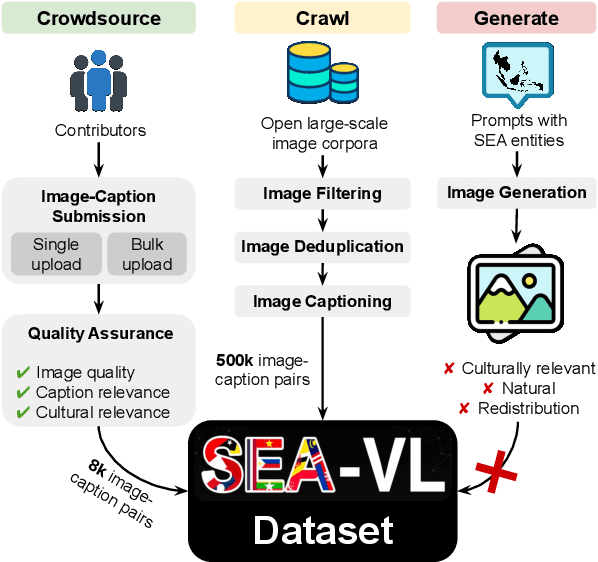
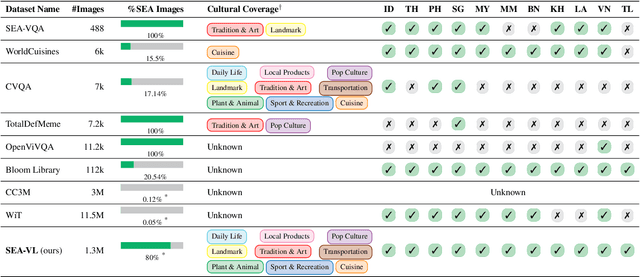
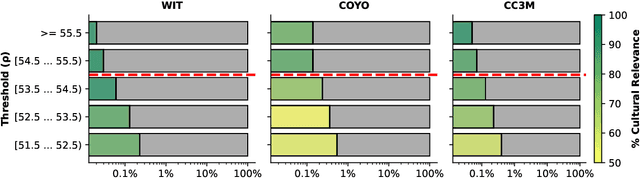
Southeast Asia (SEA) is a region of extraordinary linguistic and cultural diversity, yet it remains significantly underrepresented in vision-language (VL) research. This often results in artificial intelligence (AI) models that fail to capture SEA cultural nuances. To fill this gap, we present SEA-VL, an open-source initiative dedicated to developing high-quality, culturally relevant data for SEA languages. By involving contributors from SEA countries, SEA-VL aims to ensure better cultural relevance and diversity, fostering greater inclusivity of underrepresented languages in VL research. Beyond crowdsourcing, our initiative goes one step further in the exploration of the automatic collection of culturally relevant images through crawling and image generation. First, we find that image crawling achieves approximately ~85% cultural relevance while being more cost- and time-efficient than crowdsourcing. Second, despite the substantial progress in generative vision models, synthetic images remain unreliable in accurately reflecting SEA cultures. The generated images often fail to reflect the nuanced traditions and cultural contexts of the region. Collectively, we gather 1.28M SEA culturally-relevant images, more than 50 times larger than other existing datasets. Through SEA-VL, we aim to bridge the representation gap in SEA, fostering the development of more inclusive AI systems that authentically represent diverse cultures across SEA.
Typhoon 2: A Family of Open Text and Multimodal Thai Large Language Models
Dec 19, 2024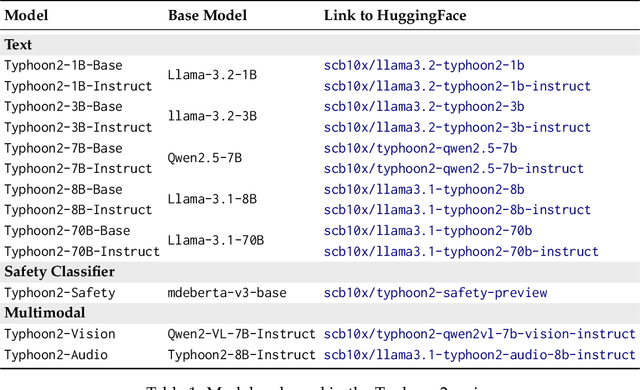
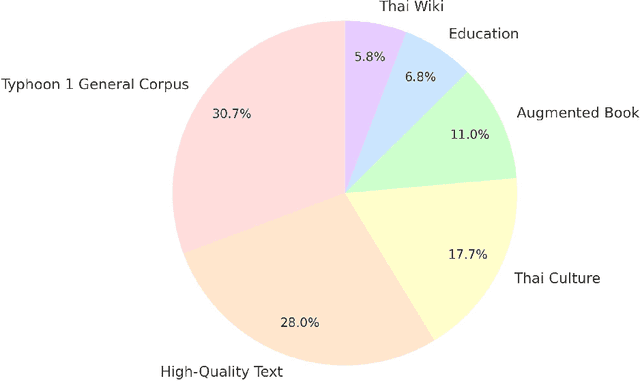
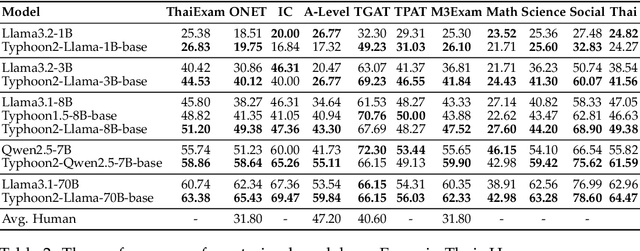
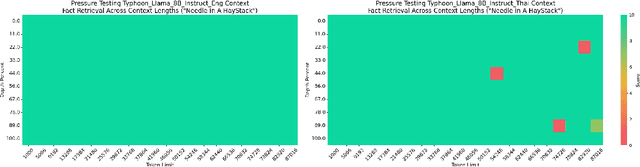
This paper introduces Typhoon 2, a series of text and multimodal large language models optimized for the Thai language. The series includes models for text, vision, and audio. Typhoon2-Text builds on state-of-the-art open models, such as Llama 3 and Qwen2, and we perform continual pre-training on a mixture of English and Thai data. We employ post-training techniques to enhance Thai language performance while preserving the base models' original capabilities. We release text models across a range of sizes, from 1 to 70 billion parameters, available in both base and instruction-tuned variants. To guardrail text generation, we release Typhoon2-Safety, a classifier enhanced for Thai cultures and language. Typhoon2-Vision improves Thai document understanding while retaining general visual capabilities, such as image captioning. Typhoon2-Audio introduces an end-to-end speech-to-speech model architecture capable of processing audio, speech, and text inputs and generating both text and speech outputs.