 Add to Chrome
 Add to Firefox
 Add to Edge
Czt
Papers and Code
Resolution Improvement in OFDM-based Joint Communication and Sensing through Combined Tracking and Interpolation
Nov 19, 2024
We investigate a monostatic orthogonal frequency-division multiplexing (OFDM)-based joint communication and sensing (JCAS) system with multiple antennas for object tracking. The native resolution of OFDM sensing, and radar sensing in general, is limited by the observation time and bandwidth. In this work, we improve the resolution through interpolation methods and tracking algorithms. We verify the resolution enhancement by comparing the root mean squared error (RMSE) of the estimated range, velocity and angle and by comparing the mean Euclidean distance between the estimated and true position. We demonstrate how both a Kalman filter for tracking, and interpolation methods using zero-padding and the chirp Z-transform (CZT) improve the estimation error. We discuss the computational complexity of the different methods. We propose the KalmanCZT approach that combines tracking via Kalman filtering and interpolation via the CZT, resulting in a solution with flexible resolution that significantly improves the range RMSE.

Modeling and Simulation of Charge-Induced Signals in Photon-Counting CZT Detectors for Medical Imaging Applications
May 21, 2024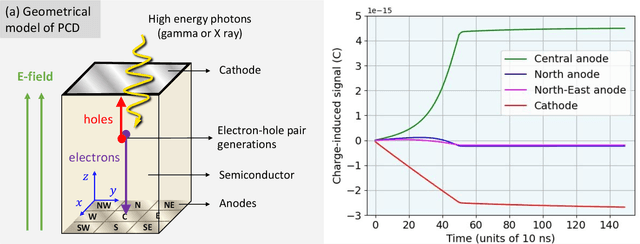
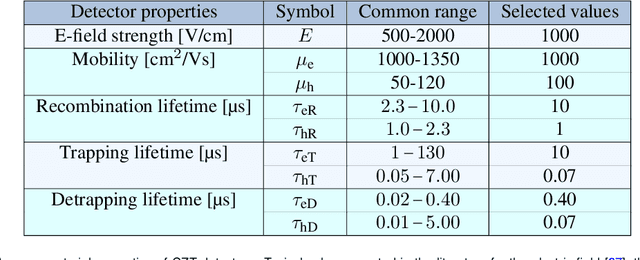
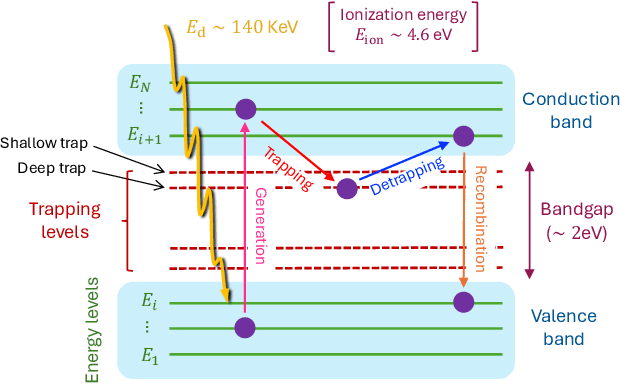
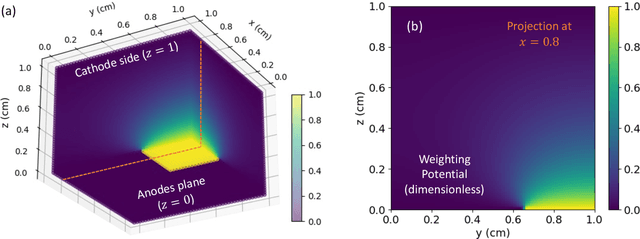
Photon-counting detectors based on CZT are essential in nuclear medical imaging, particularly for SPECT applications. Although CZT detectors are known for their precise energy resolution, defects within the CZT crystals significantly impact their performance. These defects result in inhomogeneous material properties throughout the bulk of the detector. The present work introduces an efficient computational model that simulates the operation of semiconductor detectors, accounting for the spatial variability of the crystal properties. Our simulator reproduces the charge-induced pulse signals generated after the X/gamma-rays interact with the detector. The performance evaluation of the model shows an RMSE in the signal below 0.70%. Our simulator can function as a digital twin to accurately replicate the operation of actual detectors. Thus, it can be used to mitigate and compensate for adverse effects arising from crystal impurities.
Deep adaptative spectral zoom for improved remote heart rate estimation
Mar 11, 2024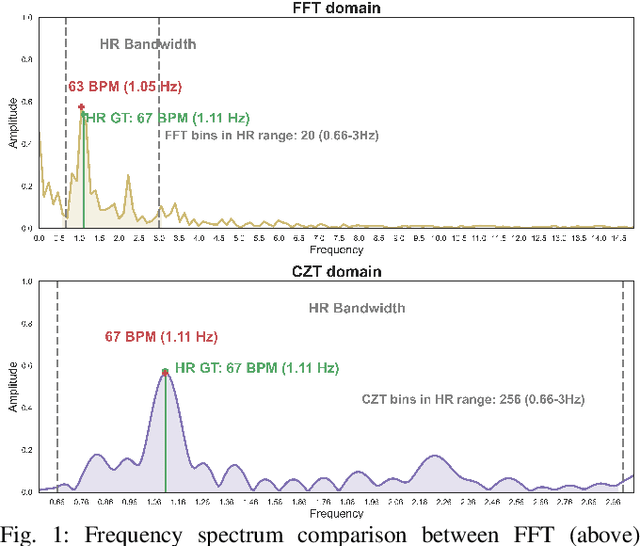
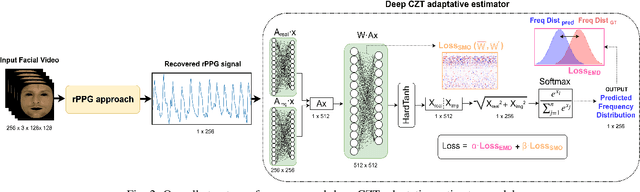
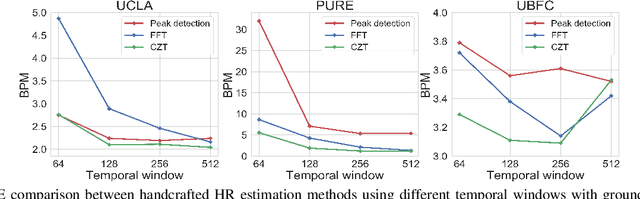
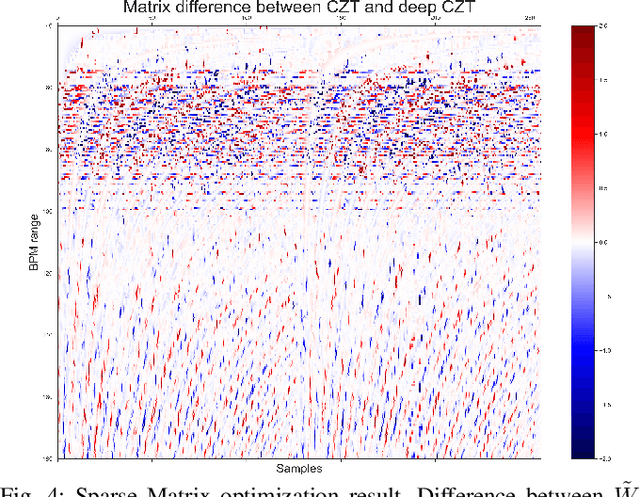
Recent advances in remote heart rate measurement, motivated by data-driven approaches, have notably enhanced accuracy. However, these improvements primarily focus on recovering the rPPG signal, overlooking the implicit challenges of estimating the heart rate (HR) from the derived signal. While many methods employ the Fast Fourier Transform (FFT) for HR estimation, the performance of the FFT is inherently affected by a limited frequency resolution. In contrast, the Chirp-Z Transform (CZT), a generalization form of FFT, can refine the spectrum to the narrow-band range of interest for heart rate, providing improved frequential resolution and, consequently, more accurate estimation. This paper presents the advantages of employing the CZT for remote HR estimation and introduces a novel data-driven adaptive CZT estimator. The objective of our proposed model is to tailor the CZT to match the characteristics of each specific dataset sensor, facilitating a more optimal and accurate estimation of HR from the rPPG signal without compromising generalization across diverse datasets. This is achieved through a Sparse Matrix Optimization (SMO). We validate the effectiveness of our model through exhaustive evaluations on three publicly available datasets UCLA-rPPG, PURE, and UBFC-rPPG employing both intra- and cross-database performance metrics. The results reveal outstanding heart rate estimation capabilities, establishing the proposed approach as a robust and versatile estimator for any rPPG method.
Cadmium Zinc Telluride (CZT) photon counting detector Characterisation for soft tissue imaging
Jan 05, 2024The use of photon counting detection technology has resulted in significant X-ray imaging research interest in recent years. Computed Tomography (CT) scanners can benefit from photon-counting detectors, which are new technology with the potential to overcome key limitations of conventional CT detectors. Researchers are still studying the effectiveness and sensitivity of semiconductor detector materials in photon counting detectors for detecting soft tissue contrasts. This study aimed to characterize the performance of the Cadmium Zinc Telluride photon counting detector in identifying various tissues. An optimal frame rate per second (FPS) of CZT detector was evaluated by setting the X-ray tube voltage and current at 25 keV, 35 keV and 0.5 mA, 1.0 mA respectively by keeping the optimum FPS fixed, the detector energy thresholds were set in small steps from 15 keV to 35 keV and the Currents were set for X-ray tubes in ranges of 0.1 mA to 1.0 mA to find the relationship between voltage and current of the X-ray source and counts per second (CPS). The samples i.e., fat, liver, muscles, paraffin wax, and contrast media were stacked at six different thickness levels in a stair-step chamber made from Plexi-glass. X-ray transmission at six different thicknesses of tissue samples was also examined for five different energy (regions) thresholds (21 keV, 25 keV, 29 keV, 31 keV, and 45 keV) to determine the effect on count per second (CPS). In this study, 12 frames per second is found to be the optimum frame rate per second (FPS) based on the spectral response of an X-ray source and CPS has a linear relationship with X-ray tube current as well. It was also noted that A sample's thickness also affects its X-ray transmission at different energy thresholds. A high sensitivity and linearity of the detectors make them suitable for use in both preclinical and medical applications.
Coronary Atherosclerotic Plaque Characterization with Photon-counting CT: a Simulation-based Feasibility Study
Dec 04, 2023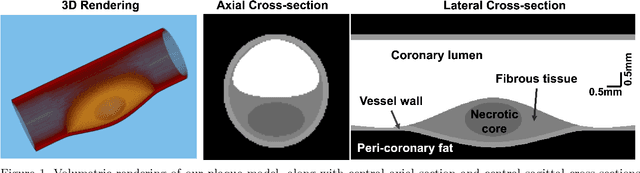
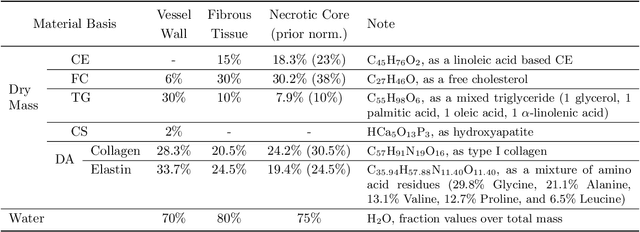
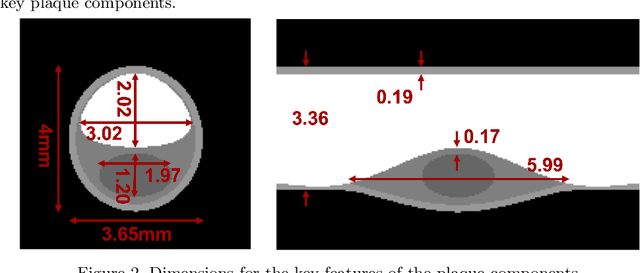

Recent development of photon-counting CT (PCCT) brings great opportunities for plaque characterization with much-improved spatial resolution and spectral imaging capability. While existing coronary plaque PCCT imaging results are based on detectors made of CZT or CdTe materials, deep-silicon photon-counting detectors have unique performance characteristics and promise distinct imaging capabilities. In this work, we report a systematic simulation study of a deep-silicon PCCT scanner with a new clinically-relevant digital plaque phantom with realistic geometrical parameters and chemical compositions. This work investigates the effects of spatial resolution, noise, motion artifacts, radiation dose, and spectral characterization. Our simulation results suggest that the deep-silicon PCCT design provides adequate spatial resolution for visualizing a necrotic core and quantitation of key plaque features. Advanced denoising techniques and aggressive bowtie filter designs can keep image noise to acceptable levels at this resolution while keeping radiation dose comparable to that of a conventional CT scan. The ultrahigh resolution of PCCT also means an elevated sensitivity to motion artifacts. It is found that a tolerance of less than 0.4 mm residual movement range requires the application of accurate motion correction methods for best plaque imaging quality with PCCT.
A Physics based Machine Learning Model to characterize Room Temperature Semiconductor Detectors in 3D
Nov 04, 2023Room temperature semiconductor radiation detectors (RTSD) for X-ray and gamma-ray detection are vital tools for medical imaging, astrophysics and other applications. CdZnTe (CZT) has been the main RTSD for more than three decades with desired detection properties. In a typical pixelated configuration, CZT have electrodes on opposite ends. For advanced event reconstruction algorithms at sub-pixel level, detailed characterization of the RTSD is required in three dimensional (3D) space. However, 3D characterization of the material defects and charge transport properties in the sub-pixel regime is a labor-intensive process with skilled manpower and novel experimental setups. Presently, state-of-art characterization is done over the bulk of the RTSD considering homogenous properties. In this paper, we propose a novel physics based machine learning (PBML) model to characterize the RTSD over a discretized sub-pixelated 3D volume which is assumed. Our novel approach is the first to characterize a full 3D charge transport model of the RTSD. In this work, we first discretize the RTSD between a pixelated electrodes spatially in 3D - x, y, and z. The resulting discretizations are termed as voxels in 3D space. In each voxel, the different physics based charge transport properties such as drift, trapping, detrapping and recombination of charges are modeled as trainable model weights. The drift of the charges considers second order non-linear motion which is observed in practice with the RTSDs. Based on the electron-hole pair injections as input to the PBML model, and signals at the electrodes, free and trapped charges (electrons and holes) as outputs of the model, the PBML model determines the trainable weights by backpropagating the loss function. The trained weights of the model represents one-to-one relation to that of the actual physical charge transport properties in a voxelized detector.
A Depth-Adaptive Filtering Method for Effective GPR Tree Roots Detection in Tropical Area
May 30, 2023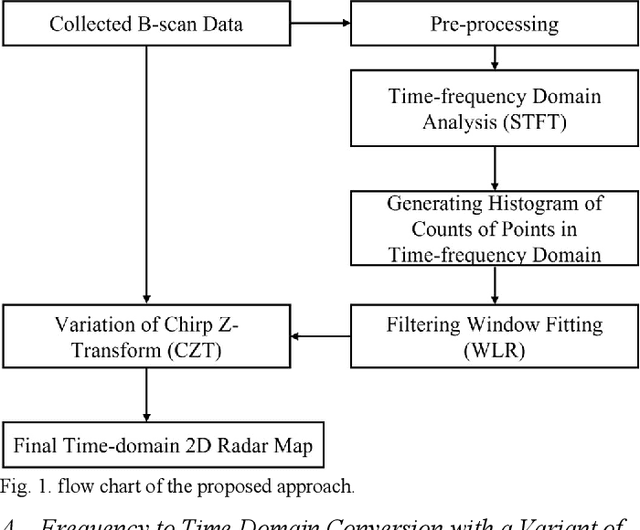
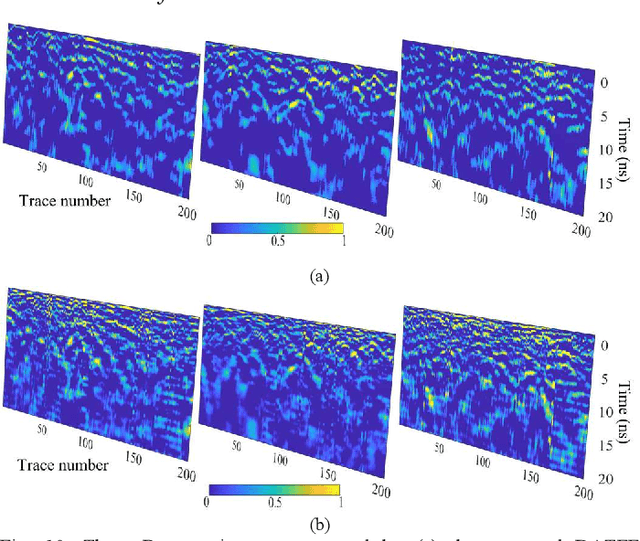
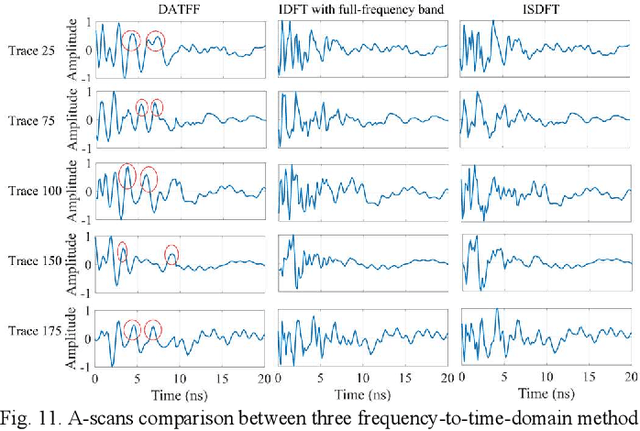
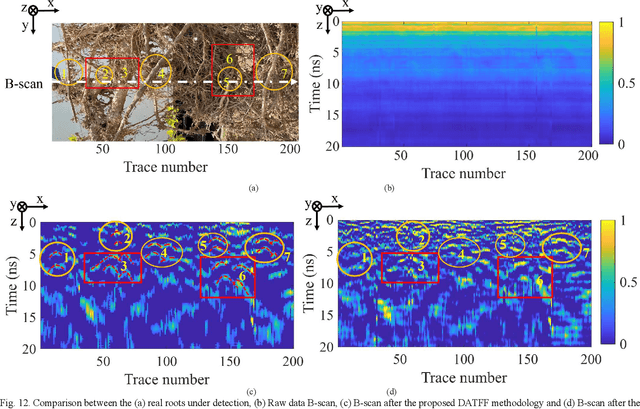
This study presents a technique for processing Stepfrequency continuous wave (SFCW) ground penetrating radar (GPR) data to detect tree roots. SFCW GPR is portable and enables precise control of energy levels, balancing depth and resolution trade-offs. However, the high-frequency components of the transmission band suffers from poor penetrating capability and generates noise that interferes with root detection. The proposed time-frequency filtering technique uses a short-time Fourier transform (STFT) to track changes in frequency spectrum density over time. To obtain the filter window, a weighted linear regression (WLR) method is used. By adopting a conversion method that is a variant of the chirp Z-Transform (CZT), the timefrequency window filters out frequency samples that are not of interest when doing the frequency-to-time domain data conversion. The proposed depth-adaptive filter window can selfadjust to different scenarios, making it independent of soil information and effectively determines subsurface tree roots. The technique is successfully validated using SFCW GPR data from actual sites in a tropical area with different soil moisture levels, and the two-dimensional (2D) radar map of subsurface root systems is highly improved compared to existing methods.
Comparison of computing efficiency among FFT, CZT and Zoom FFT in THz-TDS
Aug 09, 2021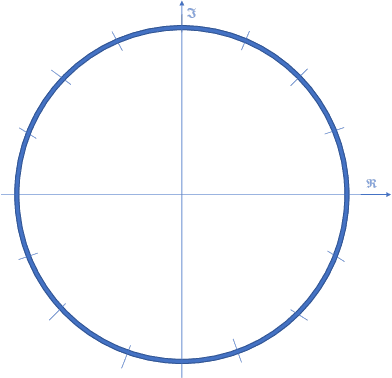

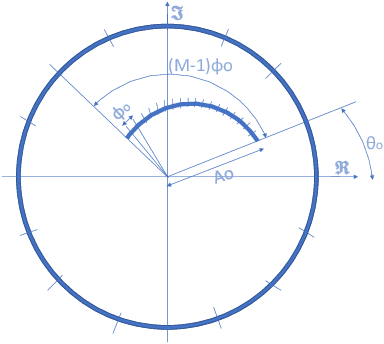

A study of alternative transforms to FFT in order to compare their potential to enhance resolution and computation time in the framework of THz time domain spectroscopy (THz-TDS) instruments is carried out. Both from simulated and experimental data it is shown that, as expected, resolution cannot be enhanced using CZT or Zoom FFT and, in terms of computing efficiency, FFT is in practical cases, the most efficient one.
High Accuracy and Low Complexity Frequency Offset Estimation Based on All-Phase FFT for M-QAM Coherent Optical Systems
May 15, 2021


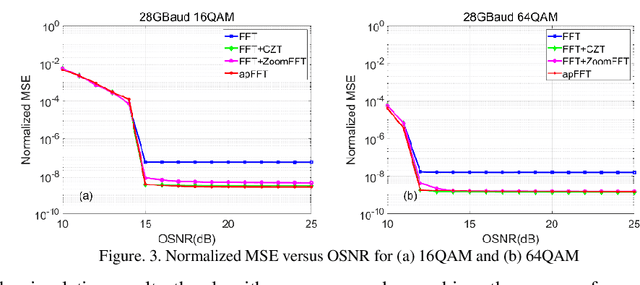
A low complexity frequency offset estimation algorithm based on all-phase FFT for M-QAM is proposed. Compared with two-stage algorithms such as FFT+CZT and FFT+ZoomFFT, our algorithm can lower computational complexity by 73% and 30% respectively, without loss of the estimation accuracy.