 Add to Chrome
 Add to Firefox
 Add to Edge
NextFlow: Unified Sequential Modeling Activates Multimodal Understanding and Generation
Jan 05, 2026
We present NextFlow, a unified decoder-only autoregressive transformer trained on 6 trillion interleaved text-image discrete tokens. By leveraging a unified vision representation within a unified autoregressive architecture, NextFlow natively activates multimodal understanding and generation capabilities, unlocking abilities of image editing, interleaved content and video generation. Motivated by the distinct nature of modalities - where text is strictly sequential and images are inherently hierarchical - we retain next-token prediction for text but adopt next-scale prediction for visual generation. This departs from traditional raster-scan methods, enabling the generation of 1024x1024 images in just 5 seconds - orders of magnitude faster than comparable AR models. We address the instabilities of multi-scale generation through a robust training recipe. Furthermore, we introduce a prefix-tuning strategy for reinforcement learning. Experiments demonstrate that NextFlow achieves state-of-the-art performance among unified models and rivals specialized diffusion baselines in visual quality.

Paint3D: Paint Anything 3D with Lighting-Less Texture Diffusion Models
Dec 22, 2023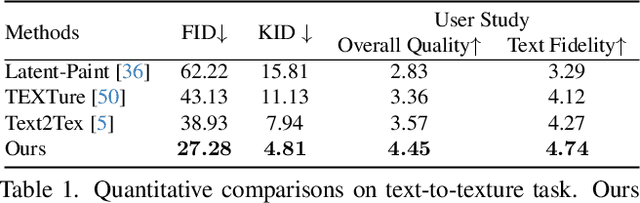
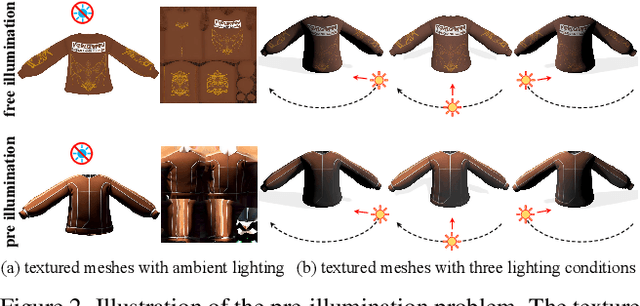
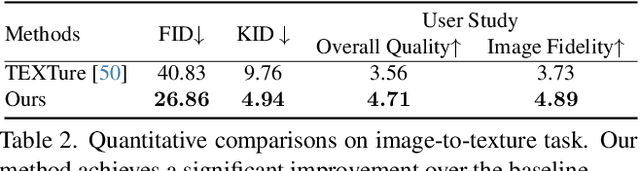
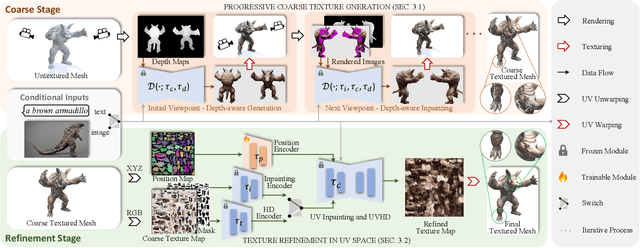
This paper presents Paint3D, a novel coarse-to-fine generative framework that is capable of producing high-resolution, lighting-less, and diverse 2K UV texture maps for untextured 3D meshes conditioned on text or image inputs. The key challenge addressed is generating high-quality textures without embedded illumination information, which allows the textures to be re-lighted or re-edited within modern graphics pipelines. To achieve this, our method first leverages a pre-trained depth-aware 2D diffusion model to generate view-conditional images and perform multi-view texture fusion, producing an initial coarse texture map. However, as 2D models cannot fully represent 3D shapes and disable lighting effects, the coarse texture map exhibits incomplete areas and illumination artifacts. To resolve this, we train separate UV Inpainting and UVHD diffusion models specialized for the shape-aware refinement of incomplete areas and the removal of illumination artifacts. Through this coarse-to-fine process, Paint3D can produce high-quality 2K UV textures that maintain semantic consistency while being lighting-less, significantly advancing the state-of-the-art in texturing 3D objects.