 Add to Chrome
 Add to Firefox
 Add to Edge
OmniMoE: An Efficient MoE by Orchestrating Atomic Experts at Scale
Feb 05, 2026
Mixture-of-Experts (MoE) architectures are evolving towards finer granularity to improve parameter efficiency. However, existing MoE designs face an inherent trade-off between the granularity of expert specialization and hardware execution efficiency. We propose OmniMoE, a system-algorithm co-designed framework that pushes expert granularity to its logical extreme. OmniMoE introduces vector-level Atomic Experts, enabling scalable routing and execution within a single MoE layer, while retaining a shared dense MLP branch for general-purpose processing. Although this atomic design maximizes capacity, it poses severe challenges for routing complexity and memory access. To address these, OmniMoE adopts a system-algorithm co-design: (i) a Cartesian Product Router that decomposes the massive index space to reduce routing complexity from O(N) to O(sqrt(N)); and (ii) Expert-Centric Scheduling that inverts the execution order to turn scattered, memory-bound lookups into efficient dense matrix operations. Validated on seven benchmarks, OmniMoE (with 1.7B active parameters) achieves 50.9% zero-shot accuracy across seven benchmarks, outperforming coarse-grained (e.g., DeepSeekMoE) and fine-grained (e.g., PEER) baselines. Crucially, OmniMoE reduces inference latency from 73ms to 6.7ms (a 10.9-fold speedup) compared to PEER, demonstrating that massive-scale fine-grained MoE can be fast and accurate. Our code is open-sourced at https://github.com/flash-algo/omni-moe.

Starling: An I/O-Efficient Disk-Resident Graph Index Framework for High-Dimensional Vector Similarity Search on Data Segment
Jan 16, 2024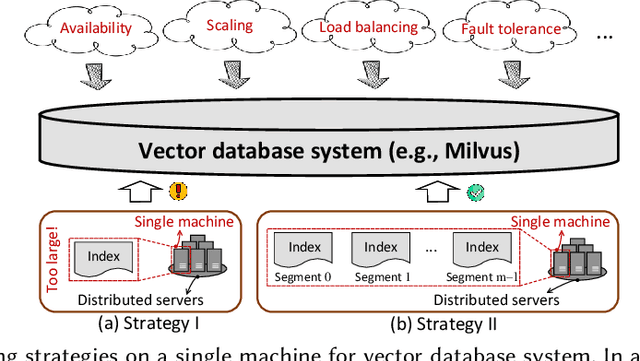

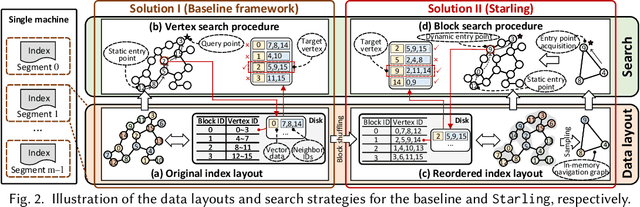
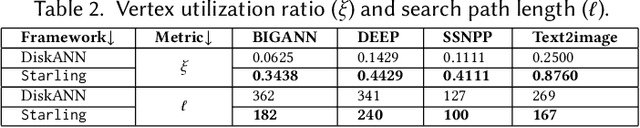
High-dimensional vector similarity search (HVSS) is gaining prominence as a powerful tool for various data science and AI applications. As vector data scales up, in-memory indexes pose a significant challenge due to the substantial increase in main memory requirements. A potential solution involves leveraging disk-based implementation, which stores and searches vector data on high-performance devices like NVMe SSDs. However, implementing HVSS for data segments proves to be intricate in vector databases where a single machine comprises multiple segments for system scalability. In this context, each segment operates with limited memory and disk space, necessitating a delicate balance between accuracy, efficiency, and space cost. Existing disk-based methods fall short as they do not holistically address all these requirements simultaneously. In this paper, we present Starling, an I/O-efficient disk-resident graph index framework that optimizes data layout and search strategy within the segment. It has two primary components: (1) a data layout incorporating an in-memory navigation graph and a reordered disk-based graph with enhanced locality, reducing the search path length and minimizing disk bandwidth wastage; and (2) a block search strategy designed to minimize costly disk I/O operations during vector query execution. Through extensive experiments, we validate the effectiveness, efficiency, and scalability of Starling. On a data segment with 2GB memory and 10GB disk capacity, Starling can accommodate up to 33 million vectors in 128 dimensions, offering HVSS with over 0.9 average precision and top-10 recall rate, and latency under 1 millisecond. The results showcase Starling's superior performance, exhibiting 43.9$\times$ higher throughput with 98% lower query latency compared to state-of-the-art methods while maintaining the same level of accuracy.