 Add to Chrome
 Add to Firefox
 Add to Edge
Chinese Labor Law Large Language Model Benchmark
Jan 15, 2026
Recent advances in large language models (LLMs) have led to substantial progress in domain-specific applications, particularly within the legal domain. However, general-purpose models such as GPT-4 often struggle with specialized subdomains that require precise legal knowledge, complex reasoning, and contextual sensitivity. To address these limitations, we present LabourLawLLM, a legal large language model tailored to Chinese labor law. We also introduce LabourLawBench, a comprehensive benchmark covering diverse labor-law tasks, including legal provision citation, knowledge-based question answering, case classification, compensation computation, named entity recognition, and legal case analysis. Our evaluation framework combines objective metrics (e.g., ROUGE-L, accuracy, F1, and soft-F1) with subjective assessment based on GPT-4 scoring. Experiments show that LabourLawLLM consistently outperforms general-purpose and existing legal-specific LLMs across task categories. Beyond labor law, our methodology provides a scalable approach for building specialized LLMs in other legal subfields, improving accuracy, reliability, and societal value of legal AI applications.

LinBridge: A Learnable Framework for Interpreting Nonlinear Neural Encoding Models
Oct 26, 2024
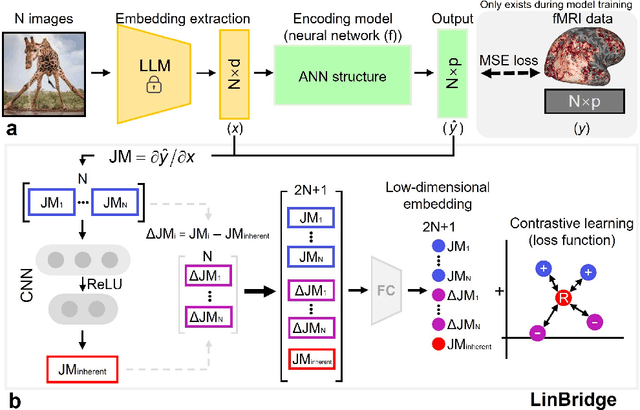

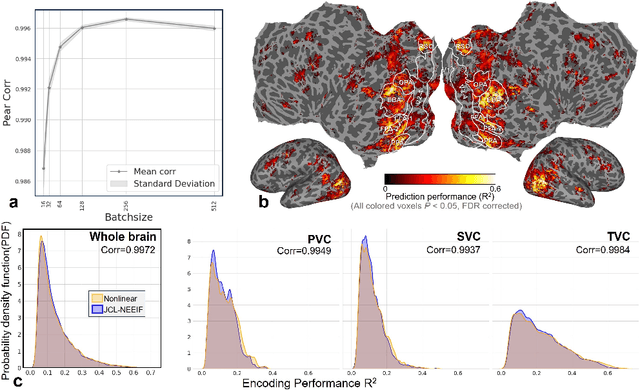
Neural encoding of artificial neural networks (ANNs) links their computational representations to brain responses, offering insights into how the brain processes information. Current studies mostly use linear encoding models for clarity, even though brain responses are often nonlinear. This has sparked interest in developing nonlinear encoding models that are still interpretable. To address this problem, we propose LinBridge, a learnable and flexible framework based on Jacobian analysis for interpreting nonlinear encoding models. LinBridge posits that the nonlinear mapping between ANN representations and neural responses can be factorized into a linear inherent component that approximates the complex nonlinear relationship, and a mapping bias that captures sample-selective nonlinearity. The Jacobian matrix, which reflects output change rates relative to input, enables the analysis of sample-selective mapping in nonlinear models. LinBridge employs a self-supervised learning strategy to extract both the linear inherent component and nonlinear mapping biases from the Jacobian matrices of the test set, allowing it to adapt effectively to various nonlinear encoding models. We validate the LinBridge framework in the scenario of neural visual encoding, using computational visual representations from CLIP-ViT to predict brain activity recorded via functional magnetic resonance imaging (fMRI). Our experimental results demonstrate that: 1) the linear inherent component extracted by LinBridge accurately reflects the complex mappings of nonlinear neural encoding models; 2) the sample-selective mapping bias elucidates the variability of nonlinearity across different levels of the visual processing hierarchy. This study presents a novel tool for interpreting nonlinear neural encoding models and offers fresh evidence about hierarchical nonlinearity distribution in the visual cortex.