 Add to Chrome
 Add to Firefox
 Add to Edge
Chinese Labor Law Large Language Model Benchmark
Jan 15, 2026
Recent advances in large language models (LLMs) have led to substantial progress in domain-specific applications, particularly within the legal domain. However, general-purpose models such as GPT-4 often struggle with specialized subdomains that require precise legal knowledge, complex reasoning, and contextual sensitivity. To address these limitations, we present LabourLawLLM, a legal large language model tailored to Chinese labor law. We also introduce LabourLawBench, a comprehensive benchmark covering diverse labor-law tasks, including legal provision citation, knowledge-based question answering, case classification, compensation computation, named entity recognition, and legal case analysis. Our evaluation framework combines objective metrics (e.g., ROUGE-L, accuracy, F1, and soft-F1) with subjective assessment based on GPT-4 scoring. Experiments show that LabourLawLLM consistently outperforms general-purpose and existing legal-specific LLMs across task categories. Beyond labor law, our methodology provides a scalable approach for building specialized LLMs in other legal subfields, improving accuracy, reliability, and societal value of legal AI applications.

GCOF: Self-iterative Text Generation for Copywriting Using Large Language Model
Feb 21, 2024
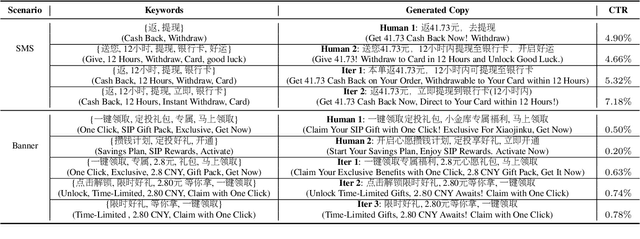
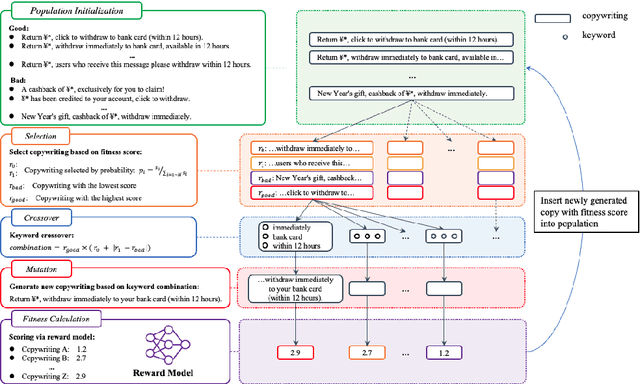
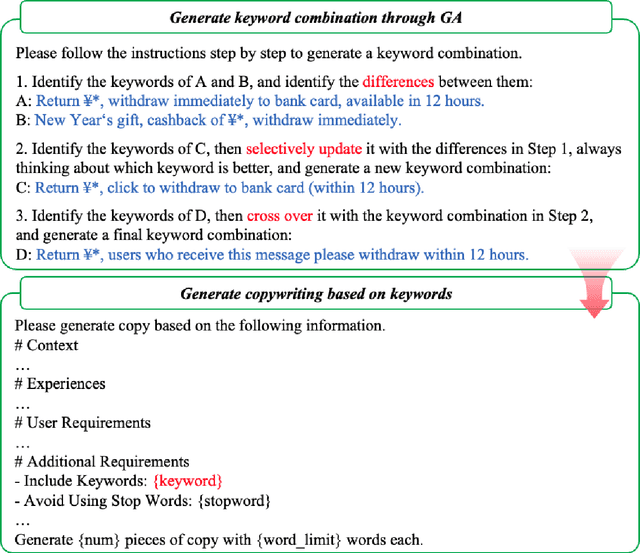
Large language models(LLM) such as ChatGPT have substantially simplified the generation of marketing copy, yet producing content satisfying domain specific requirements, such as effectively engaging customers, remains a significant challenge. In this work, we introduce the Genetic Copy Optimization Framework (GCOF) designed to enhance both efficiency and engagememnt of marketing copy creation. We conduct explicit feature engineering within the prompts of LLM. Additionally, we modify the crossover operator in Genetic Algorithm (GA), integrating it into the GCOF to enable automatic feature engineering. This integration facilitates a self-iterative refinement of the marketing copy. Compared to human curated copy, Online results indicate that copy produced by our framework achieves an average increase in click-through rate (CTR) of over $50\%$.