 Add to Chrome
 Add to Firefox
 Add to Edge
MathDoc: Benchmarking Structured Extraction and Active Refusal on Noisy Mathematics Exam Papers
Jan 15, 2026
The automated extraction of structured questions from paper-based mathematics exams is fundamental to intelligent education, yet remains challenging in real-world settings due to severe visual noise. Existing benchmarks mainly focus on clean documents or generic layout analysis, overlooking both the structural integrity of mathematical problems and the ability of models to actively reject incomplete inputs. We introduce MathDoc, the first benchmark for document-level information extraction from authentic high school mathematics exam papers. MathDoc contains \textbf{3,609} carefully curated questions with real-world artifacts and explicitly includes unrecognizable samples to evaluate active refusal behavior. We propose a multi-dimensional evaluation framework covering stem accuracy, visual similarity, and refusal capability. Experiments on SOTA MLLMs, including Qwen3-VL and Gemini-2.5-Pro, show that although end-to-end models achieve strong extraction performance, they consistently fail to refuse illegible inputs, instead producing confident but invalid outputs. These results highlight a critical gap in current MLLMs and establish MathDoc as a benchmark for assessing model reliability under degraded document conditions. Our project repository is available at \href{https://github.com/winnk123/papers/tree/master}{GitHub repository}

Knowledgeable Preference Alignment for LLMs in Domain-specific Question Answering
Nov 11, 2023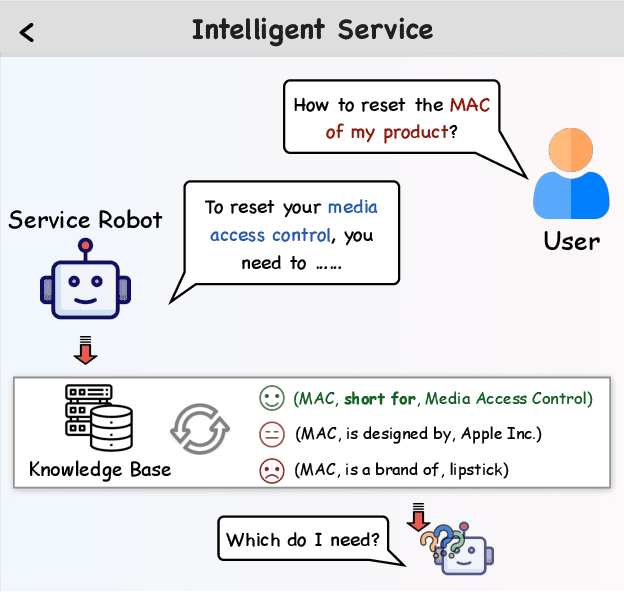
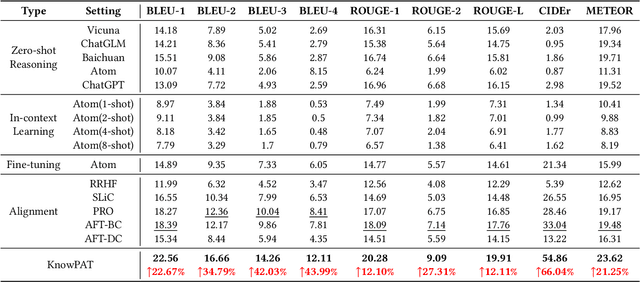
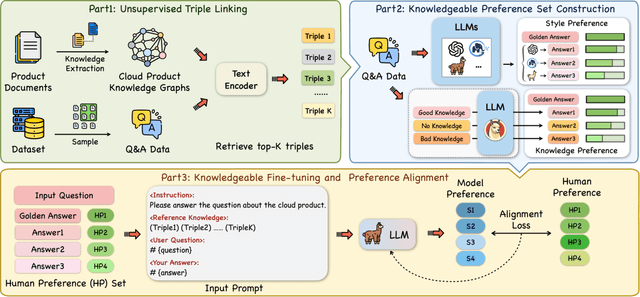
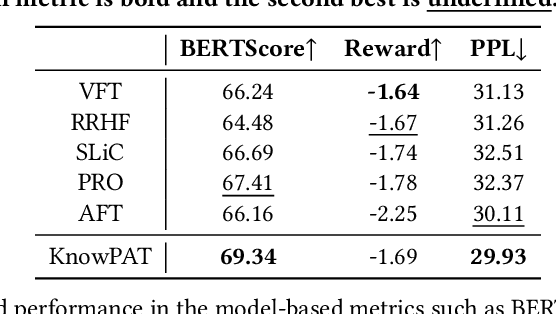
Recently, the development of large language models (LLMs) has attracted wide attention in academia and industry. Deploying LLMs to real scenarios is one of the key directions in the current Internet industry. In this paper, we present a novel pipeline to apply LLMs for domain-specific question answering (QA) that incorporates domain knowledge graphs (KGs), addressing an important direction of LLM application. As a real-world application, the content generated by LLMs should be user-friendly to serve the customers. Additionally, the model needs to utilize domain knowledge properly to generate reliable answers. These two issues are the two major difficulties in the LLM application as vanilla fine-tuning can not adequately address them. We think both requirements can be unified as the model preference problem that needs to align with humans to achieve practical application. Thus, we introduce Knowledgeable Preference AlignmenT (KnowPAT), which constructs two kinds of preference set called style preference set and knowledge preference set respectively to tackle the two issues. Besides, we design a new alignment objective to align the LLM preference with human preference, aiming to train a better LLM for real-scenario domain-specific QA to generate reliable and user-friendly answers. Adequate experiments and comprehensive with 15 baseline methods demonstrate that our KnowPAT is an outperforming pipeline for real-scenario domain-specific QA with LLMs. Our code is open-source at https://github.com/zjukg/KnowPAT.