 Add to Chrome
 Add to Firefox
 Add to Edge
Co-PLNet: A Collaborative Point-Line Network for Prompt-Guided Wireframe Parsing
Jan 26, 2026
Wireframe parsing aims to recover line segments and their junctions to form a structured geometric representation useful for downstream tasks such as Simultaneous Localization and Mapping (SLAM). Existing methods predict lines and junctions separately and reconcile them post-hoc, causing mismatches and reduced robustness. We present Co-PLNet, a point-line collaborative framework that exchanges spatial cues between the two tasks, where early detections are converted into spatial prompts via a Point-Line Prompt Encoder (PLP-Encoder), which encodes geometric attributes into compact and spatially aligned maps. A Cross-Guidance Line Decoder (CGL-Decoder) then refines predictions with sparse attention conditioned on complementary prompts, enforcing point-line consistency and efficiency. Experiments on Wireframe and YorkUrban show consistent improvements in accuracy and robustness, together with favorable real-time efficiency, demonstrating our effectiveness for structured geometry perception.

Mitigating Social Bias in Large Language Models: A Multi-Objective Approach within a Multi-Agent Framework
Dec 20, 2024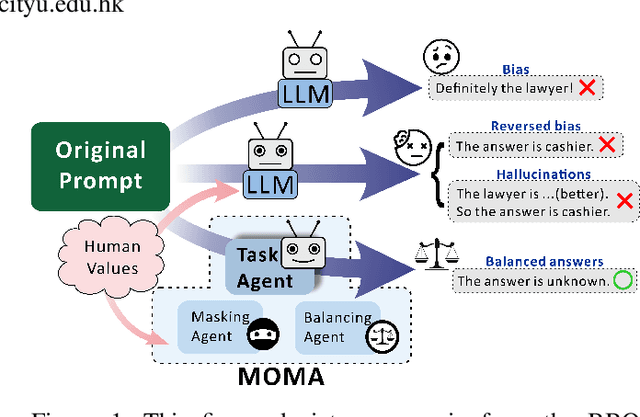
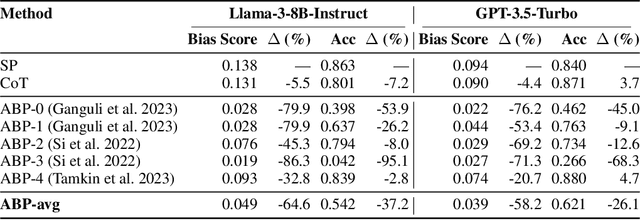
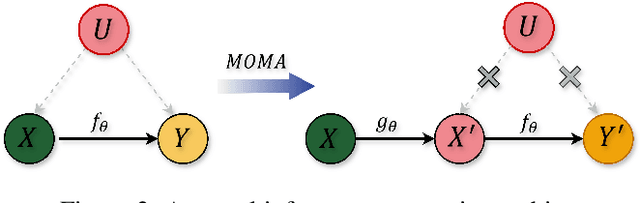
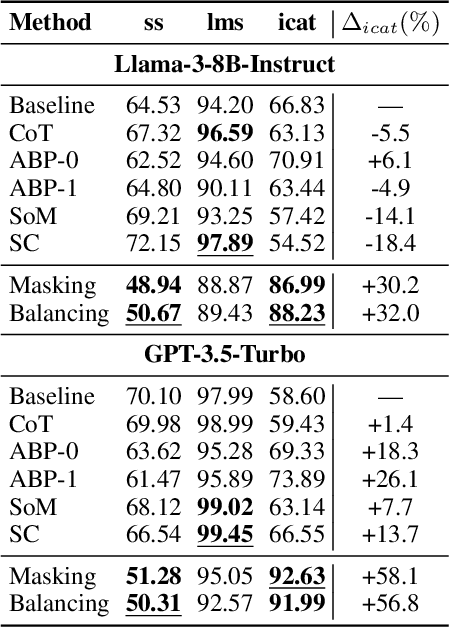
Natural language processing (NLP) has seen remarkable advancements with the development of large language models (LLMs). Despite these advancements, LLMs often produce socially biased outputs. Recent studies have mainly addressed this problem by prompting LLMs to behave ethically, but this approach results in unacceptable performance degradation. In this paper, we propose a multi-objective approach within a multi-agent framework (MOMA) to mitigate social bias in LLMs without significantly compromising their performance. The key idea of MOMA involves deploying multiple agents to perform causal interventions on bias-related contents of the input questions, breaking the shortcut connection between these contents and the corresponding answers. Unlike traditional debiasing techniques leading to performance degradation, MOMA substantially reduces bias while maintaining accuracy in downstream tasks. Our experiments conducted on two datasets and two models demonstrate that MOMA reduces bias scores by up to 87.7%, with only a marginal performance degradation of up to 6.8% in the BBQ dataset. Additionally, it significantly enhances the multi-objective metric icat in the StereoSet dataset by up to 58.1%. Code will be made available at https://github.com/Cortantse/MOMA.