 Add to Chrome
 Add to Firefox
 Add to Edge
"Rebuilding" Statistics in the Age of AI: A Town Hall Discussion on Culture, Infrastructure, and Training
Jan 24, 2026
This article presents the full, original record of the 2024 Joint Statistical Meetings (JSM) town hall, "Statistics in the Age of AI," which convened leading statisticians to discuss how the field is evolving in response to advances in artificial intelligence, foundation models, large-scale empirical modeling, and data-intensive infrastructures. The town hall was structured around open panel discussion and extensive audience Q&A, with the aim of eliciting candid, experience-driven perspectives rather than formal presentations or prepared statements. This document preserves the extended exchanges among panelists and audience members, with minimal editorial intervention, and organizes the conversation around five recurring questions concerning disciplinary culture and practices, data curation and "data work," engagement with modern empirical modeling, training for large-scale AI applications, and partnerships with key AI stakeholders. By providing an archival record of this discussion, the preprint aims to support transparency, community reflection, and ongoing dialogue about the evolving role of statistics in the data- and AI-centric future.

Advancing Real-time Pandemic Forecasting Using Large Language Models: A COVID-19 Case Study
Apr 10, 2024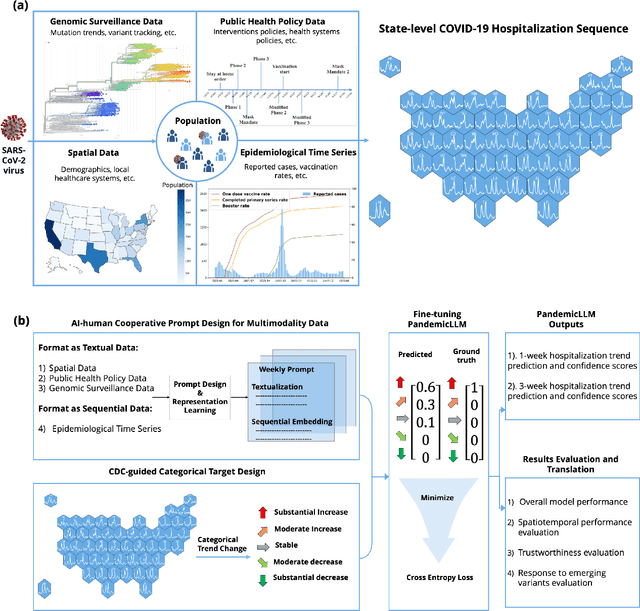
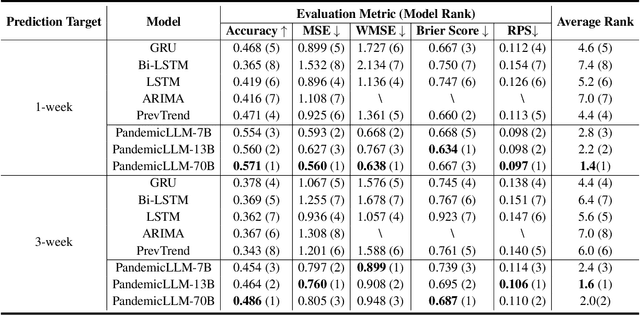
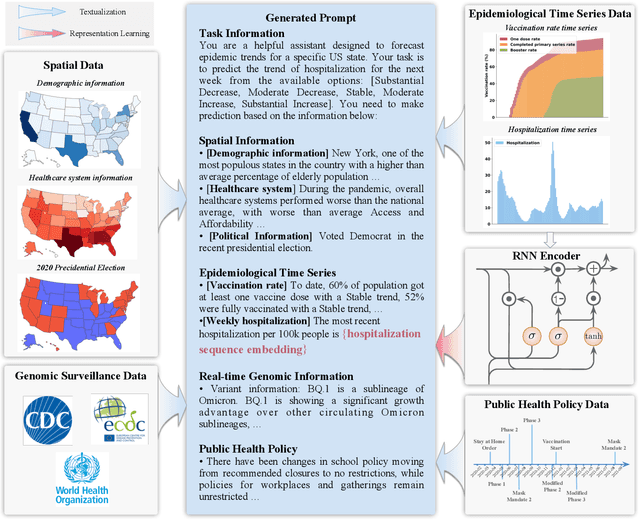
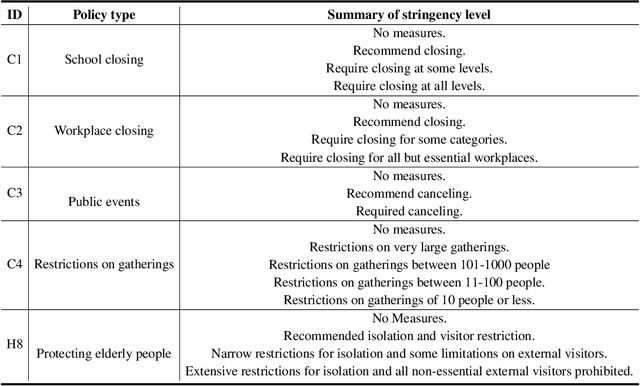
Forecasting the short-term spread of an ongoing disease outbreak is a formidable challenge due to the complexity of contributing factors, some of which can be characterized through interlinked, multi-modality variables such as epidemiological time series data, viral biology, population demographics, and the intersection of public policy and human behavior. Existing forecasting model frameworks struggle with the multifaceted nature of relevant data and robust results translation, which hinders their performances and the provision of actionable insights for public health decision-makers. Our work introduces PandemicLLM, a novel framework with multi-modal Large Language Models (LLMs) that reformulates real-time forecasting of disease spread as a text reasoning problem, with the ability to incorporate real-time, complex, non-numerical information that previously unattainable in traditional forecasting models. This approach, through a unique AI-human cooperative prompt design and time series representation learning, encodes multi-modal data for LLMs. The model is applied to the COVID-19 pandemic, and trained to utilize textual public health policies, genomic surveillance, spatial, and epidemiological time series data, and is subsequently tested across all 50 states of the U.S. Empirically, PandemicLLM is shown to be a high-performing pandemic forecasting framework that effectively captures the impact of emerging variants and can provide timely and accurate predictions. The proposed PandemicLLM opens avenues for incorporating various pandemic-related data in heterogeneous formats and exhibits performance benefits over existing models. This study illuminates the potential of adapting LLMs and representation learning to enhance pandemic forecasting, illustrating how AI innovations can strengthen pandemic responses and crisis management in the future.