 Add to Chrome
 Add to Firefox
 Add to Edge
Agent Primitives: Reusable Latent Building Blocks for Multi-Agent Systems
Feb 03, 2026
While existing multi-agent systems (MAS) can handle complex problems by enabling collaboration among multiple agents, they are often highly task-specific, relying on manually crafted agent roles and interaction prompts, which leads to increased architectural complexity and limited reusability across tasks. Moreover, most MAS communicate primarily through natural language, making them vulnerable to error accumulation and instability in long-context, multi-stage interactions within internal agent histories. In this work, we propose \textbf{Agent Primitives}, a set of reusable latent building blocks for LLM-based MAS. Inspired by neural network design, where complex models are built from reusable components, we observe that many existing MAS architectures can be decomposed into a small number of recurring internal computation patterns. Based on this observation, we instantiate three primitives: Review, Voting and Selection, and Planning and Execution. All primitives communicate internally via key-value (KV) cache, which improves both robustness and efficiency by mitigating information degradation across multi-stage interactions. To enable automatic system construction, an Organizer agent selects and composes primitives for each query, guided by a lightweight knowledge pool of previously successful configurations, forming a primitive-based MAS. Experiments show that primitives-based MAS improve average accuracy by 12.0-16.5\% over single-agent baselines, reduce token usage and inference latency by approximately 3$\times$-4$\times$ compared to text-based MAS, while incurring only 1.3$\times$-1.6$\times$ overhead relative to single-agent inference and providing more stable performance across model backbones.

Efficient Joint Resource Allocation for Wireless Powered ISAC with Target Localization
Dec 31, 2025Wireless powered integrated sensing and communication (ISAC) faces a fundamental tradeoff between energy supply, communication throughput, and sensing accuracy. This paper investigates a wireless powered ISAC system with target localization requirements, where users harvest energy from wireless power transfer (WPT) and then conduct ISAC transmissions in a time-division manner. In addition to energy supply, the WPT signal also contributes to target sensing, and the localization accuracy is characterized by Cramér-Rao bound (CRB) constraints. Under this setting, we formulate a max-min throughput maximization problem by jointly allocating the WPT duration, ISAC transmission time allocation, and transmit power. Due to the nonconvexity of the resulting problem, a suitable reformulation is developed by exploiting variable substitutions and the monotonicity of logarithmic functions, based on which an efficient successive convex approximation (SCA)-based iterative algorithm is proposed. Simulation results demonstrate convergence and significant performance gains over benchmark schemes, highlighting the importance of coordinated time-power optimization in balancing sensing accuracy and communication performance in wireless powered ISAC systems.
Tracing LLM Reasoning Processes with Strategic Games: A Framework for Planning, Revision, and Resource-Constrained Decision Making
Jun 13, 2025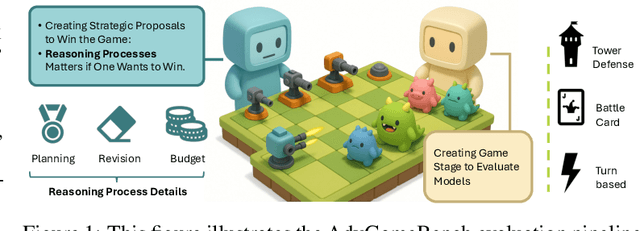
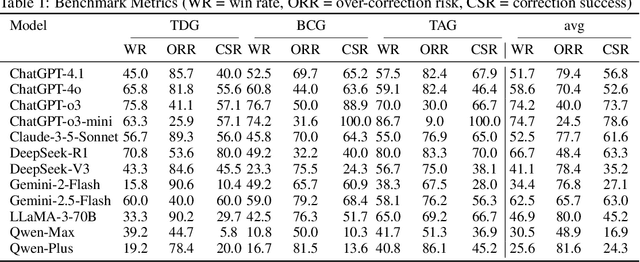
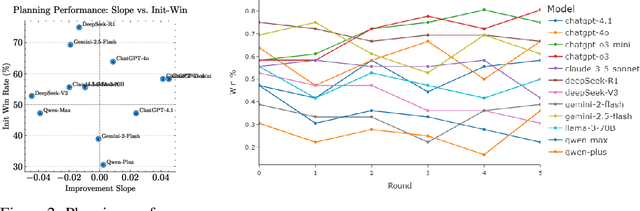
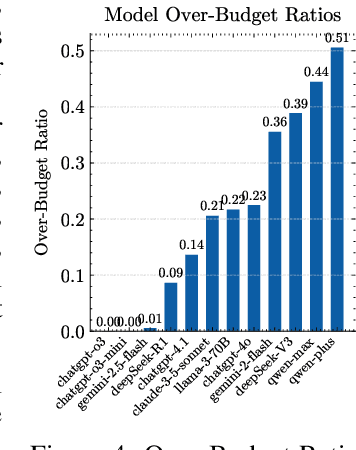
Large language models (LLMs) are increasingly used for tasks that require complex reasoning. Most benchmarks focus on final outcomes but overlook the intermediate reasoning steps - such as planning, revision, and decision making under resource constraints. We argue that measuring these internal processes is essential for understanding model behavior and improving reliability. We propose using strategic games as a natural evaluation environment: closed, rule-based systems with clear states, limited resources, and automatic feedback. We introduce a framework that evaluates LLMs along three core dimensions: planning, revision, and resource-constrained decision making. To operationalize this, we define metrics beyond win rate, including overcorrection risk rate, correction success rate, improvement slope, and over-budget ratio. In 4320 adversarial rounds across 12 leading models, ChatGPT-o3-mini achieves the top composite score, with a win rate of 74.7 percent, a correction success rate of 78.6 percent, and an improvement slope of 0.041. By contrast, Qwen-Plus, despite an overcorrection risk rate of 81.6 percent, wins only 25.6 percent of its matches - primarily due to excessive resource use. We also observe a negative correlation between overcorrection risk rate and correction success rate (Pearson r = -0.51, p = 0.093), suggesting that more frequent edits do not always improve outcomes. Our findings highlight the value of assessing not only what LLMs decide but how they arrive at those decisions
Wireless Powered Short Packet Communications with Multiple WPT Sources
Feb 24, 2023We study a multi-source wireless power transfer (WPT) enabled network supporting multi-sensor transmissions. Activated by energy harvesting (EH) from multiple WPT sources, sensors transmit short packets to a destination with finite blocklength (FBL) codes. This work for the first time characterizes the FBL reliability for such multi-source WPT enabled network and provides reliability-oriented resource allocation designs, while a practical nonlinear EH model is considered. For scenario with a fixed frame structure, we maximize the FBL reliability via optimally allocating the transmit power among multi-source. In particular, we first investigate the relationship between the FBL reliability and multiple WPT source power, based on which a power allocation problem is formulated. To solve the formulated non-convex problem, we introduce auxiliary variables and apply successive convex approximation (SCA) technique to the non-convex component. Consequently, a sub-optimal solution can be obtained. Moreover, we extend our design into a dynamic frame structure scenario, i.e., the blocklength allocated for WPT phase and short-packet transmission phase are adjustable, which introduces more flexibility and new challenges to the system design. We provide a joint power and blocklength allocation design to minimize the system overall error probability under the total power and blocklength constraints. To address the high-dimensional optimization problem, auxiliary variables introduction, multiple variable substitutions and SCA technique utilization are exploited to reformulate and efficiently solve the problem. Finally, through numerical results, we validate our analytical model and evaluate the system performance, where a set of guidelines for practical system design are concluded.